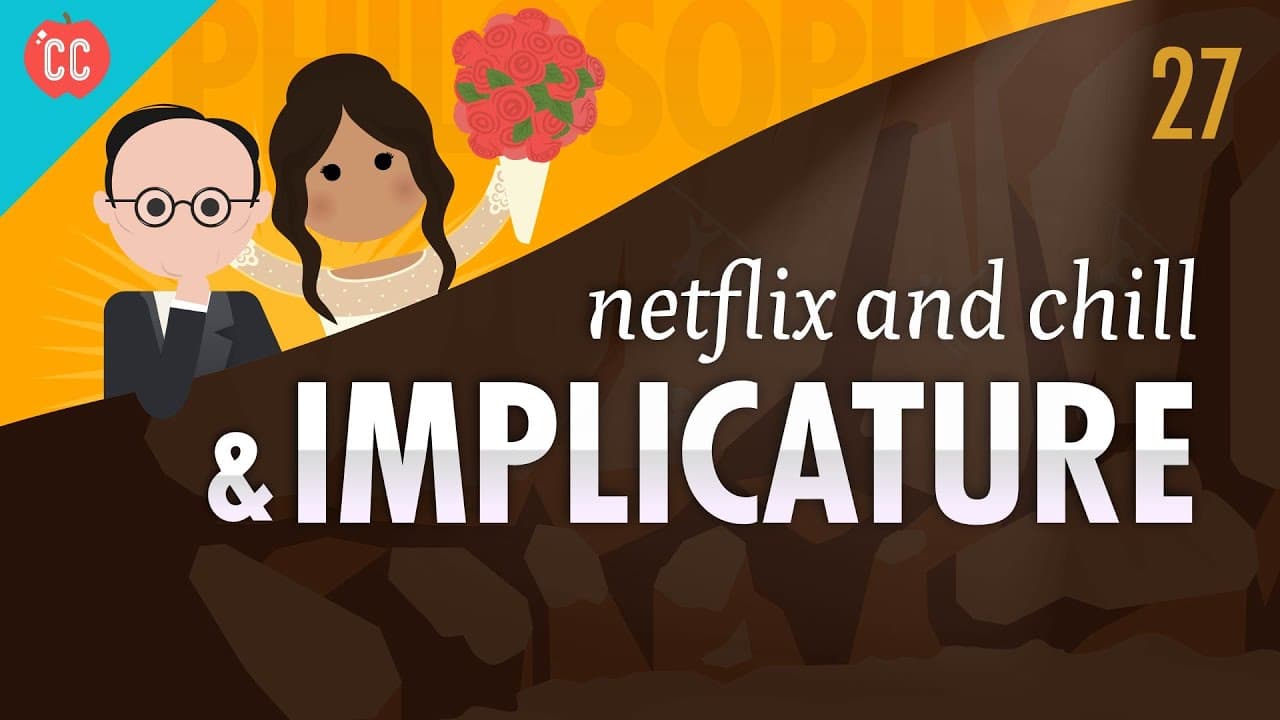
Netflix & Chill: Crash Course Philosophy #27
TL;DR
Explores how language and context shape communication meaning.
Transcript
Crash Course Philosophy is brought to you by Squarespace. Squarespace: share your passion with the world. How often do you actually think about the things you say? Like, what you’re literally saying? That’s a seriously overused word, by the way -- “literally.” A lot of the time, people use it for emphasis in ways that I consider pretty incorrect. L... Read More
Key Insights
- Language often involves figures of speech and idioms, which can obscure literal meanings, requiring contextual understanding.
- Paul Grice's conversational implicature theory differentiates between what is said and what is implied, emphasizing context in communication.
- Grice's cooperative principle suggests that successful communication relies on interpreting intended meanings based on context.
- Grice's maxims of communication include quantity, quality, relation, and manner, guiding effective conversational exchanges.
- Flouting maxims, like using sarcasm, can intentionally break these rules to convey specific communicative points.
- Performative utterances, as described by J.L. Austin, can change realities, such as pronouncing a couple married or declaring war.
- Certain conditions must be met for performative utterances to be effective, such as legal recognition of the speaker.
- Words have the power to shape reality, reflecting the deep connection between language and societal structures.
Install to Summarize YouTube Videos and Get Transcripts
Explore YouTube Video Summarizer or Get YouTube Transcript Extractor
Questions & Answers
Q: What is conversational implicature?
Conversational implicature, a concept developed by philosopher Paul Grice, refers to the idea that what is implied in a conversation often carries more meaning than what is explicitly said. It involves understanding the context and shared knowledge between speakers to interpret intended meanings, beyond the literal words used.
Q: What are Grice's maxims of communication?
Grice's maxims of communication are guidelines that help facilitate effective conversation. They include the maxim of quantity (providing the right amount of information), quality (ensuring truthfulness), relation (staying relevant), and manner (being clear and orderly). These maxims support the cooperative principle, which underpins successful communication.
Q: How do performative utterances work?
Performative utterances, as described by J.L. Austin, are speech acts that can change the state of affairs in the world. For instance, when an officiant pronounces a couple married, the words themselves enact the change. These utterances often require specific conditions to be effective, like legal recognition of the speaker's authority.
Q: Why do people sometimes flout Grice's maxims?
People flout Grice's maxims intentionally to convey specific meanings or effects, such as using sarcasm or humor. By deliberately breaking these conversational rules, speakers can emphasize a point, create irony, or provoke thought, relying on the listener's ability to interpret the intended message despite the apparent rule violation.
Q: What role does context play in understanding language?
Context plays a crucial role in understanding language as it helps interpret the intended meaning behind words. Context includes factors like shared experiences, social conventions, tone, and gestures, all of which contribute to deciphering what is implied in a conversation, beyond the literal content of the spoken words.
Q: How can language shape societal structures?
Language shapes societal structures by creating and reinforcing social norms and realities. Performative utterances, for example, can establish legal relationships, like marriage, or political states, like war, demonstrating the power of words in constructing social and legal frameworks. This reflects the deep interconnection between language and society.
Q: What is the cooperative principle in conversation?
The cooperative principle, proposed by Paul Grice, is the assumption that participants in a conversation aim to communicate effectively. It suggests that speakers and listeners work together to achieve mutual understanding, using context and shared knowledge to interpret meanings, even when the literal words do not fully convey the intended message.
Q: Why is understanding implicature important in communication?
Understanding implicature is important because it allows individuals to grasp the intended meanings behind spoken words, which often go beyond literal interpretations. By recognizing implicature, communicators can navigate figures of speech, idioms, and indirect language, leading to more accurate and meaningful exchanges, especially in complex or nuanced conversations.
Summary & Key Takeaways
-
The video explores how language often involves idioms and figures of speech, complicating literal meanings and requiring contextual understanding. Paul Grice's conversational implicature theory helps explain how we derive implied meanings from spoken words, emphasizing the importance of context in communication.
-
Grice's cooperative principle suggests that successful communication relies on interpreting intended meanings based on context. His maxims of communication, including quantity, quality, relation, and manner, provide guidelines for effective conversational exchanges, ensuring clarity and understanding between speakers.
-
Flouting maxims can intentionally break these rules to convey specific points, such as using sarcasm. J.L. Austin's concept of performative utterances highlights how words can change realities, like pronouncing a couple married, demonstrating the power of language in shaping societal structures.
Read in Other Languages (beta)
Share This Summary 📚
Summarize YouTube Videos and Get Video Transcripts with 1-Click
Try YouTube Summary with ChatGPT & Claude or YouTube Transcript Generator
Explore More Summaries from CrashCourse 📚


Summarize YouTube Videos and Get Video Transcripts with 1-Click
Try YouTube Summary with ChatGPT & Claude or YouTube Transcript Generator