Why Does American Bread Taste So Different?
TL;DR
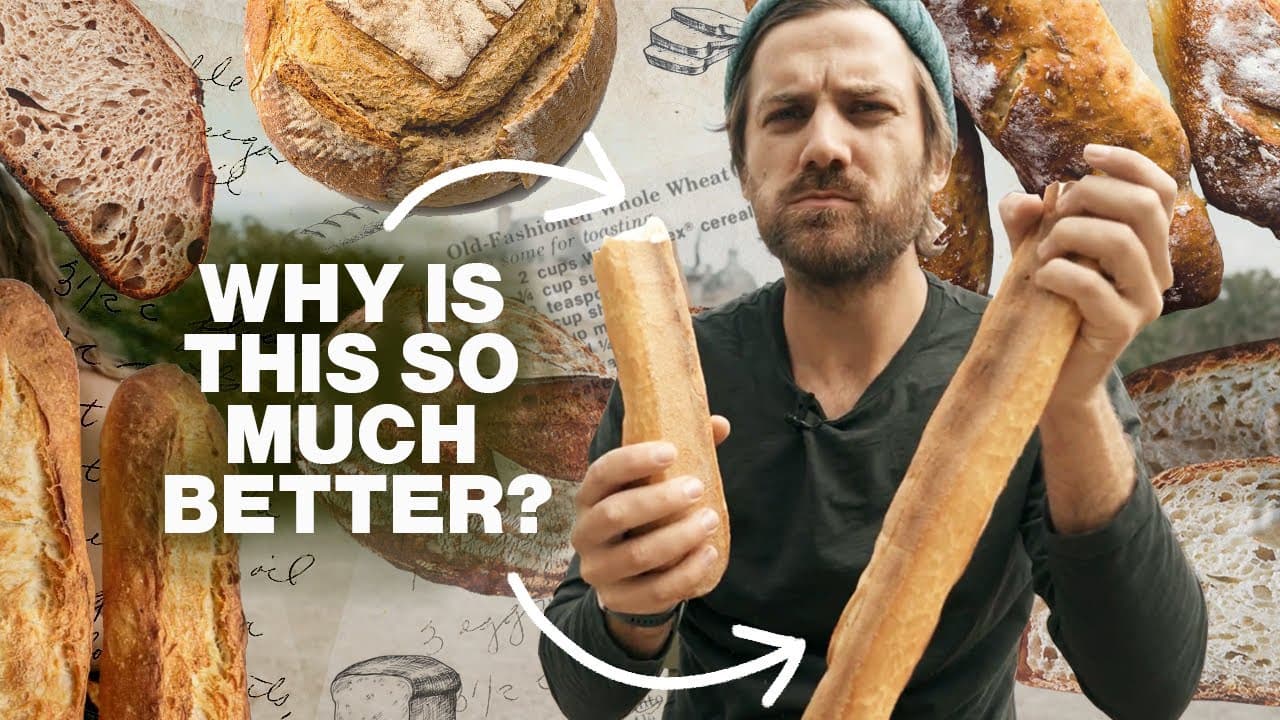
American supermarket bread became unusually soft and shelf-stable because industrial producers prioritized convenience, low cost, uniformity, and longer shelf life over traditional baking methods. By removing oil-rich parts of wheat and adding bleaches, dough conditioners, preservatives, and accelerated rising processes, manufacturers turned a simple flour, water, and yeast staple into a product that may contain 15 ingredients.
Transcript
(fast-paced chimes)
- I love bread. - There is so much good bread in France. - [Narrator] And although man does not live by bread alone, without it, a meal seems incomplete. - On every corner, there is a bakery that is pumping out delicious, fresh, well made bread. - [Announcer] It's so fresh. - This is not easily available to me, and I want to kno... Read More
Key Insights
- Bread is made possible by fermentation, in which airborne bacteria feed on sugars released from flour and produce gas. The stretchy dough traps that gas like a balloon, causing the mixture to rise before heat hardens the bubbles into the structure of a loaf.
- Wheat became foundational to civilization after humans began cultivating the grass roughly 12,000 years ago. Grinding wheat, combining it with water, fermenting the mixture, and heating it created what the narrator describes as humanity's oldest and most important prepared food.
- France has 30,000 independent bakeries, compared with 3,000 in the United States, even though the United States has a much larger population. The transcript calculates that France consequently has 50 times more bakeries per person, reflecting very different access to fresh bread.
- French bread culture is sustained by proximity and routine social contact. The transcript states that 94 percent of residents live within five minutes of a bakery, while customers visit boulangeries almost daily, interact with neighbors, and treat eating as a deliberate part of everyday life.
- Automatic bread slicing accelerated American industrialization because sliced loaves spoiled faster and created demand for longer shelf life. Producers responded by changing wheat processing and later adding substances and production controls designed to keep bread white, soft, stable, and inexpensive.
- Industrial American bread is optimized by removing oil-containing parts of the wheat berry, including the husk and bran, then using bleaches, dough conditioners, preservatives, and controlled heat to accelerate rising. The resulting loaf can remain soft for an entire week instead of one or two days.
- Some American bread additives are prohibited in the European Union and other countries, according to the transcript. Azodicarbonamide, or ADA, is presented as a whitening and softening agent used in some bread and also in yoga mats to help create a spongy texture.
- Bread represents a wider cultural tradeoff between convenience and established food traditions. The narrator argues that American preferences for low prices, softness, uniformity, and shelf life encouraged a bread-like industrial product, while traditional bakery bread relies on fewer ingredients and frequent local production.
Install to Summarize YouTube Videos and Get Transcripts
Explore YouTube Video Summarizer or Get YouTube Transcript Extractor
Questions & Answers
Q: Why does American supermarket bread taste different?
American supermarket bread tastes and feels different because it is commonly designed for low cost, convenience, softness, uniform whiteness, and extended shelf life. Producers may remove oil-rich portions of wheat and use bleaches, dough conditioners, preservatives, and controlled rising chambers. These techniques create a soft, spongy loaf that can remain usable for days, but the product differs substantially from bread made with flour, water, and yeast through traditional fermentation.
Q: How did sliced bread change American bread production?
Automatic bread slicing, introduced by the 1920s in the transcript's account, made bread more convenient by eliminating the need to cut a tough, crusty loaf by hand. Slicing also caused bread to spoil faster. That drawback encouraged producers to pursue industrial methods that extended shelf life, including changes to flour and the later use of conditioners, bleaches, preservatives, and carefully controlled rising environments.
Q: How does traditional bread dough rise?
Traditional dough rises because flour releases sugars when mixed with water, creating a stretchy mixture that attracts bacteria from the air. As the bacteria consume those sugars, they release gas. The dough traps this gas in small bubbles, so the mixture expands and becomes pillowy. When placed near heat, the bubbles harden into a stable internal structure, transforming the fermented mixture into bread.
Q: Why does industrial bread last longer than bakery bread?
Industrial bread lasts longer because manufacturers alter both its ingredients and production process. The transcript describes removing the oil-containing husk and bran from wheat, adding preservatives, bleaches, and dough conditioners, and using controlled chambers to make dough rise faster. Together, these choices produce bread that can stay white, soft, and spongy for four days, five days, six days, or a full week.
Q: How does French bread culture differ from American bread culture?
French bread culture emphasizes fresh local production, frequent bakery visits, and eating as a social routine. France is described as having 30,000 independent bakeries, compared with 3,000 in the more populous United States, producing a 50-fold per-capita difference. The transcript also says 94 percent of residents live within five minutes of a bakery, making fresh bread accessible as part of everyday neighborhood life.
Q: What ingredients are added to industrial American bread?
The transcript identifies several categories rather than providing a complete ingredient list: bleaches, dough conditioners, preservatives, and whitening or softening additives such as azodicarbonamide. It also describes controlled heat used to accelerate rising. These additions and processes can turn bread from a three-ingredient staple into a product containing 15 ingredients while preserving softness, whiteness, stability, and a spongy texture for much longer.
Q: Why is azodicarbonamide controversial in bread?
Azodicarbonamide, also called ADA in the transcript, is controversial because it is used as a whitening agent and helps products remain soft and spongy. The narrator notes that it is also used to make yoga mats spongy and says it is banned in the European Union and many other countries. It serves as the video's clearest example of how industrial bread additives differ across regulatory systems.
Q: What does bread reveal about American food culture?
Bread reveals how strongly American food production can favor convenience, cheapness, softness, and shelf stability over traditional preparation. The narrator treats industrial bread as a symbol of a broader willingness to mechanize familiar foods and add ingredients that support mass distribution. In contrast, the French model described in the transcript preserves frequent local baking, simpler ingredient lists, and social routines organized around fresh food.
Summary & Key Takeaways
-
Bread began when humans cultivated wheat, ground it into flour, mixed it with water, and allowed airborne bacteria to ferment the resulting dough. Gas released during fermentation became trapped inside the stretchy mixture, making it rise. Heating then hardened those bubbles, creating a durable prepared food that helped support human civilization.
-
France preserved a culture built around fresh bread, independent bakeries, and frequent neighborhood visits. The transcript contrasts 30,000 independent French bakeries with 3,000 in the more populous United States, describing a 50-fold per-capita difference. French consumers commonly treat buying and eating bread as a recurring social activity rather than a convenience purchase.
-
American bread changed through mechanization and industrial production, beginning with automatic slicing and continuing with refined flour, accelerated rising, conditioners, bleaches, and preservatives. These changes produced inexpensive, uniform loaves that stayed white, soft, and usable for days, but they also displaced traditional bread and normalized products containing many more ingredients.
Read in Other Languages (beta)
Share This Summary 📚
Summarize YouTube Videos and Get Video Transcripts with 1-Click
Try YouTube Summary with ChatGPT & Claude or YouTube Transcript Generator
Explore More Summaries from Johnny Harris 📚






Summarize YouTube Videos and Get Video Transcripts with 1-Click
Try YouTube Summary with ChatGPT & Claude or YouTube Transcript Generator