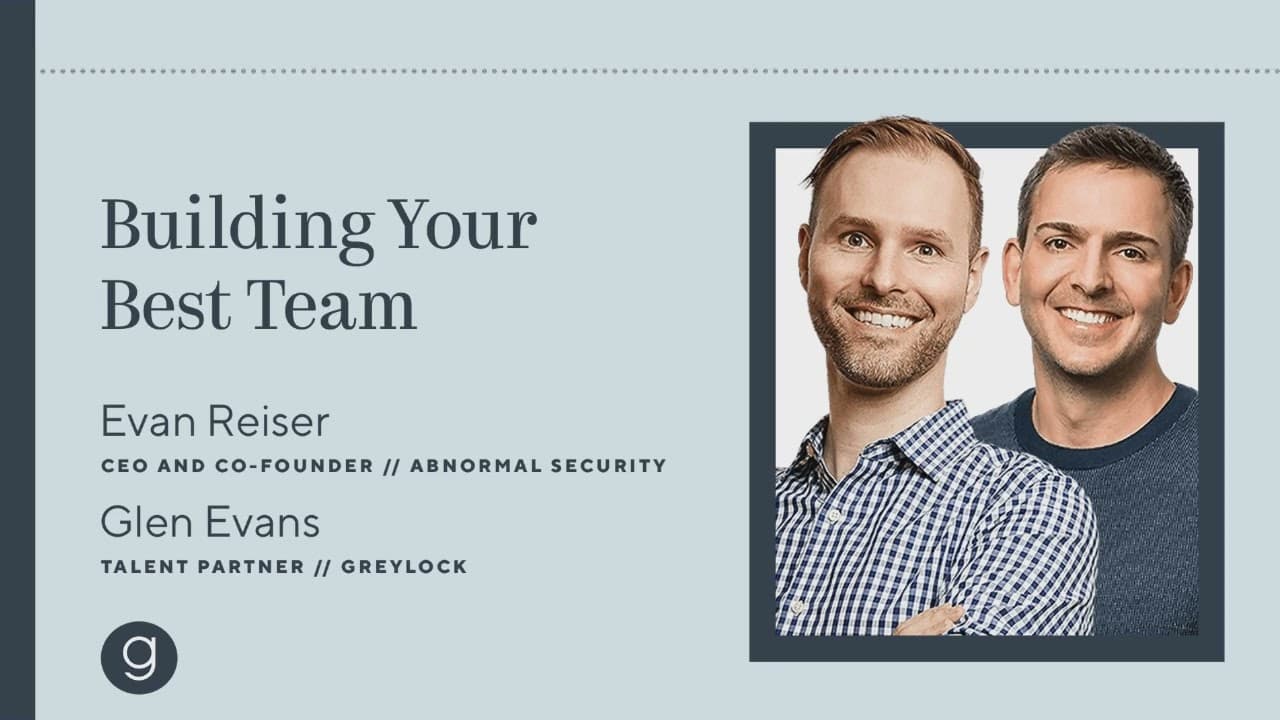
Glen Evans and Evan Reiser | Building Your Best Team (Audio)
TL;DR
Build a scalable hiring system by defining each role clearly, structuring interviews, training interviewers, and treating recruiting as a company-wide responsibility. In a remote, highly competitive labor market, startups must offer a strong team, culture, mission, and candidate experience while verifying that both the company and the candidate can fulfill each other's long-term goals.
Transcript
hi everyone welcome to gray matter the podcast from greylock where we share stories from company builders and business leaders i'm heather mack head of editorial at greylock today we're going to be talking about recruiting and hiring strategies for startups this is always a challenge for any company but it's recently gotten even more difficult due ... Read More
Key Insights
- Remote work is a major shift in the talent market because candidates can consider far more employers without being limited to nearby companies. As a result, startups compete against many more opportunities and must distinguish the quality of their team, culture, mission, compensation, and work environment.
- A clearly defined hiring process is foundational to scaling because it gives interviewers assigned roles, consistent questions, and standards for recognizing strong or weak answers. Documentation and interviewer training help preserve candidate experience and maintain the hiring bar as a company adds people and conducts more interviews.
- Mutual fit is essential because a qualified candidate must benefit from the company just as the company benefits from the candidate. Hiring can fail when someone can perform the work but the organization cannot support that person's ambitions, motivations, or desired direction over the long term.
- A recruiting engine becomes necessary when a startup grows from hiring one or two people per quarter to hiring 50 or 60. Personal energy and founder passion remain valuable, but larger volumes require aligned employees, formal systems, suitable programs, competitive compensation, and deliberate investment in the workplace.
- A bad hire is extremely costly because an apparent short-term solution can create six to 12 months of organizational debt. If the fit eventually fails, the company may find itself a year later without the right person and forced to restart the search from the beginning.
- Effective sourcing starts with understanding the role before contacting candidates. Hiring teams should identify the required skills, likely employers, relevant domains, and locations of suitable people, then map the market and develop compelling messages that persuade heavily contacted candidates to begin a conversation.
- Early-stage hiring favors adaptable generalists because a 10-person startup needs people who can operate amid ambiguity. As the company grows and its needs become more defined, hiring shifts toward specialists who can support greater scale, making role design an evolving responsibility rather than a fixed exercise.
- Personal and investor networks are important sourcing channels for an unknown startup that lacks established credibility. Abnormal Security worked closely with Greylock's recruiting team, which introduced about 100 people over time, and the company ultimately hired about 20 of those candidates.
Install to Summarize YouTube Videos and Get Transcripts
Explore YouTube Video Summarizer or Get YouTube Transcript Extractor
Questions & Answers
Q: How can a startup build a scalable hiring process?
A startup can build a scalable hiring process by defining each job clearly, assigning specific responsibilities to interviewers, standardizing questions, and documenting what strong and weak answers look like. Interview training helps maintain those standards as the organization grows. The company must also align employees around recruiting, invest in compensation and workplace programs, and provide an excellent candidate experience throughout assessment and selection.
Q: Why has remote work made startup recruiting harder?
Remote work has made recruiting harder because sought-after candidates can consider far more employers than when opportunities were primarily limited by location. A candidate who once viewed a nearby company with a good team, culture, compensation, and mission as rare may now see many comparable options. Startups therefore need to explain how their opportunity differs from the numerous other roles competing for that candidate's attention.
Q: What does mutual fit mean when hiring employees?
Mutual fit means that the candidate should be right for the company and the company should be right for the candidate. Technical qualifications alone are insufficient if the employer cannot support the person's aspirations, motivations, or desired career direction. A mismatch can function temporarily, but it may fail later and leave the company restarting the search after investing substantial time in the wrong appointment.
Q: Why should startups avoid settling for a candidate?
Startups should avoid settling because the wrong hire can set a team or company back and can be painful to unwind. The immediate cost of leaving a role open is visible, while the delayed cost of hiring someone who is not a strong mutual fit is easier to overlook. A poor match may create six to 12 months of debt before the organization returns to its original hiring problem.
Q: How should a startup begin sourcing job candidates?
A startup should begin by determining exactly what the job requires rather than rushing directly into outreach. The hiring team should identify necessary skills, relevant domains, likely current employers, and where suitable candidates may be found. It can then map the market, choose appropriate sourcing channels, and write compelling messages that give heavily recruited people a reason to accept an initial conversation.
Q: When should a startup formalize its recruiting system?
A startup should establish clear hiring practices early, then add greater formality as hiring volume increases. Founder effort, personal energy, and passion may support hiring one or two people per quarter. Those tactics are not sufficient when the organization reaches 100, 200, or 300 employees and needs 50 or 60 hires per quarter. At that point, coordinated systems and broad participation become essential.
Q: What qualities did Abnormal Security seek in candidates?
Abnormal Security looked for people who were smart, humble, and hungry, a combination Evan Reiser said had worked well for the company. The company also adjusted the type of candidate sought as its needs changed. At roughly 10 people, it valued generalists who could manage ambiguity, while later growth created a greater need for specialists capable of operating effectively at increased organizational scale.
Q: How can an unknown startup find its earliest hires?
An unknown startup can rely heavily on the founders' personal networks and the networks of its investors because the company may initially have little recognition or credibility. Abnormal Security worked closely with Greylock's recruiting team during this stage. Greylock introduced the company to about 100 people over time, and Abnormal ultimately hired about 20 of those individuals, demonstrating the practical value of trusted introductions.
Summary
In this podcast episode, Glenn Evans, the head of core talent recruiting at Greylock, and Evan Reiser, the CEO and co-founder of Abnormal Security, discuss recruiting and hiring strategies for startups. They talk about the challenges of finding and hiring great talent in the current competitive market, the importance of having a scalable system in place, and the need to prioritize recruiting and talent development as a core value of the company. They also touch on the impact of the COVID-19 pandemic on the hiring landscape and the role of compensation in attracting top talent.
Questions & Answers
Q: How has the hiring and recruiting landscape changed due to the unexpected pandemic?
The pandemic has shifted the dynamics of talent and hiring. With most things now remote or remote-friendly, companies have had to change their approach to finding, assessing, and attracting talent. The competitive hiring market has also intensified due to larger funding rounds and companies needing to scale and hire quickly.
Q: How has the shift to remote work affected the talent market?
The shift to remote work has significantly expanded job opportunities for candidates. Previously, finding a place with a good team, culture, compensation, and mission was rare, especially if it was nearby. But now, candidates have multiple job options and are looking for more than just the basics. They want to know what sets a company apart and how it aligns with their goals and aspirations.
Q: How can companies build a scalable system for hiring as they grow?
Having a clearly defined process early on is crucial for successful hiring at scale. This includes defining interviewer roles, questions, and what constitutes a good answer. Documentation, interview training, and regular calibration meetings help maintain a high hiring bar and create a positive candidate experience. As the company grows, it's important to involve the hiring manager and align interviewers to ensure the process remains effective.
Q: What are the key factors to consider in the sourcing and searching phase for new candidates?
It's important to have a clear understanding of the skills and domain expertise required for the role. Mapping out where the best talent is working and devising a strategy to attract them is crucial in a competitive market. Leveraging personal networks, utilizing investor networks, and getting help from recruiting teams can be effective in sourcing candidates. Tailoring the approach to each individual and clearly communicating the job requirements and the company's unique value proposition are also important.
Q: How can companies ensure that they ask the right questions and provide a comprehensive view of the role and the company to candidates?
Having a defined and documented process is important, but alignment among interviewers is crucial. Holding meetings to ensure everyone is on the same page regarding the purpose of the hire and the role's responsibilities helps create a consistent and positive candidate experience. Post-interview discussions and calibration meetings further fine-tune the process. Building trust and making candidates feel heard and valued is essential during the interview process.
Q: How can companies learn from sales and marketing tactics when it comes to recruiting, while avoiding making the process too transactional?
Tailoring messaging and making it personalized and unique to each candidate can help increase response rates. Companies can also promote their employment brand and create a compelling story that differentiates them from other companies. However, it's important to remember that recruiting is a partnership and mutual exploration rather than a sales process. Building trust and connections with candidates is crucial for successful recruitment.
Q: How involved should the CEO be in the hiring process?
In the early stages of a company, the CEO is often heavily involved in recruiting, from cold calling candidates to conducting interviews. As the company grows, the CEO's involvement may shift to a more supportive role, such as assisting with evaluations, providing guidance and mentorship, and helping candidates make decisions. The CEO's passion for talent and involvement in the hiring process reflects the company's commitment to building a great team.
Q: How do startups assess their staffing needs when they are still in the early stages?
Startups should identify gaps in their skill set and seek guidance from talent partners, such as the Greylock talent team. They can provide strategic guidance on developing the organization and identifying new roles and functions. Leveraging personal networks and partnerships with investors can also help find early hires when the company is still in stealth mode. The goal is to find individuals who align with the company's mission and can contribute to its growth.
Q: How important is compensation in attracting top talent, and how has it changed over the years?
Compensation is crucial in attracting top talent, especially in a competitive market. Startups need to pay competitively to secure the best candidates. Having a clear and documented compensation philosophy helps ensure fairness and aligns compensation with market standards. However, compensation is just one dimension of what attracts top talent. Factors like mission, career growth, learning opportunities, and company culture also play a significant role.
Q: How does a company build a culture of recruiting and prioritize talent development?
Building a culture of recruiting starts with valuing talent and making it a priority. It is important for everyone in the company, including the CEO, to invest time and effort in recruiting. Behaviors and values should align with the focus on building a great team. Transparent communication about the importance of talent and the reasons why it matters helps create a culture that attracts and retains top talent.
Takeaways
Recruiting and hiring strategies for startups have changed due to the COVID-19 pandemic, increased competition for talent, and the shift to remote work. Companies need to adapt their approaches and have a clearly defined process to scale with the company's growth. Building a culture of recruiting and prioritizing talent development are essential for attracting top talent. Compensation is important, but companies should also emphasize mission, learning opportunities, career growth, and company culture to stand out in the competitive market. Effective sourcing, tailored messaging, and building trust with candidates are key elements of successful recruitment.
Summary & Key Takeaways
-
Remote work dramatically expanded the opportunities available to sought-after candidates, making an acceptable team, culture, mission, and compensation insufficient for differentiation. Startups must explain why their workplace is distinctly suited to each candidate while recognizing that recruiting methods effective before the pandemic may no longer succeed in a broader, more competitive talent market.
-
A scalable hiring system begins with clearly defined jobs, interviewer responsibilities, consistent questions, documented standards, and training. Early founders can recruit a few people through personal effort and passion, but hiring dozens each quarter requires a coordinated recruiting engine, company-wide participation, deliberate investment, and an excellent experience for every candidate throughout the process.
-
Strong hiring depends on mutual fit rather than qualifications alone. A candidate may perform the work yet still be wrong for a role if the company cannot support that person's aspirations and motivations. Startups should maintain a high standard, avoid settling under pressure, and source candidates only after determining the skills and characteristics genuinely required.
Read in Other Languages (beta)
Share This Summary 📚
Summarize YouTube Videos and Get Video Transcripts with 1-Click
Try YouTube Summary with ChatGPT & Claude or YouTube Transcript Generator
Explore More Summaries from Greymatter Podcast (Audio) 📚





Summarize YouTube Videos and Get Video Transcripts with 1-Click
Try YouTube Summary with ChatGPT & Claude or YouTube Transcript Generator