What Insights Did Sam Altman Share on AI's Future?
TL;DR
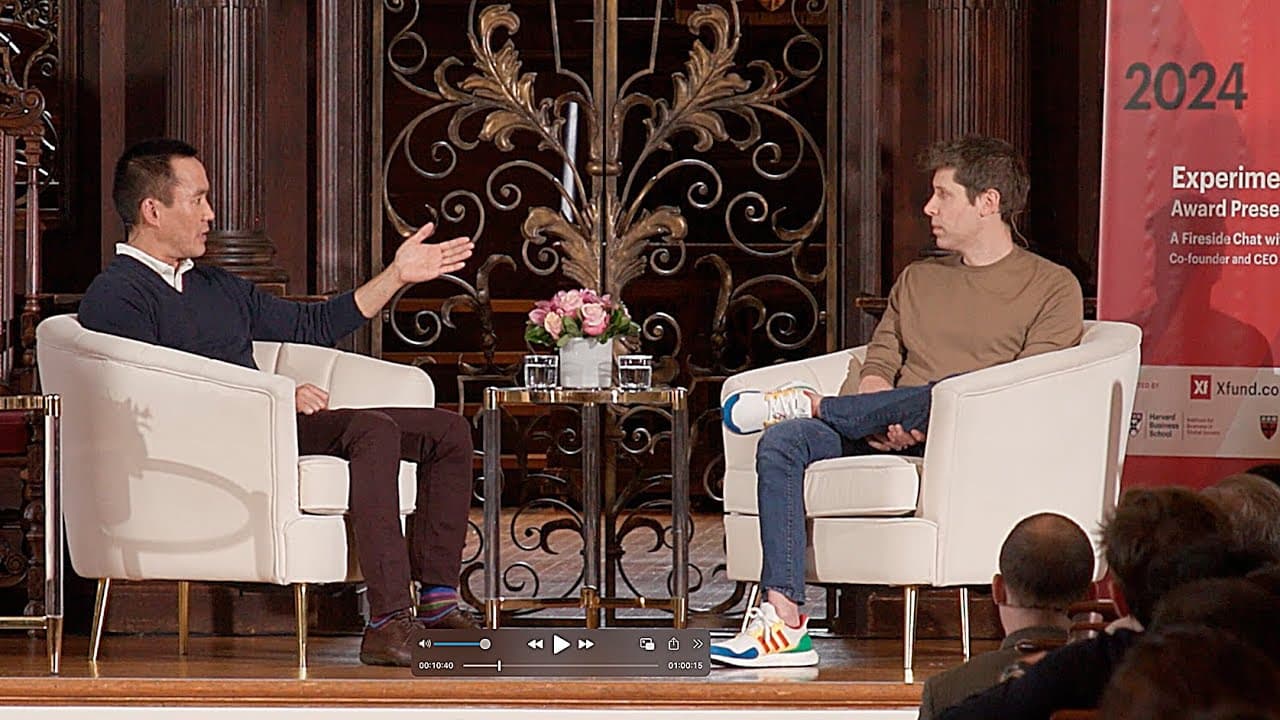
Sam Altman, CEO of OpenAI, discusses the transformative potential of AI during a Harvard chat, emphasizing its role in reducing inequality by making cognitive labor accessible. He highlights the significance of being resourceful and adaptable in the tech landscape, as well as the ethical considerations surrounding AI decisions. Altman envisions a future where AI enhances human productivity and participates in societal advancement.
Transcript
good afternoon everybody good afternoon uh my name is Deborah Spar I'm a professor at the Harvard Business School and an adviser to the XF fund and it is my great pleasure to welcome you all here this afternoon thank you so much for joining us thank you so much for dealing with a little bit more security than usual um but we have what will ... Read More
Key Insights
- Sam Altman emphasizes the importance of being relentlessly resourceful, a mindset he attributes to his success in securing deals and advancing projects.
- OpenAI's initial decision to be a not-for-profit was driven by the uncertainty of AI's commercial viability and the desire to focus on research without financial pressure.
- Altman believes AI should reduce inequality by making cognitive labor affordable, benefiting those who cannot afford expensive services like legal or medical advice.
- OpenAI's product decisions are deeply tied to research directions, with significant emphasis on ethical considerations, such as whether AI should provide legal advice.
- Altman envisions a future where AI acts as a tool to enhance human productivity and participates in society, rather than existing as a standalone superintelligence.
- Public misconceptions about AI often underestimate the rapid pace of technological advancement, and Altman finds it challenging to communicate the potential of upcoming AI capabilities.
- Altman stresses the importance of adaptability in career paths, suggesting that the current technological wave offers abundant opportunities for those willing to pivot and explore new directions.
- The cost of AI is expected to align closely with energy costs, highlighting the importance of advancements in energy to support AI growth and accessibility.
- More videos with Sam Altman:
Install to Summarize YouTube Videos and Get Transcripts
Explore YouTube Video Summarizer or Get YouTube Transcript Extractor
Questions & Answers
Q: Why did OpenAI start as a not-for-profit?
OpenAI began as a not-for-profit because the future commercial viability of AI was uncertain. The founders wanted to focus on research without the pressure of generating immediate revenue. This structure allowed them to explore the potential of AI without being constrained by financial objectives, enabling them to prioritize groundbreaking research.
Q: What are some difficult product decisions at OpenAI?
One challenging product decision involved determining whether ChatGPT should provide legal advice. The potential for inaccuracies and the legal implications in various regions made it a complex issue. OpenAI ultimately decided that ChatGPT should mostly refrain from offering legal advice, prioritizing user safety and compliance with laws.
Q: How does Altman view AI's role in addressing inequality?
Altman believes AI can significantly reduce inequality by lowering the cost of cognitive labor. As AI becomes more accessible, it can provide services like education and healthcare to those who cannot afford traditional options. This democratization of technology has the potential to uplift underserved communities and provide equal opportunities.
Q: What misconceptions do people have about OpenAI?
A common misconception is the assumption that AI progress will plateau. Altman argues that technological advancements will continue to be dramatic and transformative. He finds it challenging to convey the rapid pace of AI development and the profound impact it will have on various industries and society.
Q: How does OpenAI plan to address energy constraints?
OpenAI acknowledges that energy is a critical factor in AI development. Altman sees energy and AI as interrelated issues, with the cost of intelligence eventually approximating the cost of energy. He encourages innovation in energy solutions, such as renewable energy and storage, to support AI's growth and accessibility.
Q: What should public education on AI include?
Altman suggests that education should focus on teaching individuals how to use AI tools effectively. Understanding the capabilities and limitations of AI is crucial for future work environments. He also recommends that students gain hands-on experience with AI models, similar to how introductory computer science courses are structured.
Q: What do entrepreneurs often get wrong about AI's future?
Entrepreneurs frequently assume that AI technology is nearing its peak. Altman advises against building solutions that rely on current AI capabilities, as advancements will continue to evolve. Instead, he recommends developing adaptable systems that can leverage future AI improvements, ensuring long-term viability and success.
Q: How does OpenAI balance safety and progress?
OpenAI navigates the balance between safety and progress by carefully evaluating the implications of their research and product decisions. They prioritize ethical considerations and societal impact, ensuring that advancements align with public interest. This involves setting boundaries for AI capabilities and engaging with stakeholders to guide responsible development.
Summary & Key Takeaways
-
Sam Altman, CEO of OpenAI, shared insights into his journey and the future of AI during a conversation at Harvard. He discussed the importance of being resourceful and adaptable, drawing from his experiences in securing pivotal deals and navigating the tech landscape.
-
Altman highlighted OpenAI's initial choice to operate as a not-for-profit, driven by the uncertain commercial prospects of AI at the time. He emphasized AI's potential to reduce inequality by providing affordable cognitive labor, benefiting those unable to afford traditional services.
-
The conversation also touched on AI's ethical considerations, with Altman discussing product decisions and the role of public misconceptions. He envisions AI as a tool to enhance human productivity and stressed the importance of energy advancements in AI's future development.
Read in Other Languages (beta)
Share This Summary 📚
Summarize YouTube Videos and Get Video Transcripts with 1-Click
Try YouTube Summary with ChatGPT & Claude or YouTube Transcript Generator
Explore More Summaries from Harvard Business School 📚
Summarize YouTube Videos and Get Video Transcripts with 1-Click
Try YouTube Summary with ChatGPT & Claude or YouTube Transcript Generator