Stepper motor developing platform with TMC2209 and AS5600
TL;DR
A comprehensive guide to building and programming a stepper motor driver prototype.
Transcript
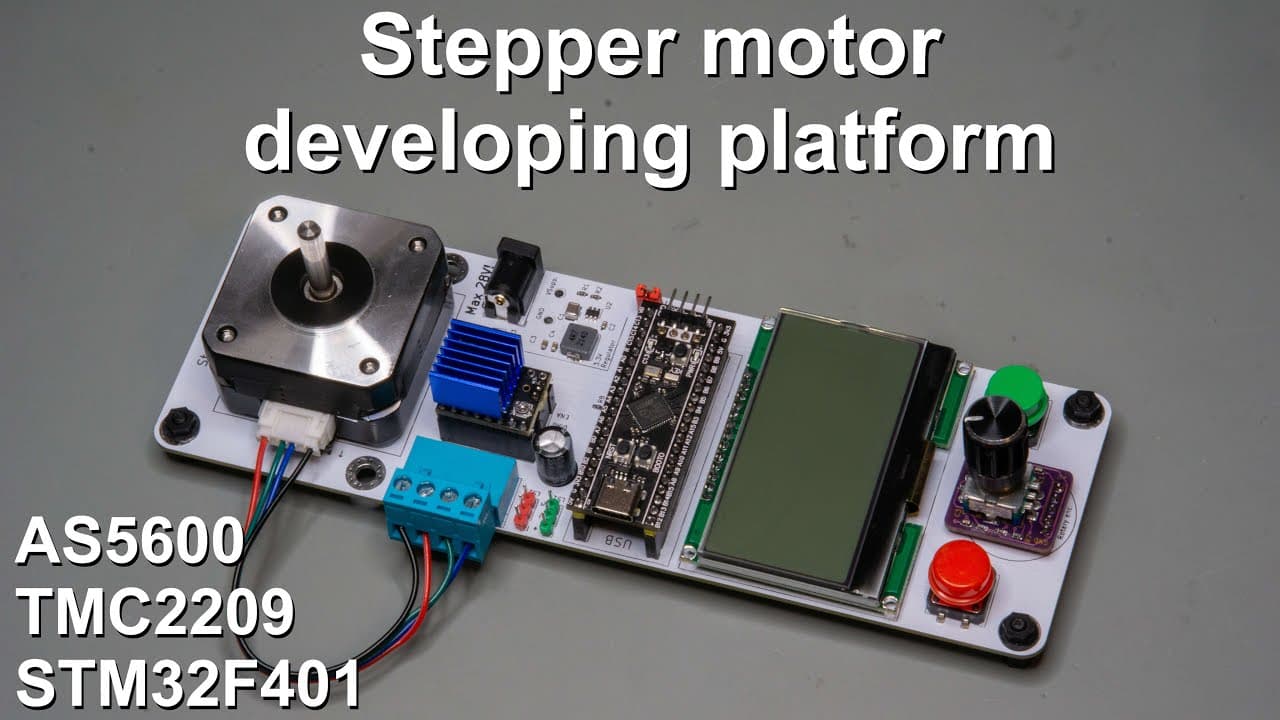
this video is sponsored by pcbway welcome everyone in this video I'm I'm going to show you my new project the basis of this project will be this nice uh board and the purpose of this project is clearly visible I made a evaluation or prototyping board uh which can be used for uh learning how to use uh stepper Motors and uh learning how to program st... Read More
Key Insights
- 🧑🦼 The prototyping board combines various electronic components to facilitate learning about stepper motors and microcontrollers.
- 🤭 The TMC 2209 stepper motor driver provides advanced features beneficial for quiet operation, appealing to many users and developers.
- 🧑🦼 The board includes a magnetic encoder, which enables precise position tracking of the stepper motor, enhancing programming capabilities.
- 👻 Incorporating limit switches allows for the development of safety features in various applications, adding value to the educational aspect of the board.
- 💄 The STM32F401 microcontroller used is recognized for its cost-effectiveness and capability, making it an ideal choice for hobbyists and educators alike.
- 🎮 The video highlights the importance of careful component placement and soldering techniques, crucial for successful assembly and functionality.
- 😒 Viewers are encouraged to use PCB manufacturing services for their projects, promoting broader engagement in electronics development.
Install to Summarize YouTube Videos and Get Transcripts
Explore YouTube Video Summarizer or Get YouTube Transcript Extractor
Questions & Answers
Q: What is the purpose of the prototyping board mentioned in the video?
The prototyping board serves as an educational platform for learning how to use and program stepper motors. It integrates components such as the TMC 2209 stepper motor driver and an AS5600 magnetic encoder, allowing users to experiment with motor control and sensor integration effectively.
Q: Why was the TMC 2209 driver chosen over other drivers?
The TMC 2209 was chosen due to its popularity in the community, particularly within 3D printing. It offers advanced features like silent operation, making it a preferred option for applications requiring stepper motor control. The community feedback from a vote also indicated a strong preference for this driver.
Q: How does the board manage power supply conflicts during programming?
The board incorporates a jumper pin that can disconnect the 3.3V back converter from other components. This design prevents power conflicts if both an external power supply and USB power from a computer are applied, ensuring safe programming without damaging the components.
Q: What features does the board include for user interaction?
The board is equipped with two buttons for basic control, a rotary encoder for more nuanced interaction, and a graphical LCD to display vital information. This combination allows users to practice coding and develop interactive programs for controlling the stepper motor.
Q: What materials and modules are used in the board?
The board primarily uses the STM32F401 microcontroller, which is known for its performance and low cost. It also includes SMD components like the AS5600, along with through-hole modules such as the graphical LCD and motor driver, making it versatile for various applications.
Q: What are the steps for assembling the board as demonstrated in the video?
The video showcases the assembly of the board, beginning with soldering the SMD components and connecting through-hole modules. It guides viewers through integrating the stepper motor with the AS5600 encoder and ensuring proper alignment and spacing, ultimately preparing the board for testing and programming.
Q: What future content can viewers expect related to this project?
Future videos will expand on this project by diving deeper into coding practices, demonstrating various motor control techniques with the TMC 2209 driver, and exploring how to effectively use the features provided by the AS5600 magnetic encoder, offering a continual learning experience.
Summary & Key Takeaways
-
The video introduces a prototyping board designed for learning and programming stepper motors, particularly using the popular TMC 2209 driver.
-
The board features essential components, including a magnetic encoder, limit switches, a graphical LCD, and buttons to enable user interaction and control.
-
Future videos will focus on coding and applications, showcasing stepper motor behavior and the workings of the integrated circuits.
Read in Other Languages (beta)
Share This Summary 📚
Summarize YouTube Videos and Get Video Transcripts with 1-Click
Try YouTube Summary with ChatGPT & Claude or YouTube Transcript Generator
Explore More Summaries from Curious Scientist 📚
![Building a Peltier cooler-based cooling box - First iteration, improvements [Part 2/6] thumbnail](/_next/image?url=https%3A%2F%2Fi.ytimg.com%2Fvi%2F0YlNw0EGnzI%2Fhqdefault.jpg&w=750&q=75)
Summarize YouTube Videos and Get Video Transcripts with 1-Click
Try YouTube Summary with ChatGPT & Claude or YouTube Transcript Generator