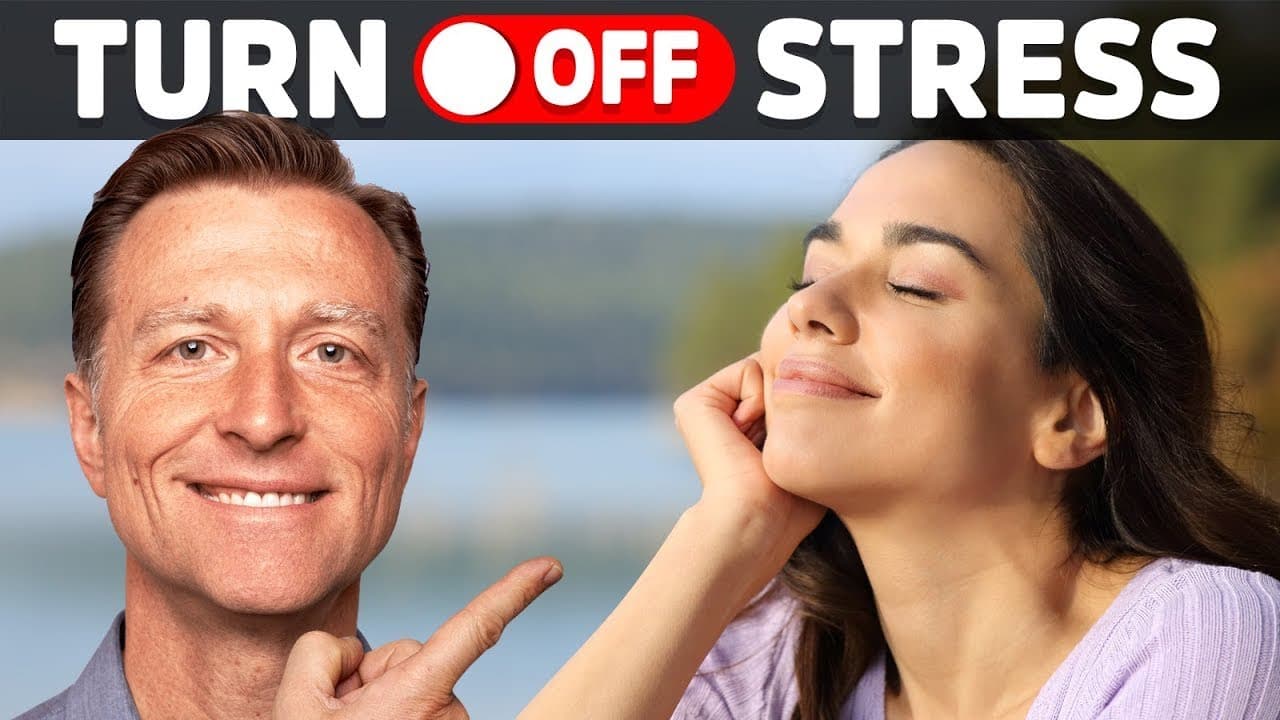
How to Calm Stress With Breathing and Movement
TL;DR
Slow, controlled breathing and deliberate muscle movement can help restore a sense of control during acute stress. The podcast recommends breathing in and out at a steady count, then walking or exercising to use the skeletal muscles; it also presents vitamin B1 as important for breathing, the brain stem, the limbic system, and nervous system function.
Transcript
Welcome to the Dr. Berg's Healthy Keto and Intermittent Fasting Podcast, where Dr. Berg takes you on the journey for the truth about getting healthy and losing healthy weight. So I'm driving my tractor, carrying a bale of hay, and the bale of hay weighed about two thousand pounds, right? And I had it on what's called the front loader, the front par... Read More
Key Insights
- Perceived control is presented as the main factor separating harmful stress from manageable stress. Exercise, heat, and cold can be positive stressors when chosen voluntarily, while situations, conditions, or relationships that feel uncontrollable can produce a more damaging stress state.
- The fight-or-flight response is an involuntary survival mechanism within the autonomic nervous system. During an acute event, it can trigger adrenaline and cortisol release, rapid breathing, elevated blood pressure, a faster pulse, sweating, panic, fear, and anger.
- The diaphragm is both automatically and voluntarily controlled, which makes breathing a practical point of intervention during stress. Deliberately slowing inhalation and exhalation can restore a sense of control when breathing has become rapid, irregular, or driven by panic.
- Controlled breathing works by shifting attention and voluntary control toward the breath. The podcast recommends slowly breathing in and out, potentially using a four-second count, to help pull the body away from the reactive sympathetic, or fight-or-flight, state.
- Skeletal muscles have involuntary reflexes as well as voluntary movement. Because they can be consciously directed, walking or exercising during a stress response provides another way to regain control and is described as helping flush out adrenaline and cortisol.
- The brain stem and limbic system are identified as origins of autonomic and emotional stress responses. The brain stem supports automatic functions, while the limbic system is associated with emotions experienced during stress, including fear and anger.
- Vitamin B1 deficiency is described as affecting the brain stem and limbic system in a way that can resemble inadequate oxygen. The podcast calls this effect pseudohypoxia and associates it with breathing difficulty and activation of sympathetic stress reflexes.
- The recommended stress response combines three focuses: controlled breathing, voluntary muscle movement, and attention to vitamin B1. Breathing and movement are presented as immediate actions, while B1 is discussed as supporting breathing, oxygen status, and nervous system function.
Install to Summarize YouTube Videos and Get Transcripts
Explore YouTube Video Summarizer or Get YouTube Transcript Extractor
Questions & Answers
Q: How can controlled breathing reduce acute stress?
Controlled breathing can reduce acute stress by placing the diaphragm under voluntary direction when breathing has become rapid or irregular. The podcast recommends slowing inhalation and exhalation, focusing closely on each breath, and possibly using a four-second count. This deliberate control is presented as a way to interrupt the reactive fight-or-flight state and help the person regain control over the body’s response.
Q: What happens to the body during a fight-or-flight response?
A fight-or-flight response activates the autonomic nervous system as a survival mechanism. According to the podcast, an acute stress event can produce a sudden release of adrenaline and cortisol, hyperventilation, increased blood pressure, a faster pulse, sweating, panic, and emotional reactions such as fear or anger. These changes occur involuntarily as the body prepares to escape from or confront a perceived danger.
Q: Why does feeling out of control increase stress?
Feeling out of control increases stress because control is presented as the key dividing factor between helpful and harmful stress. Exercise, a jacuzzi, or a cold bath can stress the body positively when they are chosen and controlled. By contrast, an uncontrollable situation, health condition, or relationship can leave a person feeling stuck while involuntary reactions and glandular secretions drive the stress response.
Q: How does walking help after a stressful event?
Walking helps after a stressful event by engaging skeletal muscles that can be consciously controlled. The podcast recommends a long walk or other exercise as a way to restore deliberate control over the body after an involuntary stress response. Muscle movement is also described as helping flush out the adrenaline and cortisol released during the event, supporting a transition away from panic and shock.
Q: Which body systems can be voluntarily controlled during stress?
The diaphragm and skeletal muscles are highlighted as body structures that have both involuntary and voluntary control. Breathing may accelerate automatically during stress, but a person can deliberately slow the diaphragm. Muscles can produce automatic reflexes, such as pulling a hand away from a hot surface, yet they can also be directed through walking or exercise to help regain control.
Q: What is the difference between positive and negative stress?
Positive stress is described as a controlled challenge that can help the body, with exercise, heat from a jacuzzi, and cold baths given as examples. Negative stress occurs when a person lacks control over a situation, condition, or relationship. The podcast argues that the degree of stress rises with the degree of lost control and falls as voluntary control is restored.
Q: How is vitamin B1 connected to stress and breathing?
Vitamin B1 is presented as important to the brain stem and limbic system, which are involved in autonomic stress responses, breathing, and emotion. The podcast states that B1 deficiency can affect these areas and create effects resembling insufficient oxygen, described as pseudohypoxia. It therefore recommends focusing on B1 when addressing breathing difficulty, nervous system function, stress recovery, and stress prevention.
Q: What are the three recommended ways to manage stress quickly?
The three recommended focuses are controlled breathing, deliberate muscle movement, and vitamin B1. Slow inhalation and exhalation place the diaphragm under voluntary control, while walking or exercise engages skeletal muscles and is described as helping clear adrenaline and cortisol. Vitamin B1 is presented as supporting the brain stem, limbic system, breathing, oxygen status, and the nervous system’s ability to stay out of stress mode.
Summary & Key Takeaways
-
Acute stress activates the autonomic nervous system and produces involuntary physical reactions, including rapid breathing, increased blood pressure, a faster pulse, sweating, and the release of adrenaline and cortisol. The podcast identifies perceived control as the key distinction between manageable, positive stress and harmful stress that leaves a person feeling trapped or powerless.
-
The diaphragm can operate both involuntarily and voluntarily, making breathing a direct way to influence a stress response. The recommended practice is to slow the breath, focus attention on inhaling and exhaling, and use a steady count of about four seconds. This controlled action can help interrupt reactive fight-or-flight physiology.
-
Skeletal muscles also function through both automatic reflexes and voluntary action. Walking or exercising deliberately restores control over movement and is presented as a way to process the physical aftermath of stress. The podcast adds vitamin B1 as a third focus because of its proposed importance to breathing and nervous system function.
Read in Other Languages (beta)
Share This Summary 📚
Summarize YouTube Videos and Get Video Transcripts with 1-Click
Try YouTube Summary with ChatGPT & Claude or YouTube Transcript Generator
Explore More Summaries from Dr. Eric Berg DC 📚
Summarize YouTube Videos and Get Video Transcripts with 1-Click
Try YouTube Summary with ChatGPT & Claude or YouTube Transcript Generator