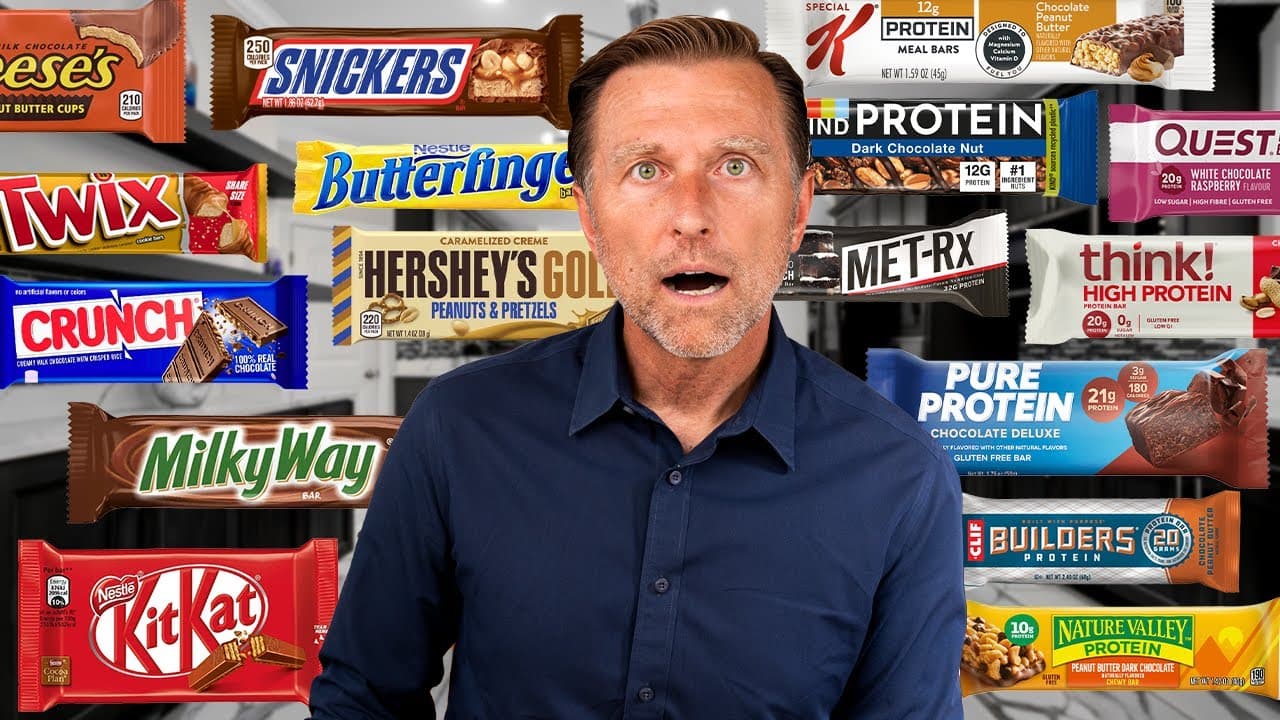
Protein Bars Are WORSE than Candy Bars!!!
TL;DR
Some protein bars may be little better than candy bars because their listed sugars, starches, and processed ingredients can produce a similarly high sugar load. The comparison covers a 50 g Snickers bar and Clif, KIND, and Quest products, including a Clif energy bar described as 55.88% sugar. Read on for the label calculations, ingredient details, and potential digestive and energy effects discussed.
Transcript
the shocking truth about protein bars protein bars are a huge industry what's in the ingredients let's first start with an actual candy bar and then we're going to do a comparison with all the healthy protein bars now if we take the Snickers bar 50 g bar 30 G of carbs 25 G of that is sugar so basically we're talking about 58% of this bar is sugar a... Read More
Key Insights
- 🤢 A significant portion of popular protein bars contains sugars that can rival those in candy bars, misleading consumers about health benefits.
- 😘 Ingredients such as glucose syrup and soy protein isolate contribute to the low nutritional value and high sugar content of many protein bars.
- 🤢 Starches in protein bars can convert to sugars quickly in the body, adding to the overall sugar load and adversely affecting blood sugar levels.
- 🏷️ Consumers should become savvy label readers to differentiate between genuinely healthy products and those loaded with hidden sugars and additives.
- 🤢 Excessive consumption of high-sugar protein bars can lead to energy crashes and other metabolic issues, reducing their effectiveness as energy-boosting snacks.
- 🤮 Marketing tactics that label protein bars as "healthy" or "natural" often omit critical information regarding their actual ingredients and sugar content.
- 😋 Alternatives to traditional protein bars exist, and consumers are encouraged to look for items with whole food ingredients, minimal processing, and quality protein sources.
Install to Summarize YouTube Videos and Get Transcripts
Explore YouTube Video Summarizer or Get YouTube Transcript Extractor
Questions & Answers
Q: Are protein bars worse than candy bars?
Some of the examined bars have sugar loads close to the Snickers bar used for comparison. The transcript describes Snickers as 58% sugar, a Clif Builder Bar as 41%, a Clif energy bar as 55.88%, a KIND bar as 37.5%, and a Quest bar as 41%, while also criticizing their starches and ultra-processed ingredients.
Q: How does the Clif Builder Bar compare with a Snickers bar?
The 68 g Clif Builder Bar has 31 g of carbohydrates, 3 g of fiber, and 17 g of listed sugar. After subtracting fiber and listed sugar, the transcript identifies 11 g of remaining carbohydrate as starch and calculates a total sugar load of 28 g, or 7 teaspoons.
Q: Why does the transcript count starches as sugar?
It describes starch as a chain of sugar molecules and says the starches in these bars turn into sugar quickly. Consequently, it adds otherwise unaccounted-for carbohydrates to the listed sugar when estimating each bar's effective sugar load.
Q: How much sugar does the Clif energy bar contain?
The 68 g Clif energy bar is described as 55.88% sugar. It has 43 g of carbohydrates, 5 g of fiber, and 17 g of listed sugar; the remaining 21 g is treated as starch, producing an estimated total of 9.5 teaspoons of sugar.
Q: What ingredients are highlighted in the Clif bars?
The Clif Builder Bar includes cane syrup, brown rice syrup, palm oil, soy flour, rice flour, and soy protein concentrate. The Clif energy bar includes oats, organic brown rice syrup, soy rice crisps, rice flour, organic tapioca syrup, organic cane syrup, chicory fiber, organic soy flour, and soy oil.
Q: Does the KIND bar match its low-glycemic marketing?
The KIND bar is described as a 40 g bar that is 37.5% sugar. Although its label says “low glycemic index,” its second ingredient is glucose syrup, followed by sugar and honey, and the transcript states that glucose syrup is not low on the glycemic index.
Q: What concerns does the transcript raise about Quest Bars?
A 60 g Quest Bar is described as 41% sugar, with 25 g of carbohydrates, 12 g of fiber, and 9 g of sugar alcohols. The transcript says that consuming 9 g of sugar alcohols may cause gas, bloating, diarrhea, and other gastrointestinal problems.
Q: Do these protein bars provide sustainable energy?
The transcript says the Clif energy bar's sugars and starches create a brief energy spike followed by a crash and low blood sugar. It adds that someone with a fast metabolism who is exercising might handle it better, but it does not present the bar as a sustainable energy source.
Summary & Key Takeaways
-
Protein bars are often marketed as healthier alternatives; however, their sugar content can be surprisingly high, sometimes exceeding that of candy bars. For example, a Snickers bar comprises about 58% sugar, while popular protein bars can range from 37% to 55% sugar content.
-
Ingredients such as starches, syrups, and low-quality proteins often inflate the perceived health benefits of these bars. Many protein bars contain hidden sugars disguised as starches, which can lead to rapid blood sugar spikes and subsequent crashes.
-
The true nutritional value of protein bars is often misrepresented. Many contain excessive ultra-processed ingredients and low-quality protein sources, making them less healthy choices for individuals seeking nutritious snacks.
Read in Other Languages (beta)
Share This Summary 📚
Summarize YouTube Videos and Get Video Transcripts with 1-Click
Try YouTube Summary with ChatGPT & Claude or YouTube Transcript Generator
Explore More Summaries from Dr. Eric Berg DC 📚





Summarize YouTube Videos and Get Video Transcripts with 1-Click
Try YouTube Summary with ChatGPT & Claude or YouTube Transcript Generator