What Tests and Diet Prevent Silent Heart Disease?
TL;DR
Every adult over 30 should get two tests: a coronary calcium score to detect silent plaque, and an inflammatory panel like the Cleveland HeartLab checking LDL particle size, oxidation, CRP, and A1C. Coronary artery disease is the number one cause of death, and inflammation is its underlying cause, often showing up as mental fog or depression.
Transcript
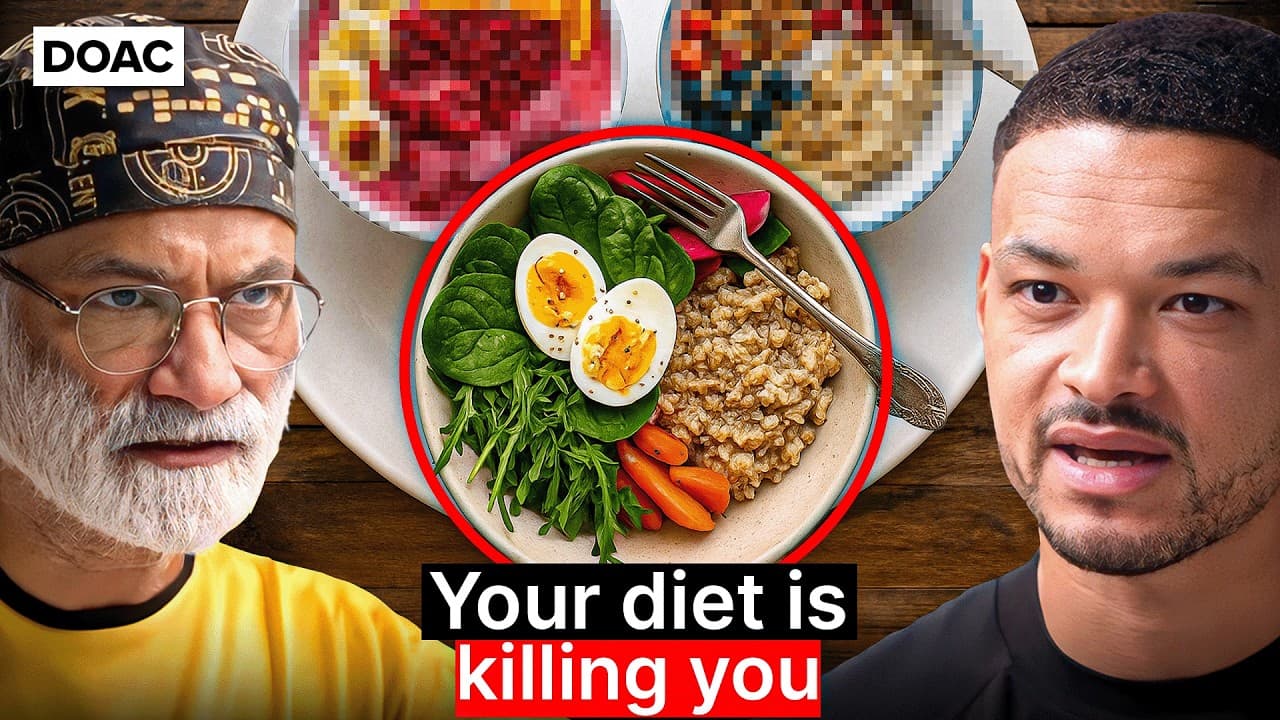
I've heard you talk quite a lot about breakfast. People ask you about what they should have for breakfast because everybody wants to know um how they should be starting their day. What is your advice on what we should be eating for breakfast to have a healthy heart and cardiovascular system? Breakfast is a tough one. I tell most of my patients that... Read More
Key Insights
- A coronary calcium score is the number one test to detect silent heart disease. A score of zero means no calcium and a good place to be, while any calcium indicates existing atherosclerosis requiring a prevention program with a good cardiologist.
- An inflammatory blood panel like the Cleveland HeartLab is essential because it measures LDL particle size, whether LDL is small dense or oxidized, CRP, interleukin 6, tumor necrosis factor, and hemoglobin A1C, not just standard cholesterol.
- Depression is often inflammation in the brain rather than a psychological problem. Patients placed on an anti-inflammatory diet frequently see their depression resolve, so mental fog, forgetfulness, and sleep disturbance can all signal bodily inflammation.
- Breakfast should be skipped for most adults, going straight to lunch and dinner to achieve an 18-hour fast (18:6). If breakfast is necessary, a couple of eggs, or kefir with a few berries and inulin powder, is the recommendation.
- OMAD, eating one meal a day at 6:00 in the evening, is practiced three to four times a week by the doctor, who reports having more energy doing it than he does in the morning.
- Grass-finished meat is nutritionally superior to grass-fed. Grass-fed can mean an animal was fed grass just one day, whereas grass-finished from beginning to end yields more omega-3, more K2, more nutrition, and fewer toxins.
- Cows eating corn produce meat high in omega-6, because cows are meant to eat grass, not corn. Sourcing meat that is organic and grass-finished avoids this excess omega-6.
- Nattokinase thins the blood slightly and reduces the tendency to form blood clots without causing bleeding. Making blood clots and high fibrinogen levels are part of metabolic syndrome, which the doctor addresses with about 8,000 units a day.
Install to Summarize YouTube Videos and Get Transcripts
Explore YouTube Video Summarizer or Get YouTube Transcript Extractor
Questions & Answers
Q: What two tests should every adult over 30 get for heart health?
Everyone over 30 with concerns should get a coronary calcium score and a good inflammatory blood panel. The calcium score reveals silent heart disease: a score of zero means no calcium and a good place to be, while any calcium indicates existing atherosclerosis and the need for a prevention program with a good cardiologist. The inflammatory panel, such as the Cleveland HeartLab, detects underlying inflammation that you may not feel.
Q: What does a coronary calcium score of zero mean?
A coronary calcium score of zero means you have no calcium in your coronary arteries, which puts you in a good place. If you do have coronary calcium, it means you already have atherosclerosis, which is plaque and hardening of the arteries, and you need to see a good cardiologist who will put you on a prevention program. The doctor recommends this test for all adults over 30 who have concerns.
Q: Why does the doctor say breakfast should be skipped?
The doctor believes most adults should pass on breakfast and go for lunch and dinner only, because that lets you complete an 18-hour fast, which he calls the 18:6 and considers optimal. If you absolutely must have breakfast, you should have breakfast and lunch and then no dinner, still planning for 18 hours. He says most people can do it and will notice how much more energy they have.
Q: What is the difference between grass-fed and grass-finished meat?
Grass-fed can simply mean the animal was taken out to a field and fed some grass one day, which the doctor calls a deceiving industry advertising practice and a lie. Grass-finished means the animal ate grass from beginning to end. Grass-finished meat has more omega-3, more K2, more nutrition, and fewer toxins, and less omega-6, because cows fed corn instead of grass produce meat high in omega-6.
Q: What supplements does Dr Jamnadas take every day?
The doctor takes D3, K2, and omega-3 fish oil as two capsules daily, vitamin C at 1 gram, inulin, and kefir, which he drinks and counts every day. He also takes magnesium and nattokinase at about 8,000 units a day, plus a probiotic called MegaSpore, which is spore-based. He describes this stack as part of his daily routine alongside his diet.
Q: How is depression connected to inflammation according to the doctor?
The doctor stresses that depression is often inflammation in the brain, not something purely psychological. He distinguishes it from being upset about a specific situation, like a car not working. He says the very symptom of depression can be a symptom of inflammation, and many patients who go on his anti-inflammatory diet find their depression goes away. Mental fog, forgetfulness, and sleep disturbance can be similar signs of inflammation.
Q: Why does the doctor take nattokinase and what does it do?
The doctor takes about 8,000 units of nattokinase a day because it thins the blood a little, so you are less likely to make blood clots. He explains that part of metabolic syndrome is a tendency to make blood clots and to have a high fibrinogen level, and his own fibrinogen was at the upper limits of normal. He notes it does not cause any bleeding or similar problems.
Q: How does a spore-based probiotic survive stomach acid?
A spore-based probiotic like MegaSpore contains spores rather than live bacteria. A bacterium can survive by sporulating, becoming a spore that later germinates under the right circumstances. Because the acidity in the stomach kills most regular probiotic bacteria, the spore passes through the stomach down to the intestines, where it germinates and grows into bacteria. These are spores of soil bacteria, the bacillus species found in soil.
Summary & Key Takeaways
-
Coronary artery disease is the number one cause of death and inflammation is its underlying cause, yet people often feel no symptoms. Everyone over 30 with concerns should get a coronary calcium score, where zero means no calcium and a good place to be.
-
The second essential test is an inflammatory panel such as the Cleveland HeartLab, which reports HDL, LDL, cholesterol plus particle sizes, oxidation, CRP, interleukin 6, tumor necrosis factor, and hemoglobin A1C. Inflammation may present as mental fog, forgetfulness, depression, or sleep disturbance rather than pain.
-
The doctor advises skipping breakfast to reach an 18-hour fast, eats grass-finished organic meats with vegetables and Indian food, and supplements with D3, K2, omega-3 fish oil, vitamin C, inulin, kefir, magnesium, nattokinase, and a MegaSpore spore-based probiotic that survives stomach acid.
Read in Other Languages (beta)
Share This Summary 📚
Summarize YouTube Videos and Get Video Transcripts with 1-Click
Try YouTube Summary with ChatGPT & Claude or YouTube Transcript Generator
Explore More Summaries from The Diary Of A CEO Clips 📚






Summarize YouTube Videos and Get Video Transcripts with 1-Click
Try YouTube Summary with ChatGPT & Claude or YouTube Transcript Generator