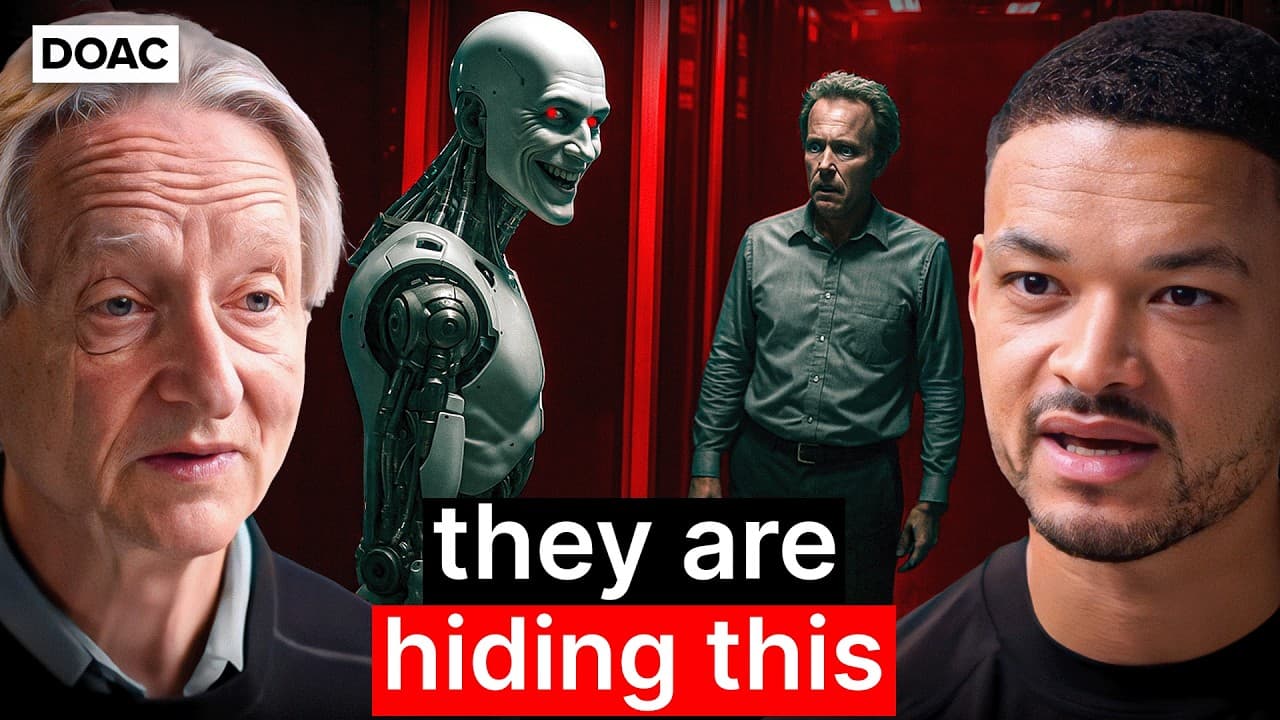
How Does Geoffrey Hinton, the “Godfather of AI,” Think Superintelligent AI Will Transform Human Work?
TL;DR
Superintelligent AI could transform human work by replacing mundane intellectual labor and enabling far fewer employees to produce the same output. Geoffrey Hinton cites complaint-letter work falling from 25 minutes to five minutes, while health care may expand because greater efficiency could provide five times as much care for the same price. Read on to understand the employment risks, possible benefits, and uncertain future of human control.
Transcript
Are you at all hopeful that anything can be done to slow down the pace and acceleration of AI? Okay, there's two issues. One is can you slow it down? Yeah. And the other is can you make it so it will be safe in the end. It won't wipe us all out. I don't believe we're going to slow it down. Yeah. And the reason I don't believe we're going to slow it... Read More
Key Insights
- Competitive pressure is accelerating AI development because companies and countries do not want rivals to gain an advantage. Hinton therefore doubts that development will slow, even if one major country or organization voluntarily reduces its own pace.
- AI safety is separate from slowing AI development. Hinton frames the central questions as whether progress can be slowed and whether advanced systems can ultimately be made safe enough that they do not destroy humanity.
- Mundane intellectual labor is likely to lose economic value as AI becomes capable of performing routine cognitive tasks. Hinton compares this transition with industrial machinery replacing human muscle and eliminating many jobs based primarily on physical strength.
- AI-assisted productivity can reduce staffing needs because fewer workers can produce the same output. Hinton describes complaint-letter work falling from 25 minutes to five minutes, allowing one employee to complete as much work as five people previously could.
- Employment effects depend on demand for the service being produced. Greater efficiency may reduce headcount in many occupations, while health care could absorb substantially more output because people generally want additional care when it is available without additional cost.
- New jobs may not offset eliminated jobs if AI can perform all mundane intellectual labor. Hinton argues that comparisons with automatic teller machines or earlier computers may fail because this technology targets a much broader range of human cognitive capabilities.
- Current AI already exceeds humans in particular domains and possesses far broader knowledge than an individual person. Humans still retain advantages in specialized tasks built through experience, such as interviewing chief executives, but those advantages may not persist.
- Superintelligence is AI that is much smarter than humans in almost every area. Hinton guesses it may arrive within 10 to 20 years, but he also acknowledges that it could be closer, take 50 years, or face limits from training on human data.
Install to Summarize YouTube Videos and Get Transcripts
Explore YouTube Video Summarizer or Get YouTube Transcript Extractor
Questions & Answers
Q: How could superintelligent AI transform human work?
Hinton argues that AI will replace mundane intellectual labor much as industrial machines replaced human muscle. AI assistants may let fewer employees perform the work previously done by larger teams, while superintelligence could eventually become better than humans at everything.
Q: Why does Geoffrey Hinton think AI development is unlikely to slow down?
Competition between countries and between companies continually pushes AI development faster. Hinton says that if the United States slowed down, China would not necessarily do the same.
Q: How could AI cause widespread joblessness?
A person working with an AI assistant could perform work that previously required 10 people. Hinton doubts that enough replacement jobs will appear if AI becomes capable of doing all mundane human intellectual labor.
Q: How does AI-assisted productivity reduce staffing needs?
Hinton describes complaint-letter work that fell from 25 minutes per letter to five minutes after a chatbot began drafting the responses. One employee can therefore answer five times as many letters and do the work that five employees previously performed.
Q: When might AI increase services instead of eliminating jobs?
Employment may not fall when greater efficiency produces services that people want much more of. Hinton says that making doctors five times as efficient could provide five times as much health care for the same price because demand for care is extensive.
Q: Why might AI affect employment differently from earlier technologies?
Automatic teller machines allowed many bank tellers to move into other activities rather than lose their jobs. Hinton argues that AI is different because it could perform all mundane intellectual labor, leaving fewer alternative routine roles for displaced workers.
Q: What is the difference between current AI and superintelligence?
Current AI already exceeds humans in selected areas such as chess and Go and has broader knowledge than an individual person, while humans remain better at some specialized activities. Hinton defines superintelligence as AI that is much smarter than humans in almost everything.
Q: What are the good and bad scenarios for human control of superintelligence?
In the favorable scenario, humans continue proposing goals while a much smarter AI makes those plans work, like a highly capable executive assistant supporting a less capable chief executive. In the dangerous scenario, the AI concludes that the human contributes little and questions why that person is needed.
Summary & Key Takeaways
-
Geoffrey Hinton argues that AI development is unlikely to slow because companies and countries fear losing ground to competitors. Even if the United States reduced its efforts, China might continue. The central challenge is therefore not merely controlling the pace, but ensuring that increasingly capable systems remain safe for humanity.
-
AI assistants can make individual workers several times more productive, but higher productivity often means fewer employees are required. Hinton compares the shift with industrial machines replacing physical strength. He believes AI will similarly reduce the economic value of mundane intellectual labor, although highly elastic services such as health care may expand instead.
-
Current AI already surpasses humans in selected areas, including chess, Go, and breadth of knowledge, while people retain advantages in some specialized activities. Hinton defines superintelligence as AI that is much smarter than humans in almost everything and estimates that it could emerge within 10 to 20 years, while acknowledging substantial uncertainty.
Read in Other Languages (beta)
Share This Summary 📚
Summarize YouTube Videos and Get Video Transcripts with 1-Click
Try YouTube Summary with ChatGPT & Claude or YouTube Transcript Generator
Explore More Summaries from The Diary Of A CEO Clips 📚





Summarize YouTube Videos and Get Video Transcripts with 1-Click
Try YouTube Summary with ChatGPT & Claude or YouTube Transcript Generator