How Do I Use Just 2 AI Tools to Make Money Selling Digital Products?
TL;DR
Use Canva AI to create transformation-focused product mockups and Typefully to distribute written content across X, Threads, and LinkedIn. Canva AI can turn a detailed prompt into a lifestyle scene, while Typefully adapts one idea for multiple platforms and tracks link clicks and sales. The approach prioritizes customer acquisition before complicated automation; read on for the exact mockup, image, distribution, and measurement workflow.
Transcript
I'm really tired of YouTube videos telling you how to create digital products using AI, but nobody, and I mean nobody, is talking about how to actually sell them with simple AI tools. Everyone's obsessed with showing you how to generate digital products with Chachi PT prompts. And to be honest, I myself am guilty of loving these videos. But then wh... Read More
Key Insights
- AI is most useful at the beginning when it removes repetitive work that obstructs revenue-producing activity. Sellers should focus first on getting customers, apply AI to tasks that can drive sales, and postpone elaborate automation until they have identified a process that already works.
- A digital product is effectively the transformation customers expect after using it. Plain PDF screenshots and text descriptions may not help shoppers visualize that outcome, so product imagery should demonstrate the desired lifestyle, emotional benefit, organization, productivity, or other result associated with the offer.
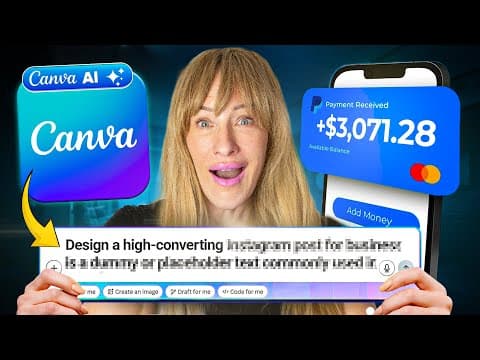
- Canva AI can generate lifestyle mockup scenes from a detailed prompt describing the device, setting, accessories, lighting, aesthetic, audience, and intended emotional message. The example prompt places a blank iPad in a warm, minimal, cozy home office designed for busy professionals aged 25 to 40.
- Creative Fabrica can complement Canva AI by supplying specialized digital-product mockup templates. The recommended blended approach combines Canva’s generated scenes and customization capabilities with purpose-built template elements because the transcript says no single tool is currently perfectly tailored to digital-product mockups.
- A complete lifestyle story requires several coordinated images rather than one isolated mockup. The suggested set includes a clean hero image for the primary listing, a real-life context image, close-up detail shots of important features, and emotionally focused images showing the product’s promised transformation.
- The blended mockup workflow can reduce work that previously took hours in Photoshop to about 20 minutes. The resulting images can be reused across Etsy listings, landing pages, and social posts, where stronger presentation is intended to make the offer appear more premium and understandable.
- Written social platforms can provide free traffic without requiring video production. X and Threads are presented as less competitive, more beginner friendly, supportive of consistent quality content, and capable of directing visitors to product pages without the restrictions described for other platforms.
- Typefully adapts one content idea for multiple written platforms and applies platform-specific formatting. It also provides analytics focused on outcomes such as link clicks and sales, enabling sellers to judge posts by commercially useful behavior instead of relying only on likes, retweets, or other attention metrics.
Install to Summarize YouTube Videos and Get Transcripts
Explore YouTube Video Summarizer or Get YouTube Transcript Extractor
Questions & Answers
Q: How can beginners use two AI tools to sell digital products?
Use Canva AI to create product mockups that show the customer’s expected transformation, then use Typefully to distribute written content across X, Threads, and LinkedIn. Focus first on tasks that can drive revenue and attract customers, then automate the process after proving what works.
Q: Why are mockups important for selling digital products?
Customers may struggle to visualize a product’s transformation from a plain PDF screenshot or text description. Lifestyle scenes, feature close-ups, and emotionally relevant images help communicate what life could look like after using the workbook, template, course, or planner.
Q: How do you create a digital product mockup with Canva AI?
Enter a detailed prompt defining the device, environment, lighting, audience, aesthetic, supporting objects, and intended emotion. The example requests a blank iPad in a warm, minimal, cozy home office for busy professionals aged 25 to 40, with coffee, plants, a notebook, and a gold pen conveying calm organization and productivity.
Q: Why combine Canva AI with Creative Fabrica for mockups?
Canva AI generates and customizes lifestyle scenes, while Creative Fabrica supplies specialized digital-product mockup templates and elements. The recommended workflow combines them because the transcript says no single tool is perfectly tailored to digital-product mockups.
Q: What images should a digital product listing include?
Use a clean hero image, a real-life context image, close-up shots of important features, and emotionally focused transformation imagery. Together, these images present the product, show how it fits into a customer’s life, explain its details, and communicate the desired result.
Q: How quickly can the Canva AI mockup workflow create product images?
The blended Canva AI and Creative Fabrica workflow can reduce work that previously took hours in Photoshop to about 20 minutes. The finished images can then be reused across Etsy listings, landing pages, and social posts.
Q: How does Typefully help market digital products?
Typefully turns one written content idea into versions suited to X, Threads, and LinkedIn. It handles platform-specific formatting and reduces the repetitive work of manually copying, rewriting, and scheduling posts across those platforms.
Q: Which metrics show whether social content is selling digital products?
Prioritize link clicks and actual sales because they reveal whether a post moves people toward purchasing. Likes and retweets show attention, while Typefully’s analytics help identify the individual posts producing commercially useful outcomes.
Summary & Key Takeaways
-
New digital-product sellers should use AI first on work that can directly support revenue instead of spending time constructing complicated automations. Customers matter more than perfect systems at the beginning. Once a sales method has been proven, repetitive parts of that working process can be automated with greater confidence and purpose.
-
Product presentation should communicate the customer’s expected transformation, not merely display a workbook, template, course, or PDF page. Canva AI can generate a lifestyle scene, while Creative Fabrica supplies specialized mockup templates. Together, they support hero images, real-life context, detailed feature shots, and emotionally relevant transformation imagery.
-
Product discovery requires traffic as well as persuasive presentation. Typefully helps sellers write and adapt one content idea for X, Threads, and LinkedIn, reducing manual copying, formatting, and scheduling work. Its analytics can then distinguish attention metrics from commercially useful outcomes by revealing which posts generate link clicks and actual sales.
Read in Other Languages (beta)
Share This Summary 📚
Summarize YouTube Videos and Get Video Transcripts with 1-Click
Try YouTube Summary with ChatGPT & Claude or YouTube Transcript Generator
Explore More Summaries from Luna Vega 📚





Summarize YouTube Videos and Get Video Transcripts with 1-Click
Try YouTube Summary with ChatGPT & Claude or YouTube Transcript Generator