How to Build End-to-End Claude Skill Systems
TL;DR
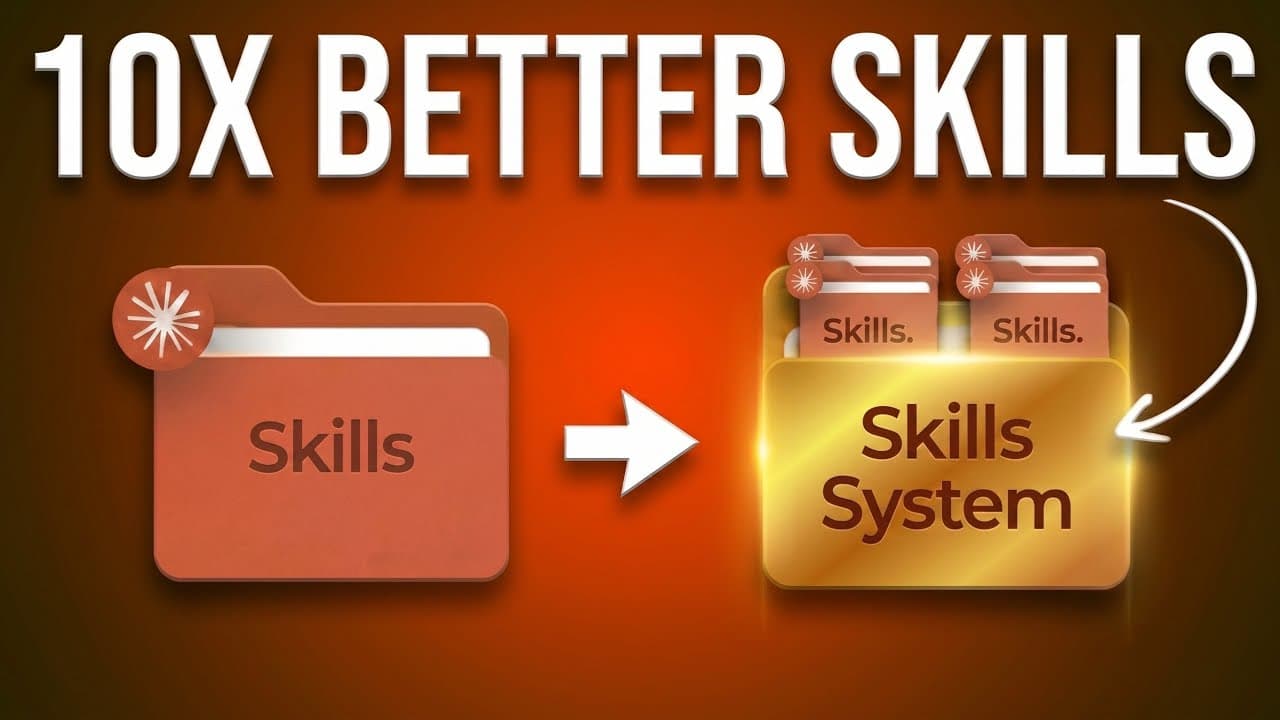
Build small, focused Claude skills, then connect them with one orchestrator skill that manages ordering, inputs, handoffs, validation, and human approval. This structure turns isolated outputs into reusable end-to-end workflows while avoiding the poor maintainability, excessive context loading, and reduced output quality associated with one large skill that tries to handle everything.
Transcript
Downloaded claw code skills are generic. They're bloated and they're also at the same time lacking context. But that's not even their biggest problem. They're still built for one task at a time. Think copywriting, researching, whatever. Whilst real businesses don't operate like that at all, because real work isn't one process document with five dif... Read More
Key Insights
- Isolated skills produce limited outputs because they handle only one part of a larger process. A copywriting skill can draft a LinkedIn post, but the user may still need to select a topic, conduct research, find visuals, schedule the post, and connect every step manually.
- Mega-skills undermine the advantages of modular skill design because their logic becomes difficult to reuse and maintain. When research, writing, repurposing, scheduling, and posting are condensed into one large instruction file, updating or applying one capability elsewhere requires additional work.
- Progressive disclosure preserves response speed and quality by loading only the context required for the current task. A mega-skill loads excessive material at once, which can overwhelm the model and significantly reduce the quality of its output, according to the explanation provided in the transcript.
- A skill system connects focused skills through one orchestrator skill. The orchestrator contains the prompt and instruction set that control the sequence, route information, format inputs and outputs, request human involvement where necessary, validate stages, and continue working toward completion.
- Effective orchestration depends on five defined elements: the participating skills and their order, the inputs required by each skill, the handoff format between steps, the locations of human approval checkpoints, and the way visual results are displayed to the user.
- Sequential workflow orchestration uses explicit step ordering, clear dependencies, and validation at each stage. In this pattern, individual skills serve as reusable components, while the skill system acts as the automation wrapper that coordinates those components around a complete objective.
- The short-form video system converts one long-form YouTube video into five portrait clips. It extracts a word-level timestamped transcript, identifies and scores clip-worthy moments, reframes approved clips using face detection and tracking, and adds illustrations timed to spoken keywords.
- Reusable focused skills can support multiple workflows without duplicating their core logic. Copywriting capability separated from a content workflow can also contribute to newsletter introductions or landing pages, while updates to that capability can be made independently instead of inside several large workflow documents.
Install to Summarize YouTube Videos and Get Transcripts
Explore YouTube Video Summarizer or Get YouTube Transcript Extractor
Questions & Answers
Q: What is a Claude skill system?
A Claude skill system is an end-to-end automation made from multiple small, focused skills connected by one orchestrator skill. The orchestrator provides the prompt and instruction set that determine step order, required inputs, output handoffs, validation, and human checkpoints. This arrangement lets each skill perform one job while its result feeds directly into the next stage of a larger business workflow.
Q: How do you connect Claude skills into an end-to-end workflow?
Connect Claude skills by creating an orchestrator skill that defines the entire chain. Specify which skills participate, the order in which they run, what input each step requires, and how every output must be formatted for the next step. The orchestrator should also define validation rules, human approval points, result presentation, and a loop that continues working until the workflow is complete.
Q: Why are isolated Claude skills insufficient for business workflows?
Isolated Claude skills address individual tasks but leave people responsible for connecting the surrounding work. A copywriting skill may produce a LinkedIn post, yet topic selection, research, visual sourcing, and scheduling can remain manual. The result resembles a single question-and-answer interaction rather than an automated business process. Connecting specialized skills removes the need to copy and paste outputs between separate prompts.
Q: Why should you avoid building one large mega-skill?
A mega-skill sacrifices modularity, maintainability, and progressive disclosure. Its internal logic becomes locked inside one large workflow, making capabilities such as copywriting harder to reuse for newsletters or landing pages. Updates require searching through a long instruction document, while loading the entire skill introduces unnecessary context that can overwhelm the model and reduce output quality.
Q: What must an orchestrator skill define?
An orchestrator skill must define five core elements. It identifies the skills involved and their execution order, states the inputs each skill needs, specifies how outputs transfer cleanly between stages, places human approval or adjustment checkpoints, and determines how results will be presented. Possible presentation formats mentioned include Markdown files, links, an HTML dashboard, and PNG images.
Q: How do human approval checkpoints fit into skill systems?
Human approval checkpoints let the workflow pause for review or adjustment before continuing into later stages. Their placement depends on the user and the process. In the demonstrated video workflow, selected clip-worthy moments become approved clips before extraction and reframing. This structure preserves human control at consequential decisions while allowing the remaining connected steps to operate automatically.
Q: How does the short-form video skill system work?
The system begins with a long-form YouTube video URL and extracts a word-level timestamped transcript. It then identifies five clip-worthy moments and scores each across five categories. Approved clips are extracted and reframed for portrait presentation using face detection and tracking. Later stages add illustrations timed to spoken keywords and package the rendered clips with titles, descriptions, thumbnails, and files.
Q: Why are word-level timestamps and face tracking important?
Word-level timestamps allow the editing stage to synchronize pop-out illustrations with the exact frame where a keyword is spoken. Face tracking supports portrait reframing by detecting faces across sampled frames and keeping the relevant face as the primary focus, even when it moves across the original landscape video. Together, these capabilities automate two precise editing tasks within the larger clip-production chain.
Summary & Key Takeaways
-
Claude skills work best as modular components within connected workflows. Using one skill alone leaves the user responsible for research, scheduling, and other surrounding tasks. A skill system instead chains specialized capabilities so that each output becomes the next step's input and contributes to a complete business outcome.
-
A strong skill system combines several small skills with an orchestrator skill. Its instruction set defines the architecture, required inputs, output handoffs, human approval checkpoints, and presentation of results. This wiring allows the workflow to continue until completion without requiring users to copy outputs manually between separate prompts.
-
The demonstrated system turns one long-form YouTube video into five short-form clips. Its chain extracts a word-level timestamped transcript, scores potential moments, obtains approval, reframes clips with face tracking, adds precisely timed illustrations, and packages each rendered clip with supporting materials such as a thumbnail, description, title, and file.
Read in Other Languages (beta)
Share This Summary 📚
Summarize YouTube Videos and Get Video Transcripts with 1-Click
Try YouTube Summary with ChatGPT & Claude or YouTube Transcript Generator
Explore More Summaries from Simon Scrapes 📚

Summarize YouTube Videos and Get Video Transcripts with 1-Click
Try YouTube Summary with ChatGPT & Claude or YouTube Transcript Generator