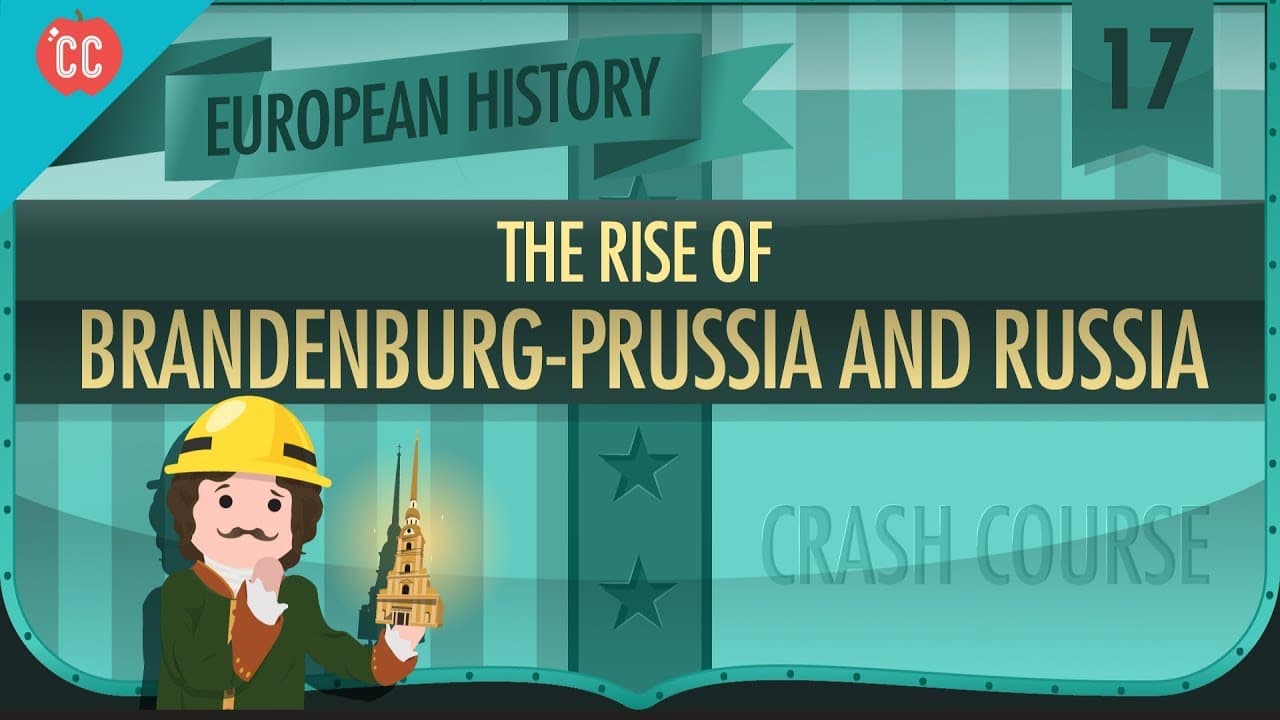
The Rise of Russia and Prussia: Crash Course European History #17
TL;DR
Russia and Prussia rose as major European powers in the 17th and 18th centuries through aggressive state-building, strong armies, and Westernizing reforms. In Russia, Tsar Peter I built a 200,000-strong standing army, reorganized the nobility by a merit-based table of ranks, defeated Sweden in 1721, and founded St. Petersburg as a Western-style capital. Prussia's Hohenzollerns similarly strengthened the military and centralized power. Read on to see how each transformed its state and its people.
Transcript
hi I'm John Green and this is crash course European history so in our last episode we saw the Hapsburgs with the help of Romanians and some others drive the Ottomans out of large swaths of Eastern Europe which started the Habsburg expansion eastward but there were some other important States making big moves during the 17th century today we're gonn... Read More
Key Insights
- 👯 The relationship between the government and the people is complex, even in absolutist governments like the Russian monarchy.
- ✊ State-building and modernization efforts require the support of external institutions and individuals in order to retain power.
- ✊ Modernization does not always result in increased protection or power for the most vulnerable in society.
- 😮 The rise of Russia and Prussia was influenced by factors such as military strength, consolidation of power, and effective state-building strategies.
- 🥰 Both nations had different impacts on the lives of their citizens, with some experiencing advancements in education and arts while others faced harsh working conditions and limited rights.
- 💪 The downfall of Poland-Lithuania can be attributed, in part, to the failure of its constitutional system compared to the stronger government institutions in Russia and Prussia.
- 🥳 Building a strong state or empire requires convincing both internal and external parties of its legitimacy and power, which can be achieved through various means such as treaties and national symbols.
Install to Summarize YouTube Videos and Get Transcripts
Explore YouTube Video Summarizer or Get YouTube Transcript Extractor
Questions & Answers
Q: How did Peter the Great modernize Russia?
Peter reorganized both the military and the nobility, creating a precise table of ranks where promotion depended on service to the state rather than nepotism, making the aristocracy more meritocratic. He built a standing army of some 200,000 recruits, a massive number for Europe at the time, and eliminated the power of the Orthodox patriarch by leaving the post vacant and setting up a lay council headed by the Tsar. He also founded St. Petersburg as a Western-style capital.
Q: Why did Peter the Great found St. Petersburg?
After traveling to Western Europe in 1697 and admiring cities like Amsterdam, Peter wanted a European-style city with an outlet to the Baltic. Tens of thousands of serfs were commandeered from aristocrats' workforces to build it at great cost in lives, reclaiming the marshy site through canals. He ordered museums, libraries, universities, and stately government buildings, and required aristocrats to build lavish houses and hold social events.
Q: How did Russia defeat Sweden in the Great Northern War?
Sweden's ambitious ruler Charles XII first defeated Russian forces at Narva in 1700 and also beat Poland. Peter then fortified his army further and built a coalition with Denmark and Poland that ultimately conquered Sweden in 1721, ending its continental influence. As a result Russia gained Sweden's continental territory, including Estonia and Livonia.
Q: How did Peter the Great's reforms impact women's roles in society?
Peter saw St. Petersburg as a backdrop for reforming women's roles, decreeing an end to the veiling and seclusion of women. Women were expected to leave seclusion and appear at public events such as dances. His goals for reforming women's roles were not fully achieved, but the changes marked a break from traditional practices.
Q: What was the streltsy revolt and how did Peter respond?
The streltsy were a band of infantrymen first created by Ivan the Terrible. In spring 1698, while Peter was in Western Europe, they rose up against bad conditions and hoped to revive the rule of the imprisoned regent Sophia. Peter ordered them crushed, and after returning in August 1698 he had hundreds of the streltsy tortured, exiled, or executed, clearing the way for his modern fighting force.
Q: Was the Russian Tsar an absolute ruler with total power?
Not entirely. Peter only became Tsar with the help of his advisers and the support of powerful interest groups such as the Orthodox Church, the army, the aristocracy, and wealthy traders, and the Russian people had to seal the deal through public demonstrations of approval. The video stresses that even absolutist governments could only retain power with support from outside institutions and individuals.
Q: What role did the Hohenzollern family play in Prussia's rise?
In Prussia the Hohenzollern family, starting with the Great Elector Frederick William, focused on strengthening the military and consolidating power. They weakened representative bodies and allowed nobles greater control over the lives of peasants. Prussia became known for having a large army relative to its small size.
Q: What made Russia and Prussia effective at state-building compared to Poland-Lithuania?
Both Russia and Prussia prioritized building strong armies and government institutions and consolidated power, in part by granting greater control to the nobility. Their stronger government institutions contrasted with Poland-Lithuania, whose constitutional system failed, contributing to its downfall. Both nations proved effective at shaping the future of Europe.
Summary & Key Takeaways
-
Peter the Great takes steps to modernize Russia, including reorganizing the military and nobility, building a standing army, and founding schools to teach math and science.
-
Peter also establishes the city of St. Petersburg as a symbol of Westernization, leading to reforms in women's roles and the end of traditional practices like wearing beards.
-
In Prussia, the Hohenzollern family focuses on strengthening the military and consolidating power, leading to the creation of a strong army and the weakening of representative bodies.
-
Prussia becomes known for its large army and small state, while both Russia and Prussia prove to be effective at state-building and shaping the future of Europe.
Read in Other Languages (beta)
Share This Summary 📚
Summarize YouTube Videos and Get Video Transcripts with 1-Click
Try YouTube Summary with ChatGPT & Claude or YouTube Transcript Generator
Explore More Summaries from CrashCourse 📚
Summarize YouTube Videos and Get Video Transcripts with 1-Click
Try YouTube Summary with ChatGPT & Claude or YouTube Transcript Generator