Electron microscope animation: Carbon nanotubes pulled into thread
TL;DR
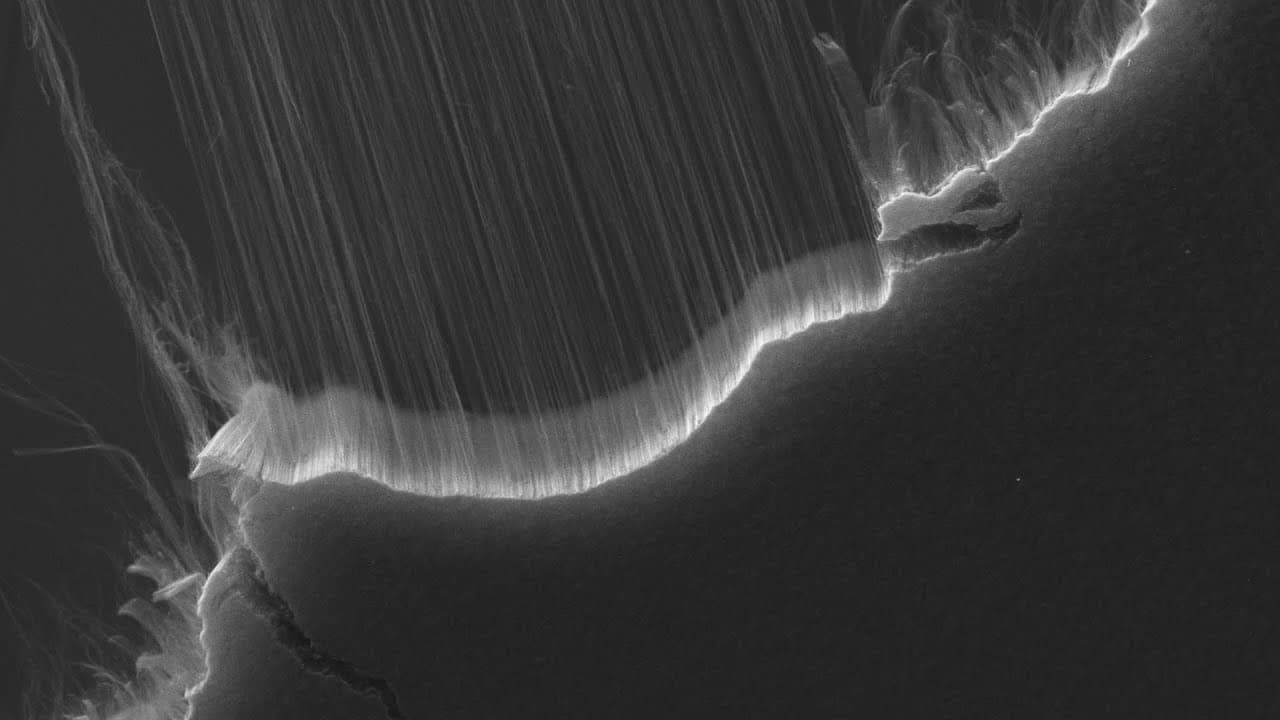
This video showcases how a scanning electron microscope was used to create an animation of carbon nanotubes being pulled into a thread, providing a closer look at the process.
Transcript
today on Applied Science I'm going to show you how I used the scanning electron microscope to make an animation of carbon nanotubes being pulled into a thread in my last video I showed how to make carbon nanotubes and one of the unusual properties of these is if you make the carpet of carbon nanotubes in just the right way you can actually pull a t... Read More
Key Insights
- 💁 Carbon nanotubes can be formed into a thread-like structure by pulling it from a carpet arrangement.
- 😚 A scanning electron microscope can provide a close-up view of individual carbon nanotubes.
- 🎮 The microscope used in the video has two stages, enabling precise control in pulling the thread and adjusting the zoom level.
- 😀 The animator faced challenges in capturing frames for the animation due to the limitations of the vintage microscope.
- 🎮 Future improvements aim to automate the frame collection process and enhance motion control and autofocus capabilities.
- 🔬 Electron microscope animation techniques are currently underutilized in industry.
- 🌱 The animator plans to develop a more advanced acquisition system for future projects.
Install to Summarize YouTube Videos and Get Transcripts
Explore YouTube Video Summarizer or Get YouTube Transcript Extractor
Questions & Answers
Q: How were the carbon nanotubes used to create a thread?
The carbon nanotubes were arranged in a carpet-like structure, and by pulling at one end, the nanotubes bonded together in a way that formed a thread-like structure.
Q: How were the frames for the animation collected?
The frames were collected using a vintage electron microscope that was not originally designed for digital image acquisition. The animator manually adjusted the microscope and saved each frame to a computer.
Q: What challenges were faced in creating a smooth zoom for the animation?
The microscope used discrete steps of magnification, so the animator had to collect separate sets of frames at each zoom level and interpolate the frames to achieve a smooth zoom effect in the final animation.
Q: What improvements does the animator hope to make in future projects?
The animator plans to build a more sophisticated acquisition device with stepper motors on the micrometers, allowing for automated frame collection and higher-quality animations. Full motion control and autofocus are also desired.
Summary & Key Takeaways
-
The video demonstrates the process of creating carbon nanotubes and how they can be used to pull a thread out, resembling the unraveling of fabric.
-
By using a scanning electron microscope, the animator was able to capture close to 600 frames of the process, revealing the individual carbon nanotubes and their arrangement.
-
The microscope used in the video is unique as it has two stages, allowing for precise control in pulling the thread out and adjusting the zoom level.
Read in Other Languages (beta)
Share This Summary 📚
Summarize YouTube Videos and Get Video Transcripts with 1-Click
Try YouTube Summary with ChatGPT & Claude or YouTube Transcript Generator
Explore More Summaries from Applied Science 📚
Summarize YouTube Videos and Get Video Transcripts with 1-Click
Try YouTube Summary with ChatGPT & Claude or YouTube Transcript Generator