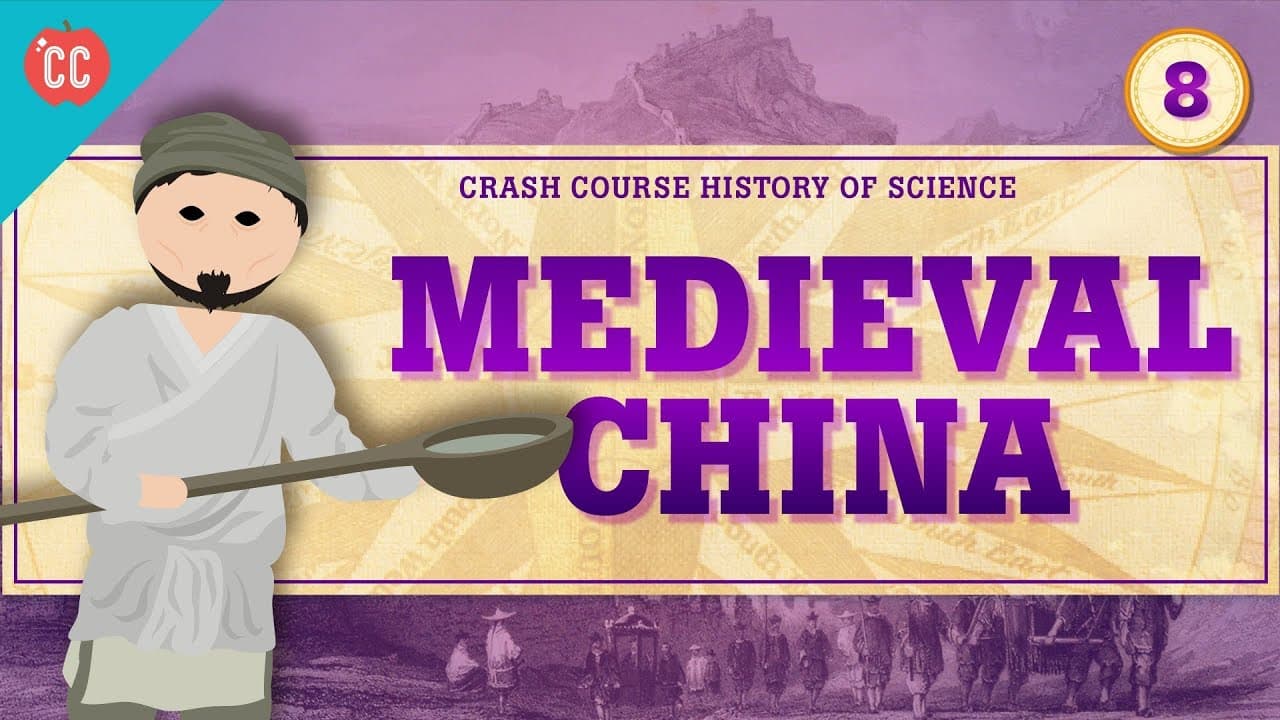
Medieval China: Crash Course History of Science #8
TL;DR
Medieval China saw significant technological and scientific advancements during the Song Dynasties.
Transcript
Look at this map of China and tell me if, from what we’ve learned so far, you can tell me about the Chinese civilization. Yep, rivers, big ones… and from them ran the bureaucracy and technology necessary for controlling water. Like Egypt, Sumer, and Mesoamerica, ancient China represents a hydraulic civilization—one that maintained its population by... Read More
Key Insights
- Ancient China is classified as a hydraulic civilization, similar to Egypt and Sumer, due to its advanced water management systems that supported agriculture and population growth.
- The Chinese developed a continuous literary and scientific tradition, unlike other ancient civilizations, which included innovations like the standardized test for state control and knowledge transmission.
- Confucianism, emphasizing order and tradition, became the official state ideology during the Song Dynasties, influencing Chinese culture and governance despite the presence of competing philosophies like Buddhism and Mohism.
- The Song Dynasty was marked by advancements in agriculture, notably through the introduction of new rice varieties, which led to population growth, urbanization, and the rise of a middle class.
- China's technological innovations include the invention of the wheelbarrow, silk production, earthquake monitors, and gunpowder, demonstrating the state's role in driving technical progress.
- The Song Dynasty saw the development of movable-type printing and astronomical devices, supported by the state, which facilitated cultural unification and advancements in natural philosophy.
- Infrastructure projects like the Grand Canal and advancements in iron production and hydraulic engineering were pivotal in supporting China's economic and military strength during the Song period.
- The concept of a 'Scientific Revolution' is debated in the context of China, as many technical achievements were made by anonymous artisans over time, challenging the Western-centric narrative of scientific progress.
Install to Summarize YouTube Videos and Get Transcripts
Explore YouTube Video Summarizer or Get YouTube Transcript Extractor
Questions & Answers
Q: What is a hydraulic civilization, and how does ancient China fit this description?
A hydraulic civilization is one that maintains its population and agricultural productivity through advanced water management systems, such as diverting rivers for irrigation. Ancient China fits this description due to its early development of such systems, which supported its large population and allowed the civilization to thrive. This characteristic is comparable to other ancient civilizations like Egypt and Sumer.
Q: How did Confucianism influence the Song Dynasty's governance and society?
Confucianism, with its emphasis on tradition, etiquette, and respect for hierarchy, became the official state ideology during the Song Dynasty. It influenced governance by promoting an orderly society and shaping the values of civil servants through the civil service examination system. This focus on Confucian principles helped maintain social stability and a unified cultural identity across the empire.
Q: What were some key technological innovations during the Song Dynasty?
The Song Dynasty was a period of significant technological advancement, including the introduction of new rice varieties that improved agricultural productivity, the development of movable-type printing, and the construction of astronomical devices. Additionally, infrastructure projects like the Grand Canal and advancements in iron production and hydraulic engineering were crucial in supporting China's economic and military strength.
Q: How did the Song Dynasty's agricultural innovations impact Chinese society?
Agricultural innovations during the Song Dynasty, such as the introduction of early-ripening rice varieties, led to increased food production and supported population growth. This, in turn, contributed to urbanization and the rise of a leisured middle class. The agricultural surplus facilitated trade and manufacturing, driving economic expansion and cultural development across China.
Q: What role did the state play in technological and scientific advancements in medieval China?
The state played a significant role in driving technological and scientific advancements in medieval China by supporting research and development. This included sponsoring projects like astronomical clocks and orreries, as well as infrastructure developments such as the Grand Canal. The state's involvement ensured that innovations aligned with its goals of economic growth, social stability, and military strength.
Q: Why is the concept of a 'Scientific Revolution' debated in the context of China?
The concept of a 'Scientific Revolution' is debated in the context of China because many of its technological and scientific advancements were made over long periods by anonymous artisans, rather than through a concentrated period of rapid change led by individual scholars. This challenges the Western-centric narrative of scientific progress and suggests that China's development followed a different, yet equally significant, path.
Q: What impact did the Grand Canal have on China's economy and society?
The Grand Canal, completed during the Song Dynasty, had a profound impact on China's economy and society by facilitating the efficient movement of goods and people across vast distances. It enabled merchants to transport large quantities of grain and other commodities, supporting trade and economic growth. The canal also demonstrated the state's engineering capabilities and its ability to integrate different regions into a cohesive economic network.
Q: How did Confucianism and the civil service examinations influence Chinese culture?
Confucianism and the civil service examinations significantly influenced Chinese culture by promoting a unified set of values centered around order, tradition, and respect for authority. The examinations ensured that civil servants were well-versed in Confucian texts, creating a shared cultural framework among the educated elite. This system helped maintain social stability and reinforced the hierarchical structure of Chinese society.
Summary & Key Takeaways
-
Ancient China is known for its hydraulic civilization, which utilized advanced water management systems for agriculture. The Song Dynasties were particularly notable for technological innovations and a continuous tradition of scientific and literary development, setting them apart from other ancient civilizations.
-
Confucianism played a significant role in shaping Chinese culture and governance during the Song Dynasties. Despite the presence of other philosophical schools, it became the official state ideology, influencing the values and order of society, particularly through the civil service examination system.
-
The Song Dynasty saw major advancements in agriculture, infrastructure, and technology, including the introduction of new rice varieties, the construction of the Grand Canal, and the development of movable-type printing. These innovations contributed to economic growth, urbanization, and China's overall strength during this period.
Read in Other Languages (beta)
Share This Summary 📚
Summarize YouTube Videos and Get Video Transcripts with 1-Click
Try YouTube Summary with ChatGPT & Claude or YouTube Transcript Generator
Explore More Summaries from CrashCourse 📚





Summarize YouTube Videos and Get Video Transcripts with 1-Click
Try YouTube Summary with ChatGPT & Claude or YouTube Transcript Generator