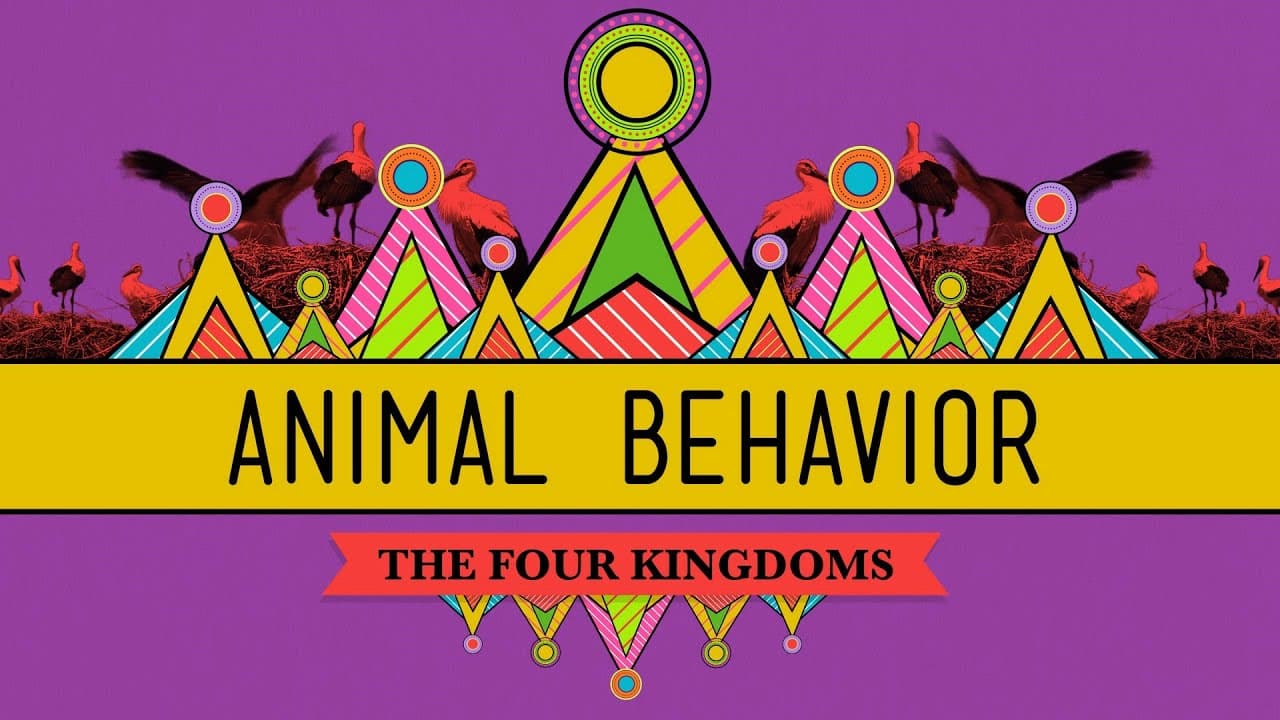
Animal Behavior - CrashCourse Biology #25
TL;DR
Animal behavior is influenced by natural selection and serves survival and reproductive purposes.
Transcript
Behavior is action in response to a stimulus. My cat Cameo is now responding to both an external stimulus the sound of a bag of treats, and an internal stimulus her hunger, or at least her insatiable desire for treats. Sometimes animal behavior can seem really far out, but if you look closely enough, you can see how all behavior serves a purpose to... Read More
Key Insights
- Animal behavior is a response to stimuli and serves purposes like mating, eating, avoiding predators, and raising young, influenced by natural selection.
- Behavior is limited by an animal's morphology and physiology, which are shaped by hereditary traits, affecting what an animal can physically do.
- Some behaviors are learned, and natural selection favors brain structures capable of learning, demonstrating a genetic underpinning for adaptive behaviors.
- Niko Tinbergen developed four questions to understand animal behavior, focusing on proximate and ultimate causes, crucial for evolutionary biology.
- Foraging behavior is influenced by natural selection to maximize energy efficiency, exemplified by the optimal foraging model, as seen in alligator snapping turtles.
- Sexual selection influences behaviors that enhance reproductive success, like the bowerbird's elaborate displays to attract mates.
- Altruistic behaviors, like vampire bats sharing food, can be explained by inclusive fitness, benefiting relatives and enhancing community survival.
- Ethologists like Tinbergen, Lorenz, and von Frisch laid the foundation for studying animal behavior, with contributions to understanding imprinting and social bonds.
Install to Summarize YouTube Videos and Get Transcripts
Explore YouTube Video Summarizer or Get YouTube Transcript Extractor
Questions & Answers
Q: What limits an animal's behavior according to the video?
An animal's behavior is limited by its morphology and physiology, which are hereditary traits. Morphology refers to the physical structure of an animal, determining what it can physically do, while physiology involves the function of that morphology. These limitations are shaped by natural selection, influencing evolutionary advantages.
Q: How does natural selection influence animal behavior?
Natural selection influences animal behavior by acting on both physical traits and behaviors that provide evolutionary advantages. Behaviors that enhance survival and reproduction are favored, while those that are detrimental are weeded out. This process ensures that animals with beneficial behaviors have a higher chance of success and passing on their genes.
Q: What are Niko Tinbergen's four questions about animal behavior?
Niko Tinbergen's four questions aim to understand animal behavior by focusing on proximate and ultimate causes. Proximate causes involve what stimulus causes a behavior and how an animal's body responds. Ultimate causes explore why natural selection favors a behavior, including its role in survival and reproduction and its evolutionary history.
Q: How does the optimal foraging model relate to animal behavior?
The optimal foraging model relates to animal behavior by suggesting that natural selection favors behaviors that maximize energy efficiency in food acquisition. Animals aim to exploit food sources while using the least amount of energy possible. The alligator snapping turtle exemplifies this by using its tongue to attract prey rather than actively hunting.
Q: What role does sexual selection play in animal behavior?
Sexual selection plays a significant role in animal behavior by influencing traits and behaviors that enhance reproductive success. It often involves competition for mates and the development of features or behaviors that attract potential partners. The bowerbird's elaborate displays and collections to attract females are an example of sexual selection in action.
Q: How is altruism explained in animal behavior?
Altruism in animal behavior is explained by the concept of inclusive fitness, which considers the benefits of a behavior to an individual's relatives. Altruistic acts, like vampire bats sharing food, can enhance the survival of related individuals, thus indirectly benefiting the altruistic animal by ensuring the continuation of shared genes within the community.
Q: Who were the key figures in the study of animal behavior?
Key figures in the study of animal behavior include Niko Tinbergen, Konrad Lorenz, and Karl von Frisch. These ethologists laid the foundation for understanding animal behavior, contributing concepts like Tinbergen's four questions, Lorenz's imprinting studies, and von Frisch's work on bee communication. Their research provided crucial insights into the evolutionary basis of behavior.
Q: What is imprinting, and who discovered it?
Imprinting is the formation of social bonds in infant animals, involving both learned and innate components. Konrad Lorenz discovered imprinting through his experiments with graylag geese and ducklings. He observed that newly hatched goslings imprinted on the first moving object they saw, often following him instead of their biological mothers, demonstrating the significance of early experiences in social behavior.
Summary & Key Takeaways
-
Animal behavior is a response to stimuli and serves essential survival and reproductive purposes. It is influenced by natural selection, which acts on both physical traits and behaviors that provide evolutionary advantages. Morphology and physiology limit what an animal can do, and some behaviors are learned, with a genetic underpinning.
-
Niko Tinbergen's four questions help understand animal behavior, focusing on proximate and ultimate causes. Foraging behavior is shaped by natural selection to maximize energy efficiency, as seen in the optimal foraging model. Sexual selection influences behaviors that enhance reproductive success, like the bowerbird's elaborate displays.
-
Altruistic behaviors, such as vampire bats sharing food, can be explained by inclusive fitness, benefiting relatives and enhancing community survival. Ethologists like Tinbergen, Lorenz, and von Frisch laid the foundation for studying animal behavior, contributing to understanding imprinting and social bonds in animals.
Read in Other Languages (beta)
Share This Summary 📚
Summarize YouTube Videos and Get Video Transcripts with 1-Click
Try YouTube Summary with ChatGPT & Claude or YouTube Transcript Generator
Explore More Summaries from CrashCourse 📚

Summarize YouTube Videos and Get Video Transcripts with 1-Click
Try YouTube Summary with ChatGPT & Claude or YouTube Transcript Generator