How to Build Agent Loops With Clear Stop Criteria
TL;DR
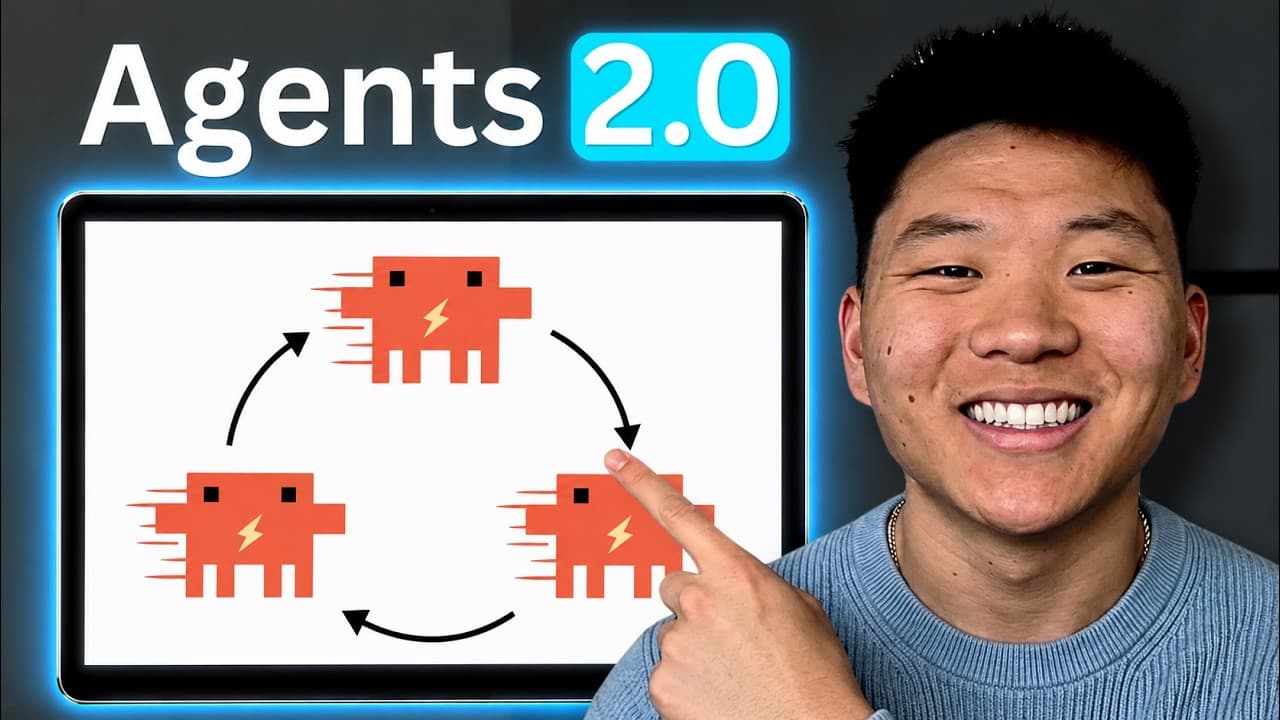
Agent loops improve output by repeatedly reasoning, acting, observing results, and stopping when a defined goal is met. The most important elements are an objective goal and a verifiable definition of done, while elaborate multi-agent fleets are often unnecessary. A single agent with strong checks can handle many workflows effectively.
Transcript
Right here, I've got four different agents that are looping, calling other sub aents, and writing all these prompts for me, and designing systems for me. But is this actually productive, or is that just a cool demo? Here's your monthly reminder that you shouldn't be prompting coding agents anymore. You should be designing loops that prompt your age... Read More
Key Insights
- Loop engineering is the practice of replacing yourself as the person who repeatedly prompts an agent with a system that performs those prompts and iterations. The system receives a purpose, evaluates its progress, and continues working until it reaches an established stopping point.
- An agent loop is a recurring process in which an AI reasons about what to do, acts on that decision, observes the result, and repeats. The process ends when the agent determines through verification that it has satisfied the stated goal and completion criteria.
- The two central pillars of an effective loop are a clearly defined goal and a reliable verification method. The goal specifies the required outcome, while verification allows the agent to decide objectively whether to continue iterating or stop and report completion.
- Verification is the most important part of many agent workflows because AI output is rarely perfect after one attempt. Tests, screenshots, visual reviews, scoring rubrics, or other checks can supply feedback that helps an agent revise its work without repeated human intervention.
- Most tasks do not require a massive architecture or agents operating continuously. A single terminal session with one agent, a strong prompt, and an effective verification process can often perform the required reasoning, implementation, observation, and repetition.
- Agent loop architectures can range from a solo agent to a maker-checker system or a manager with multiple helpers. A solo agent handles the entire cycle, while a maker-checker separates production from grading and feedback.
- Objective stop conditions are more dependable than instructions such as continuing until the agent is satisfied. The strongest loops connect completion to a measurable result, although creative work may still require subjective rubrics or a separately evaluated scoring agent.
- The thumbnail loop generated 10 concepts and scored them for qualities including small-size clarity, curiosity, emotional pull, and visual contrast. It selected three candidates, improved their weakest elements, rescored them, and continued refining the strongest concept before producing the final result.
Install to Summarize YouTube Videos and Get Transcripts
Explore YouTube Video Summarizer or Get YouTube Transcript Extractor
Questions & Answers
Q: What is an AI agent loop?
An AI agent loop is a recurring workflow in which an agent reasons about the next step, acts on that reasoning, observes the result, and repeats the cycle. It continues until a specified goal has been achieved and verified. Instead of requiring a human to review every attempt and provide each follow-up prompt, the loop handles much of that feedback and iteration itself.
Q: How does loop engineering replace repeated human prompting?
Loop engineering replaces repeated human prompting by giving an agent a goal, a process for checking its work, and a condition that determines when it should stop. The agent plans and implements an action, observes the outcome, compares it with the completion criteria, and tries again when necessary. The human defines the desired outcome and the standard for completion rather than directing every revision.
Q: Why is verification important in an agent loop?
Verification tells the agent whether its work actually meets the definition of done. It can involve running a code test, reviewing a screenshot, performing a visual check, or applying a scoring rubric. Without verification, the agent lacks dependable feedback for deciding whether to revise its work or stop, making repeated actions less likely to produce meaningful quality improvements.
Q: How should a stop condition for an agent loop be defined?
A stop condition should be stated as objectively as the task allows. The agent needs a checkable definition of done, comparable to testing whether a cake is finished by inserting a fork and inspecting the result. A measurable target is preferable to an instruction such as continuing until satisfied, because the agent can consistently compare each result with an explicit standard.
Q: Do agent loops require multiple agents working continuously?
Agent loops do not require fleets of agents or continuous operation. Many workflows can be completed with one agent in a single terminal session, provided it can reason, act, observe, verify, and repeat. Agents running on a cadence or in response to events may be more useful than constant activity, especially when around-the-clock work does not match the person's actual needs.
Q: What agent loop architectures can be used?
An agent loop can use a solo structure, a maker-checker arrangement, or a manager with several helpers. In a solo loop, one agent reasons, acts, observes, and repeats. In a maker-checker structure, one agent creates the output and another grades it and supplies feedback. A manager structure uses a primary agent to coordinate helpers while maintaining responsibility for the overall process.
Q: How did the thumbnail agent loop work?
The thumbnail loop created 10 concepts and scored each against a rubric that included clarity at small size, curiosity, emotional pull, and visual contrast. It selected the top three concepts, identified each one's weakest element, improved them, and rescored the revisions. It then continued iterating on the strongest concept, with the demonstrated run taking 27 minutes to produce its final thumbnail.
Q: What was the main weakness of the thumbnail loop?
The thumbnail loop relied on subjective scores and used a stopping instruction based on whether the agent was satisfied. Those conditions are less precise than a measurable completion target. A possible improvement described in the source is to use a separate scoring agent, prompt it specifically for evaluation, and test its scoring ability through multiple evaluations before relying on its judgments.
Summary & Key Takeaways
-
Loop engineering replaces repeated human prompting with a system that gives an agent a goal, lets it determine and perform the next action, checks the result, and repeats as necessary. The agent stops only when it verifies that the output satisfies a clearly stated definition of done.
-
Verification matters more than building an elaborate agent architecture. Many tasks can use a solo loop in one terminal session, while other situations may benefit from a maker-checker arrangement or a manager coordinating helpers. The appropriate structure depends on the task rather than pressure to run agents continuously.
-
The thumbnail example generated 10 concepts, scored them with a rubric, selected the top three, improved their weakest features, rescored them, and iterated on the strongest option. It demonstrated the loop structure, but its subjective scoring and vague stopping rule showed why measurable criteria and reliable evaluators are important.
Read in Other Languages (beta)
Share This Summary 📚
Summarize YouTube Videos and Get Video Transcripts with 1-Click
Try YouTube Summary with ChatGPT & Claude or YouTube Transcript Generator
Explore More Summaries from Nate Herk | AI Automation 📚
Summarize YouTube Videos and Get Video Transcripts with 1-Click
Try YouTube Summary with ChatGPT & Claude or YouTube Transcript Generator