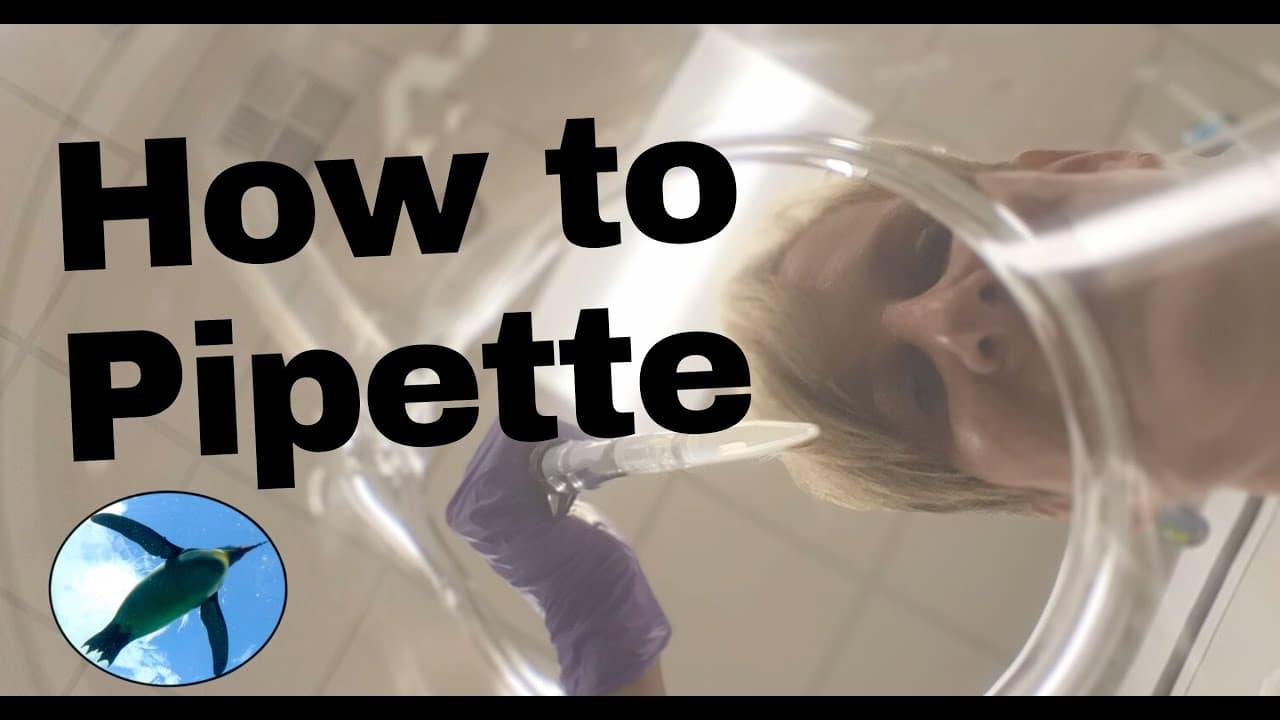
Lab Skills: How to Pipette
TL;DR
Learn about the different types of pipettes, how to read their volumes, adjust them, and use them properly in scientific laboratories.
Transcript
you have used one of these and you have certainly used one of these in a science lab we need to do the same thing to move liquids around but we have to do it with more precision and we use a pipette for that pipette refers to the tube itself the word actually comes from the French meaning little pipe and we also use it as a verb just to make things... Read More
Key Insights
- 🫗 Pipettes are essential tools in scientific laboratories for precise liquid transfer.
- 🧡 Different pipette models have varying volumes and adjustable ranges to cater to different needs.
- 🫠 Reading the volume and adjusting on a pipette requires attention to detail and understanding of place values.
- 💁 Proper technique, such as not touching the pipette tip to the solution's bottom, is crucial to avoid contamination.
- 🔸 Micro pipettors are used for smaller volumes and have specific recommended ranges for accuracy.
- 💁 Ejecting the pipette tip into an appropriate container is important for disposal and preventing contamination.
- 🤩 Practice is key to becoming proficient in using pipettes, as it can initially be challenging to grasp all the details.
Install to Summarize YouTube Videos and Get Transcripts
Explore YouTube Video Summarizer or Get YouTube Transcript Extractor
Questions & Answers
Q: What is a pipette and why is it used in a lab?
A pipette is a tube used to move liquids in a lab. It is used to transfer precise amounts of liquids without contamination or loss.
Q: How do you read the volume on a pipette?
The volume on a pipette is indicated by markings, with each increment representing a specific volume. The user should read the volume at the meniscus of the liquid.
Q: How do you adjust the volume on a pipette?
The volume on a pipette can be adjusted using a plunger or thumb wheel. Larger adjustments are made with the plunger, while fine adjustments are made with the thumb wheel.
Q: What are micro pipettors used for?
Micro pipettors, also known as pipetmen, are used to move small volumes of liquid. They have adjustable ranges and recommended ranges to ensure accurate results.
Summary & Key Takeaways
-
Pipettes are used in science labs to precisely move liquids. They are essentially tubes that create pressure gradients to push and pull liquids.
-
Pipettes come in different sizes, with markings indicating the volume they dispense. They are used with controllers and should never touch the bottom of the solution.
-
For smaller volumes, micro pipettors are used, which have adjustable ranges and recommended ranges for accurate results.
Read in Other Languages (beta)
Share This Summary 📚
Summarize YouTube Videos and Get Video Transcripts with 1-Click
Try YouTube Summary with ChatGPT & Claude or YouTube Transcript Generator
Explore More Summaries from ThePenguinProf 📚





Summarize YouTube Videos and Get Video Transcripts with 1-Click
Try YouTube Summary with ChatGPT & Claude or YouTube Transcript Generator