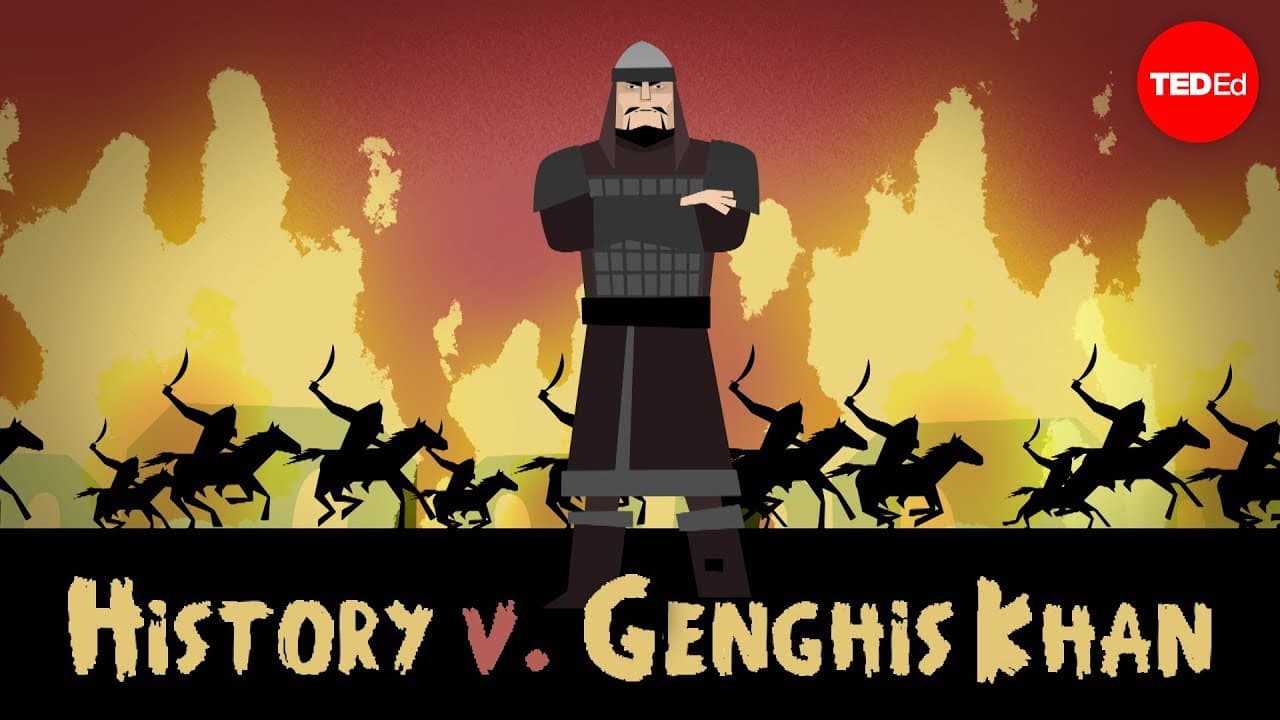
History vs. Genghis Khan - Alex Gendler
TL;DR
Genghis Khan united warring Mongol clans to create the largest empire in history, but his conquests caused the deaths of millions. His legacy is complex; while known for brutality, he also enforced loyalty and justice among his enemies, promoted religious tolerance, and fostered cultural exchange across Eurasia.
Transcript
He was one of the most fearsome warlords who ever lived, waging an unstoppable conquest across the Eurasian continent. But was Genghis Khan a vicious barbarian or a unifier who paved the way for the modern world? We'll see in "History vs. Genghis Khan." "Order, order. Now who's the defendant today? Khan!" "I see Your Honor is familiar with Gengh... Read More
Key Insights
- 🫱 Genghis Khan overcame adversity as a child to become one of the greatest leaders in history, uniting warring clans to create an empire that stretched across Eurasia.
- 🌸 The loss of population in Northern China was a result of the Jin Dynasty's harassment and rebellion, rather than solely Genghis Khan's atrocities.
- 👮 The Mongol Empire practiced religious tolerance, treated soldiers well, promoted based on merit, and enforced rule of law, contributing to cultural exchange and the development of unified states.
- 🥺 The intentional spread of the Black Plague by the Mongols is uncertain, but the siege of Kaffa did lead to the spread of the disease to Europe.
- 🎙️ More videos with Genghis Khan:
Install to Summarize YouTube Videos and Get Transcripts
Explore YouTube Video Summarizer or Get YouTube Transcript Extractor
Questions & Answers
Q: Was Genghis Khan a vicious barbarian or a unifier who paved the way for the modern world?
Genghis Khan can be seen as both. He was a fearsome warlord who caused the deaths of millions, but he also united warring Mongol clans and created a vast empire that promoted religious tolerance, treated soldiers well, and enforced universal rule of law.
Q: Did Genghis Khan intentionally spread the Black Plague to Europe?
While it is true that the Mongols catapulted infected bodies over city walls during the siege of Kaffa, it is uncertain whether it was intentional or simply an attempt to undermine their enemies. Additionally, the accounts of the event were written long after to serve as negative portrayals of the Mongols.
Q: Did Genghis Khan's conquests have any positive effects?
Yes, the Mongol Empire promoted cultural exchange and trade along the Silk Road, leading to the flourishing of knowledge and the development of unified states like Russia and China. Genghis Khan's descendants also had an influence on ruling noble families across Eurasia.
Q: How did Genghis Khan treat women in his empire?
While Genghis Khan's army was brutal in many ways, women in the Mongol ranks actually had more rights and control over domestic affairs than most women of that time. They could divorce their husbands, were trusted advisors, and Genghis Khan remained loyal to his first wife throughout his life.
Summary
In this video, the debate revolves around whether Genghis Khan was a vicious barbarian or a unifier who paved the way for the modern world. The video presents arguments and counter-arguments regarding Genghis Khan's military conquests, the brutality of his army, his treatment of women, the casualties of his descendant's conquests, the intentional spreading of the Black Plague, religious tolerance, and the impact on culture and civilization. The video raises questions about the reliability of historical accounts, the balance between a leader's significance and the deaths caused in their wake, and the lasting legacy of conquerors.
Questions & Answers
Q: Was Genghis Khan a vicious barbarian or a unifier?
Genghis Khan was a great leader who overcame constant strife to unite warring Mongol clans and forge the greatest empire the world had seen at that time. His military campaigns were aimed at unifying the Mongols and expanding their territories. While his conquests were brutal, it is important to consider the historical context and the actions of other medieval armies. Genghis Khan's atrocities were not uncommon for his time and should be seen in relation to other leaders and their armies.
Q: What led Genghis Khan to invade Northern China?
The Jin Dynasty had long harassed the northern tribes, paying them off to fight each other and periodically attacking them. Genghis Khan sought to avoid suffering the same fate as the last Khan who tried to unite the Mongols. The demographic changes observed, such as the loss of population in Northern China, may also be explained by poor census keeping and the fact that many peasants were brought into the Khan's army.
Q: Did Genghis Khan's army go beyond justice?
While Genghis Khan preferred enemies to surrender and pay tribute, he believed in loyalty and diplomatic law. The cities that were massacred were ones that rebelled after surrendering or killed ambassadors. However, multiple accounts suggest brutality beyond justice, such as ripping unborn children from mothers' wombs or using prisoners as human shields. It is important to note that these accounts were written over a hundred years after the fact and may not be entirely reliable.
Q: What were the benefits of Genghis Khan's empire?
Despite the casualties caused by Genghis Khan's descendants' conquests, the Mongol Empire practiced religious tolerance, treated their soldiers well, promoted based on merit, established a vast postal system, and enforced the universal rule of law. They also made significant contributions to culture by saving doctors, scholars, and artisans from conquered places and spreading knowledge throughout their realm.
Q: Did Genghis Khan intentionally spread the Black Plague?
When the Mongols saw their own troops dying of the Plague during the Golden Horde's Siege of Kaffa, they catapulted infected bodies over the city walls. While this indicates a level of intent, it is important to consider that the accounts referencing this were written long after the fact. The actual extent of intentionality is debatable.
Q: Did Genghis Khan's conquests lead to devastation and the Dark Ages in certain regions?
While there were instances of devastation, such as the annihilation of Baghdad, Mongol rule provided stability that allowed the Silk Road to flourish. This facilitated trade and cultural exchange between East and West, contributing to the Renaissance in Western Europe. Moreover, the Mongol legacy forged unified states like Russia and China out of warring princedoms. Genghis Khan's descendants even became ruling nobility in various parts of Eurasia.
Q: Can a leader's historical or cultural significance outweigh the deaths they caused?
This is a complex question that elicits different perspectives. While Genghis Khan's conquests had a significant death toll, his military and administrative prowess, religious tolerance, contributions to culture, and the lasting impact on civilizations such as Russia and China cannot be ignored. Whether one believes the deaths caused can be outweighed by these factors is subjective and open to interpretation.
Q: How reliable are historical accounts about Genghis Khan?
Many historical accounts were written long after the events they describe, making their reliability questionable. Additionally, the bias of authors and the long-term effects of Genghis Khan's rule on the surviving population may have influenced the written record. It is important to approach these accounts with skepticism and consider varying perspectives.
Q: What is the significance of a conqueror's legacy in history?
Conquerors like Genghis Khan leave a lasting legacy that shapes the course of history. They are often remembered for their military successes and the empires they built. However, the impact of their conquests on the conquered population should not be neglected. The conqueror's legacy should be viewed in relation to both their achievements and the consequences of their actions.
Q: How many people are believed to be descendants of Genghis Khan today?
It is estimated that around 16 million men today, which accounts for around one in every 200 men, are descended from Genghis Khan. This significant number highlights the widespread genetic influence of his lineage and the lasting impact of his reign.
Takeaways
The debate surrounding Genghis Khan's legacy raises important questions about the balance between a leader's significance and the losses inflicted during their reign. It challenges us to consider the historical context and weigh the achievements against the consequences. While Genghis Khan's conquests were undoubtedly brutal and caused significant casualties, his contributions to administration, culture, religious tolerance, and the lasting impact on unified states call for a nuanced interpretation of his historical significance. Ultimately, the stories that survive and the judgments we make about historical figures are shaped by the perspectives and biases of those who record and interpret history.
Summary & Key Takeaways
-
Genghis Khan, born as Temüjin, overcame adversities and united Mongol clans to form the greatest empire stretching from the Pacific to Europe's heartland.
-
The Khan's invasion and slaughter led to the loss of 2/3 of the population in Northern China, but it was in response to the Jin Dynasty's harassment and rebellion.
-
While Genghis Khan's army was ruthless, his strict understanding of justice and loyalty to surrendering enemies differentiated him from other medieval armies.
Read in Other Languages (beta)
Share This Summary 📚
Summarize YouTube Videos and Get Video Transcripts with 1-Click
Try YouTube Summary with ChatGPT & Claude or YouTube Transcript Generator
Explore More Summaries from TED-Ed 📚





Summarize YouTube Videos and Get Video Transcripts with 1-Click
Try YouTube Summary with ChatGPT & Claude or YouTube Transcript Generator