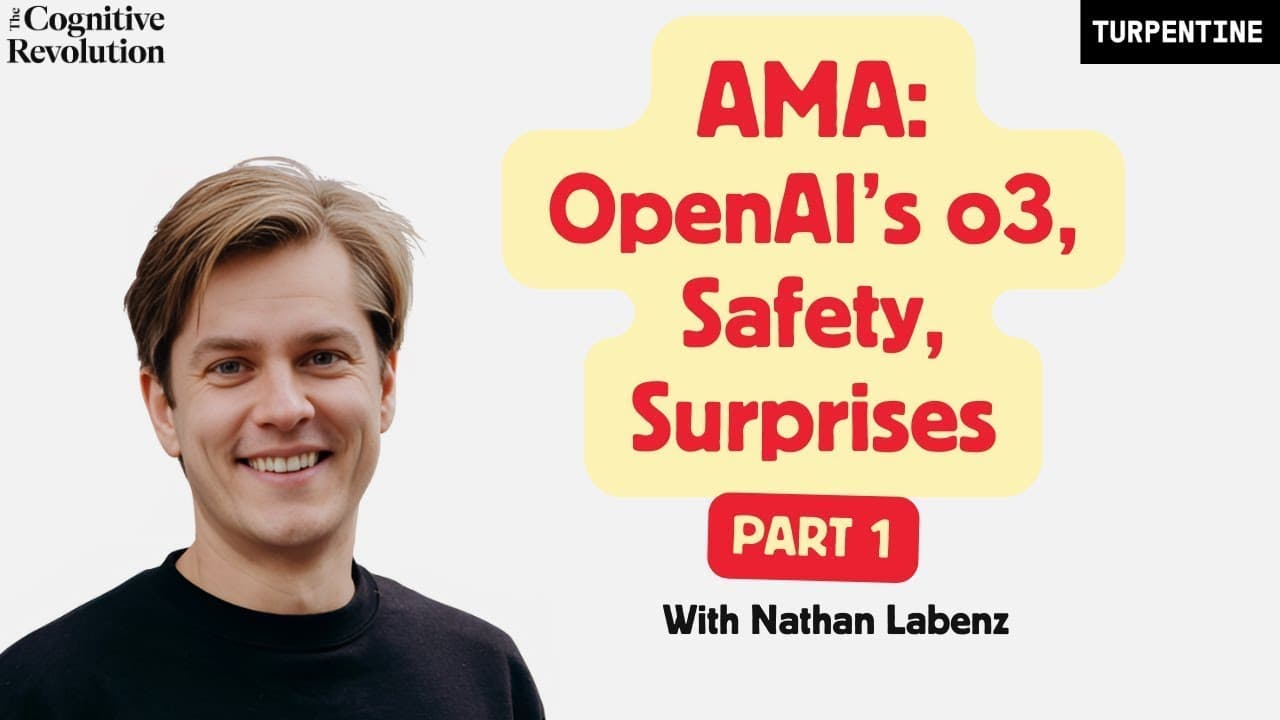
AI AMA – Part 1: OpenAI’s o3, Deliberative Alignment, and AI Surprises of 2024
TL;DR
Exploring AI advancements, safety, and education impacts in 2024.
Transcript
even with these reasoning models they are still weird they are still subject to sort of cached heris they're subject to bad perception they're subject to just like straight up bad reasoning and you can expose that in simple toy examples we hope the underlying reality is such that these things are like pretty manageable because we're not you know ta... Read More
Key Insights
- OpenAI's o3 models have shown impressive benchmark results, indicating advancements in AI reasoning and performance.
- The deliberative alignment safety plan by OpenAI aims to integrate policies into AI models for safer AI behavior.
- AI's impact on education is significant, offering personalized learning experiences, but adoption in classrooms remains slow.
- Programming and coding careers may see changes due to AI advancements, prompting individuals to pursue intrinsic interests.
- Reinforcement learning and efficiency improvements are driving AI models to achieve surprising and sometimes inscrutable results.
- The debate on AI's role in society continues, with discussions on its potential to democratize technology or concentrate power.
- AI's ability to handle large context windows and complex tasks is improving, yet practical applications in everyday workflows lag.
- Future AI developments may include more autonomous agents and applications, enhancing productivity and problem-solving capabilities.
Install to Summarize YouTube Videos and Get Transcripts
Explore YouTube Video Summarizer or Get YouTube Transcript Extractor
Questions & Answers
Q: What is the significance of OpenAI's o3 models?
OpenAI's o3 models represent a significant advancement in AI reasoning and performance, achieving high scores on various benchmarks. These models demonstrate improved capabilities in handling complex tasks and reasoning, which could lead to transformative changes across multiple industries. Their development suggests that AI is becoming more adept at problem-solving and decision-making, potentially influencing areas such as education, coding, and business processes.
Q: How does OpenAI's deliberative alignment plan aim to improve AI safety?
OpenAI's deliberative alignment plan seeks to improve AI safety by integrating detailed policies into AI models. This approach involves using a purely helpful model to generate responses based on a predefined policy, which is then evaluated and fine-tuned to align with desired behaviors. The goal is to create AI systems that can adhere to specific guidelines, reducing risks associated with AI deployment and ensuring that AI actions are consistent with human values and safety standards.
Q: What impact could AI have on education?
AI has the potential to revolutionize education by providing personalized learning experiences and real-time tutoring. Advanced AI models can offer tailored support to students, helping them understand complex subjects and improve their learning outcomes. However, the integration of AI in classrooms is progressing slowly, with challenges related to adoption, teacher training, and resistance to change. The future of AI in education depends on how effectively these challenges are addressed and the willingness of educational institutions to embrace new technologies.
Q: Should individuals still pursue coding careers in light of AI advancements?
The decision to pursue a coding career should be based on individual interests and motivations rather than solely on market trends. While AI advancements are changing the landscape of programming, there are still opportunities for those passionate about coding to thrive. AI can enhance coding skills by providing tools and support, making it easier to learn and apply programming concepts. However, individuals should consider their long-term goals and intrinsic motivations when deciding on a career path, as AI may continue to evolve and impact various industries.
Q: What are the potential societal implications of AI's continued advancement?
AI's continued advancement raises important questions about its role in society, including concerns about democratization versus concentration of power. On one hand, AI could democratize access to technology and resources, allowing more people to benefit from its capabilities. On the other hand, there is a risk that AI could concentrate power in the hands of a few organizations or individuals, leading to inequality and ethical concerns. The societal implications of AI depend on how it is developed, regulated, and integrated into various sectors.
Q: How might AI models become 'weirder' in 2025?
As AI models continue to advance, particularly with reinforcement learning and efficiency improvements, they may exhibit behaviors that are surprising or inscrutable to humans. This 'weirdness' could manifest in unexpected solutions to problems or strategies that deviate from human logic. Such developments might lead to increased scrutiny and debate about AI's decision-making processes and the transparency of its actions. Understanding and managing this 'weirdness' will be crucial for ensuring AI's safe and effective integration into society.
Q: What are the challenges in deploying AI effectively in real-world applications?
Deploying AI effectively in real-world applications involves overcoming challenges related to integration, cost, and user acceptance. While AI models have shown impressive capabilities, practical implementation often lags due to issues such as high computational costs, lack of understanding of best practices, and resistance from users who may be skeptical of AI's reliability. Addressing these challenges requires a focus on developing user-friendly applications, educating stakeholders about AI's potential, and ensuring that AI solutions are cost-effective and scalable.
Q: What future trends can we expect in AI development and deployment?
Future trends in AI development and deployment are likely to include the rise of autonomous agents, improved reasoning capabilities, and the integration of AI into more complex workflows. As AI models become more sophisticated, they will be able to handle a wider range of tasks with greater autonomy, potentially transforming industries such as healthcare, finance, and education. Additionally, advancements in AI safety and alignment will be crucial for ensuring that AI systems operate within ethical and societal boundaries, minimizing risks and maximizing benefits.
Summary & Key Takeaways
-
The episode discusses OpenAI's o3 models, which have achieved significant benchmark advancements, showcasing improvements in AI reasoning and performance. These models are expected to influence various sectors, including education and coding careers, by offering new capabilities and efficiencies.
-
OpenAI's new safety plan, deliberative alignment, focuses on integrating policies into AI models to ensure safer behavior. This approach aims to align AI actions with predefined guidelines, potentially transforming how AI is deployed across different domains.
-
The discussion highlights AI's potential impact on education, offering personalized learning experiences and tutoring. However, the adoption of AI in classrooms is slow, and there are concerns about AI's influence on traditional education systems and career choices.
Read in Other Languages (beta)
Share This Summary 📚
Summarize YouTube Videos and Get Video Transcripts with 1-Click
Try YouTube Summary with ChatGPT & Claude or YouTube Transcript Generator
Explore More Summaries from Cognitive Revolution "How AI Changes Everything" 📚





Summarize YouTube Videos and Get Video Transcripts with 1-Click
Try YouTube Summary with ChatGPT & Claude or YouTube Transcript Generator