How Can 3D Printing Enhance Virtual Reality?
TL;DR
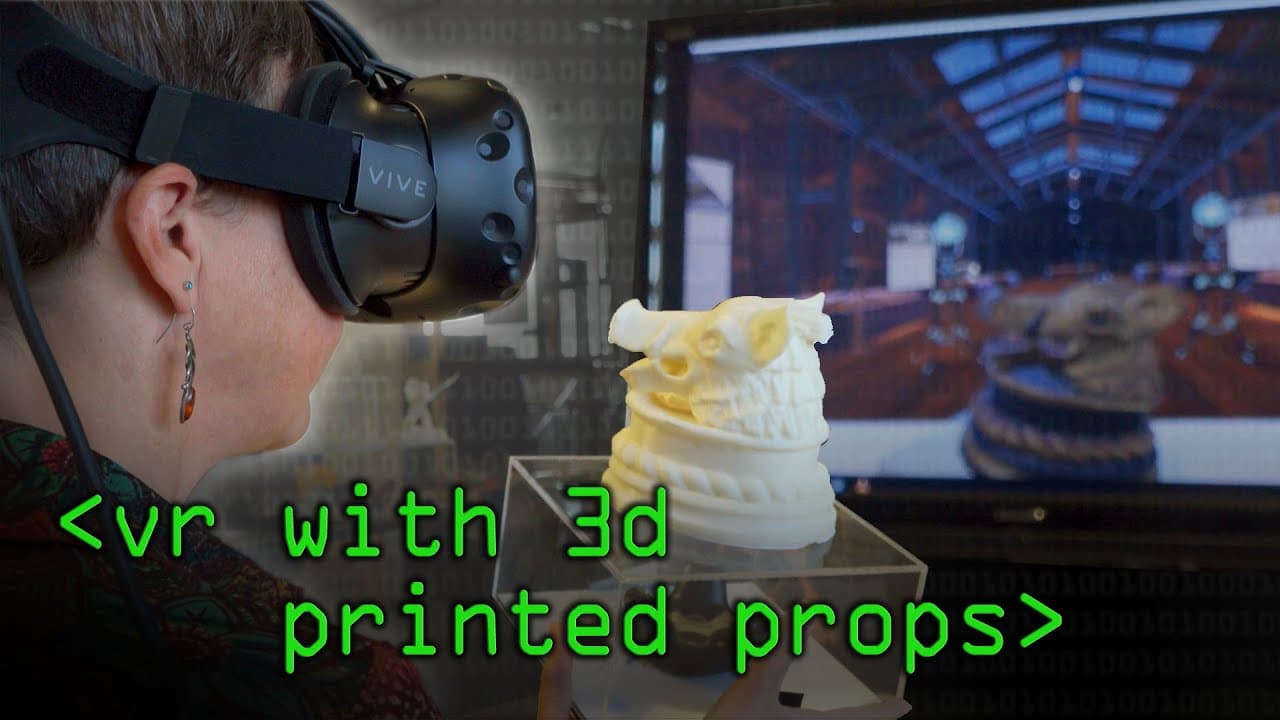
3D printing enhances virtual reality by allowing users to interact with physical replicas of scanned objects in a digital environment. The video explores the technologies used to track these objects and the innovations of combining real and virtual worlds, providing unique experiences that expand access to previously unreachable museum collections.
Transcript
we're in the mixed reality lab of the university of nottingham's computer science school and this is actually the lab space where quite a few things happen so it's in a state of perpetual mess and chaos but this is the little uh piece of santee we've carved out we grab the space to set up a virtual reality bay running off a vive which is usually we... Read More
Key Insights
- 🤗 The Vive virtual reality system is preferred over other options due to its open nature and compatibility with accessories like the Vive tracker.
- 💦 Various technologies are used to locate physical objects in virtual reality, but indoor GPS technology is still a work in progress.
- 🎁 3D printing scanned models presents challenges as the models often require cleanup and fixes to be suitable for printing.
- 💪 Different 3D printing technologies, such as sintering, offer highly detailed and strong prints, but they are not yet widely accessible.
- 🍱 In cases where 3D printing is not feasible, placing a tracker inside an acrylic box provides a compromise for interacting with virtual objects.
- 👻 Virtual reality experiences are created using the Unity game engine, which allows for the integration of various elements and easy development.
- 👻 The ability to virtually interact with objects expands access to museum collections and allows for unique experiences that would not be possible in traditional museum settings.
Install to Summarize YouTube Videos and Get Transcripts
Explore YouTube Video Summarizer or Get YouTube Transcript Extractor
Questions & Answers
Q: Why do they prefer using the Vive virtual reality system over other options like Oculus?
The Vive system is preferred because it offers more open development possibilities, allowing for the use of accessories like the Vive tracker to enhance virtual reality interactions.
Q: How do they locate physical objects in virtual reality?
Locating physical objects is achieved through technologies like ultra-wideband tracking, timer flight, and optical tracking. These methods help determine the position of the object in space for accurate overlaying of photorealistic scans.
Q: Why is the ability to haptically experience objects in different scales significant?
Being able to interact with objects at different scales in virtual reality provides a unique experience. It allows users to explore miniatures or larger objects that wouldn't be physically accessible and enables new forms of interaction and immersion.
Q: How do they address issues with line of sight and occlusion in tracking physical objects?
To overcome issues with line of sight, the lab places the tracking devices inside boxes, enabling the tracking to work seamlessly while preventing the trackers from being occluded by the user's hand. This solution is commonly used for practical benefits.
Summary & Key Takeaways
-
The video showcases the mixed reality lab at the University of Nottingham, where they use the Vive virtual reality system for development due to its open nature.
-
The lab focuses on scanning physical objects, 3D printing them, and overlaying photorealistic scans onto the printed objects for unique virtual reality interactions.
-
Various technologies are utilized to locate physical objects in space, and the possibilities of haptic interactions and experiencing objects at different scales are explored.
Read in Other Languages (beta)
Share This Summary 📚
Summarize YouTube Videos and Get Video Transcripts with 1-Click
Try YouTube Summary with ChatGPT & Claude or YouTube Transcript Generator
Explore More Summaries from Computerphile 📚


Summarize YouTube Videos and Get Video Transcripts with 1-Click
Try YouTube Summary with ChatGPT & Claude or YouTube Transcript Generator