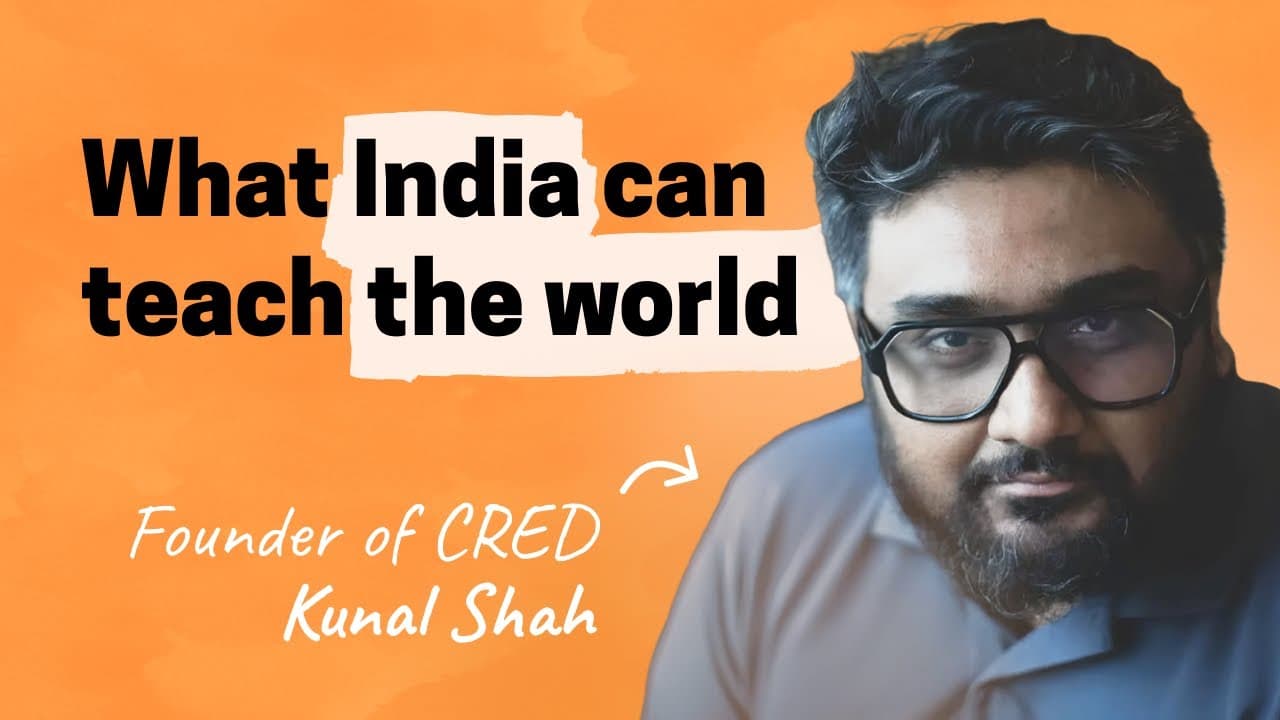
Kunal Shah on Building Products That Win in India
TL;DR
A product becomes compelling when users rate its efficiency at least four points above the existing solution. Kunal Shah calls this the Delta 4 framework, which predicts irreversible adoption, tolerance for occasional failure, organic recommendations, and lower customer acquisition costs. He also argues that success in India requires understanding local attitudes toward trust, risk, time, daily usage, and monetization.
Transcript
Microsoft, Adobe, Alphabet, IBM, Palo Alto Networks, even Starbucks, the CEOs of these companies were all born in India and immigrated to the US. A lot of CEOs have done well because they follow the “dharma” of the founders quite well. “These are the principles that were given to me and I'm going to sustain this and make it even bigger.” I wa... Read More
Key Insights
- The Delta 4 framework is a measurable test that compares the efficiency of an existing solution with a new product on a ten-point scale. A product reaches Delta 4 when users rate the new experience at least four points higher than the previous method.
- Delta 4 products are difficult to abandon because their efficiency advantage makes adoption effectively irreversible. Shah illustrates this with app-based transportation, which can remain preferable to traditional cab access even when the service occasionally fails or creates inconvenience.
- User tolerance is greater when a product delivers a large efficiency improvement. Customers may forgive occasional problems with a Delta 4 experience, while products offering only a marginal advantage receive little tolerance because returning to the previous behavior remains easy.
- A Unique Brag-worthy Proposition is the natural desire to tell others about a significantly more efficient experience. Shah argues that people cannot stop sharing Delta 4 products, allowing recommendations and demonstrations to replace some paid customer acquisition.
- Technology does not automatically improve efficiency. Buying a suit online can use sophisticated technology while producing an experience no better than, or worse than, purchasing one offline, particularly when fit and the final result matter more than transactional convenience.
- The Delta 4 test is applicable to individual features, complete products, and businesses. Teams can score the current and proposed experiences before investing heavily, helping them identify whether the improvement is large enough to overcome customers' limited time and existing habits.
- India presents distinct product-building conditions involving trust, risk aversion, perceptions of time, usage, and monetization. The conversation emphasizes that companies may grow daily active users quickly without producing similar growth in average revenue per user, which affects viable business models.
- India's startup environment is changing as founders gain respect, unicorns receive public recognition, and the country observes a National Startup Day. Shah says the current generation must prove that Indian startups can become very large, profitable companies.
Install to Summarize YouTube Videos and Get Transcripts
Explore YouTube Video Summarizer or Get YouTube Transcript Extractor
Questions & Answers
Q: What is Kunal Shah's Delta 4 framework?
The Delta 4 framework measures whether a new product creates a sufficiently large efficiency improvement over an existing solution. Users score both experiences on a ten-point scale, and the new option should rank at least four points higher. Shah presents this test as a more concrete alternative to saying that a product must be ten times better without defining how that claim can be measured.
Q: How do you apply the Delta 4 framework to a product?
First, ask users to score the efficiency of their current method on a ten-point scale. Then ask them to score the proposed product or experience using the same scale. If the new solution scores at least four points higher, it meets the Delta 4 threshold. The framework can evaluate an individual feature, a complete product, or an entire business model.
Q: Why do Delta 4 products spread through word of mouth?
Delta 4 products create an improvement that feels striking enough for customers to demonstrate or recommend to other people. Shah calls this quality a Unique Brag-worthy Proposition. Because users naturally share the experience, the company can acquire customers through personal recommendations rather than depending entirely on advertising or performance marketing, resulting in lower or sometimes zero customer acquisition costs.
Q: Why do users tolerate failures in Delta 4 products?
Users tolerate occasional failures because the new product remains substantially more efficient than the old alternative. Shah uses app-based transportation as an example: a service failure may be frustrating, but it does not necessarily persuade a customer to return permanently to the traditional cab experience. The four-point efficiency advantage gives the product room to disappoint occasionally without losing its underlying appeal.
Q: Does adding technology always make a product more efficient?
Adding technology does not guarantee a better overall experience. Shah discusses buying a suit online as an example: the digital transaction may appear convenient, but poor fit can make the final outcome no better than buying offline. If the efficiency difference is below four points, adoption remains reversible, customers have little tolerance for failure, and they are unlikely to recommend the product enthusiastically.
Q: Why might a slightly better product fail to gain adoption?
A slightly better product may not justify the attention, effort, or behavioral change required from busy customers. People already have established products, applications, and habits, so a modest improvement gives them little reason to investigate or switch. Under the Delta 4 framework, an advantage below four points is reversible and produces neither strong loyalty nor meaningful tolerance when the new experience fails.
Q: What makes building products for India different?
Building for India requires understanding conditions that may differ from those in the United States and other markets. The conversation identifies trust as essential, describes many consumers as more risk-averse, and notes that the concept of time is not the same. It also highlights a commercial challenge: companies can grow daily active users without achieving comparable growth in average revenue per user.
Q: What opportunity does Kunal Shah see for Indian startups?
Shah sees a changing environment in which founders are respected, unicorns are celebrated, and India has a National Startup Day. He believes the present generation of founders must demonstrate that Indian startups can become very large, profitable companies. Despite the challenges of trust, risk aversion, and monetization, he says he would not want to be anywhere else while building a company.
Summary & Key Takeaways
-
Kunal Shah presents Delta 4 as a measurable alternative to claiming that a product is ten times better. Teams compare the efficiency of an existing behavior with their proposed solution on a ten-point scale. A difference of at least four indicates that the new behavior has a strong chance of lasting.
-
Products that achieve Delta 4 tend to produce three outcomes: adoption becomes difficult to reverse, users tolerate occasional failures, and customers naturally share the experience. Shah calls the third outcome a Unique Brag-worthy Proposition. These recommendations can reduce customer acquisition costs because discovery happens through people rather than paid advertising alone.
-
Building in India requires attention to market characteristics that may differ from those of the United States and other countries. The conversation highlights trust, risk aversion, approaches to time, and the gap between growing daily active users and increasing average revenue per user. These factors shape product design and business strategy.
Read in Other Languages (beta)
Share This Summary 📚
Summarize YouTube Videos and Get Video Transcripts with 1-Click
Try YouTube Summary with ChatGPT & Claude or YouTube Transcript Generator
Explore More Summaries from Lenny's Podcast 📚






Summarize YouTube Videos and Get Video Transcripts with 1-Click
Try YouTube Summary with ChatGPT & Claude or YouTube Transcript Generator