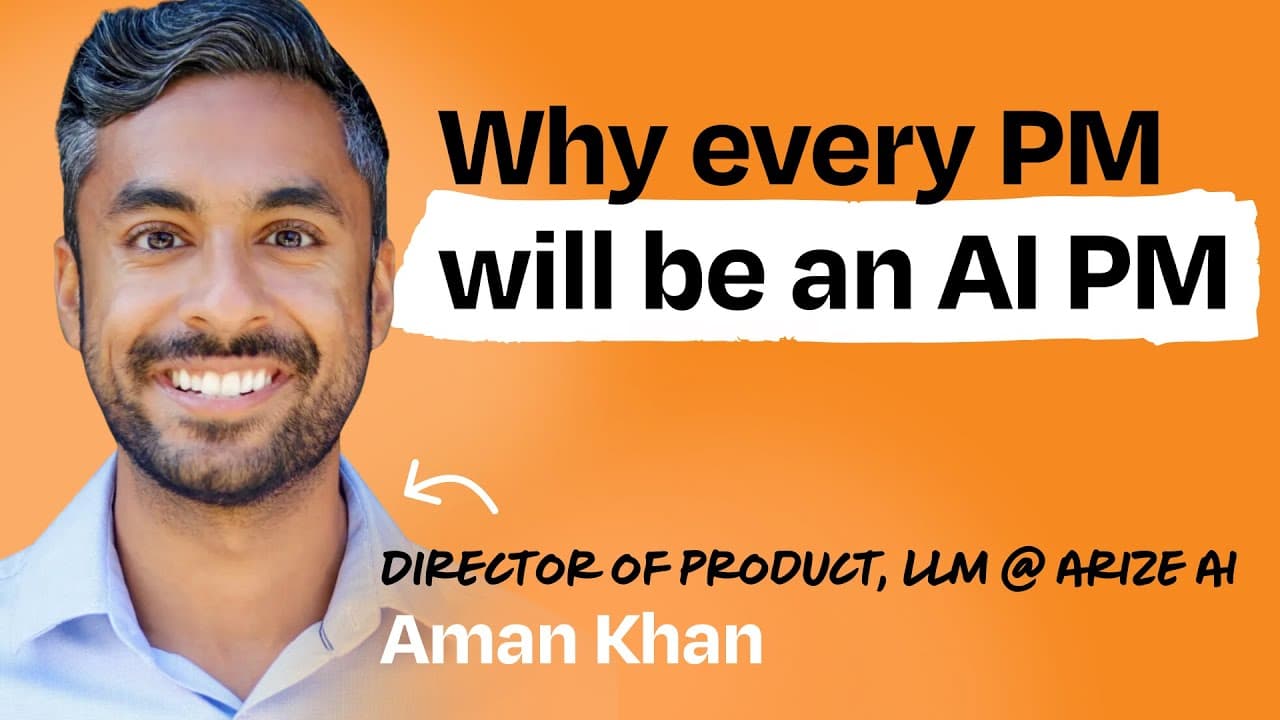
How to Become an AI Product Manager: Aman Khan's Guide
TL;DR
Breaking into AI product management is now easier than before because tools like tutorials on building an app in an hour lower the barrier that once required a machine learning background. Aman Khan describes three flavors of AI PM: platform PMs building tools for AI engineers, product PMs whose core experience is model-powered, and AI-powered PMs who use AI across their existing workflow.
Transcript
What if the product manager came to the meeting with prototypes? What if you come to the design team and instead of a PRD, you actually already have your mocks? With AI, it's super feasible for a product manager to come to a meeting and say, hey, I already have some ideas here. I wanted to mock them up this way. They're probably wrong, but ... Read More
Key Insights
- Breaking into AI product management is arguably easier now than before, because tutorials showing how to build an app in an hour lower the barrier that previously required a machine learning foundation to get hired at AI companies.
- A product manager is responsible for bringing together design, engineering, biz dev, operations, and sales to ship impact, representing the customer and getting to a solution that solves their problems, with the AI component layered on top.
- AI platform PMs build tools for AI engineers, such as observability and evaluation platforms, helping engineers understand whether their app is doing what they expect and proving that impact to leadership.
- AI product PMs work where the core product is centered around AI, like ChatGPT or NotebookLM, packaging model technology built by researchers and engineers to make it consumable for consumers, businesses, or enterprises.
- AI-powered PMs are enabled by AI technology across the entire stack of their existing role, using large language models to build experiences without building the core model from the ground up.
- The tooling space for building on large language models is nascent and clunky, since people have only been building on top of LLMs for a couple of years, making the interfaces early and unrefined.
- AI will eventually be as common as the database is for SaaS applications, meaning most PMs in the near future will likely become one flavor of AI product manager.
- AI makes it feasible for a product manager to arrive at a meeting with prototypes and mocks instead of a PRD, so the starting point is higher resolution even if the ideas are probably wrong.
Install to Summarize YouTube Videos and Get Transcripts
Explore YouTube Video Summarizer or Get YouTube Transcript Extractor
Questions & Answers
Q: What is an AI product manager?
An AI product manager is a PM whose role incorporates artificial intelligence. Like any product manager, they bring together design, engineering, biz dev, operations, and sales to ship impact and represent the customer in solving their problems. The AI component layers on top of this, and Aman Khan breaks it into three flavors: AI platform PMs, AI product PMs, and AI-powered PMs, each defined by how central AI is to what they build.
Q: How can someone break into AI product management?
It is counterintuitively easier now to break into AI product management than before, according to Aman Khan. Previously you needed a foundation and background in machine learning to get a shot at companies building AI products. Today, resources like YouTube videos showing how to build an app in an hour, which would not have been possible even a year ago, lower the barrier and give aspiring AI PMs a more accessible starting point to learn and demonstrate capability.
Q: What are the three types of AI product managers?
Aman Khan describes three flavors. AI platform PMs build tools for AI engineers, such as observability and evaluation platforms. AI product PMs work where the core product is centered around AI, like ChatGPT or NotebookLM, packaging model technology for consumers or businesses. AI-powered PMs are enabled by AI across their existing product workflow, using models to build customer experiences without building the core model themselves.
Q: What does an AI platform product manager do?
An AI platform product manager builds tools for AI engineers. Aman Khan works at Arize, an observability and evaluation platform for artificial intelligence that started with machine learning models like ranking, regression, and classification, and has pivoted toward large language models. The role focuses on enabling AI engineers to understand their app's impact and helping AI PMs at customer companies prove to leadership that their app is doing what they expect on the end business.
Q: What is an AI-powered product manager?
An AI-powered product manager is enabled by AI technology across the entire stack of the role they already do as a PM. They are not responsible for building the core model from the ground up and may lack access to research teams like those at Google or OpenAI, but they can still use large language models or any models to build the best experience for their customers. Aman Khan expects many PMs to trend toward this as AI becomes more pervasive.
Q: How does AI change how a product manager works in meetings?
With AI, it is feasible for a product manager to come to a meeting already having mocked up prototypes instead of bringing a PRD to the design team. The PM can say they already have some ideas and mocked them up a certain way. The ideas are probably wrong, but the starting point now looks a little bit higher resolution, giving the team a more concrete basis to react to and iterate from.
Q: Why is the tooling for building AI applications still early?
The tooling for building on large language models is nascent and pretty clunky because the interfaces are new. People have only really been building on top of large language models for a couple of years, so the whole space is early. Tools used to build on top of models and answer the question 'is my app doing the thing I expect it to do' are still very immature, which is exactly the gap Aman Khan's work at Arize aims to address.
Q: Why does Aman Khan believe most PMs will become AI product managers?
Aman Khan believes AI will become as common as the database is for SaaS applications, making it a pervasive part of technology. Because of this, he sees most PMs in the near future becoming one flavor of AI product manager, whether building tools for other companies deploying AI, working behind cutting-edge models like the next NotebookLM, or building around a transformer or GPT model that does part of the work needed to solve a customer's problem.
Summary & Key Takeaways
-
Aman Khan, Director of Product at Arize AI with prior roles at Spotify's ML platform team, Cruise, Zipline, and Apple, has intentionally stayed an individual contributor his whole career. The conversation covers how to get into AI, how to thrive as an AI PM, and how to succeed long-term as an IC.
-
Khan breaks AI product management into three flavors: platform PMs who build tools for AI engineers, product PMs whose core experience is powered by the underlying model, and AI-powered PMs who use AI across their existing product workflow. He places himself in the platform category at Arize.
-
Breaking into AI PM is counterintuitively easier now than before, since resources like build-an-app-in-an-hour videos remove the need for a deep machine learning background. Khan predicts AI will become as ubiquitous as the database for SaaS, so most PMs will eventually become some flavor of AI product manager.
Read in Other Languages (beta)
Share This Summary 📚
Summarize YouTube Videos and Get Video Transcripts with 1-Click
Try YouTube Summary with ChatGPT & Claude or YouTube Transcript Generator
Explore More Summaries from Lenny's Podcast 📚



Summarize YouTube Videos and Get Video Transcripts with 1-Click
Try YouTube Summary with ChatGPT & Claude or YouTube Transcript Generator