How to choose relational vs non relational databases
TL;DR
Relational databases store data in structured tables with primary keys and defined relationships, enabling data consistency and easy backup. Non relational databases use flexible models like key value, column store, graph, and document stores, offering scalability and flexibility for different use cases. Both types serve different workloads depending on structure, access patterns, and growth needs.
Transcript
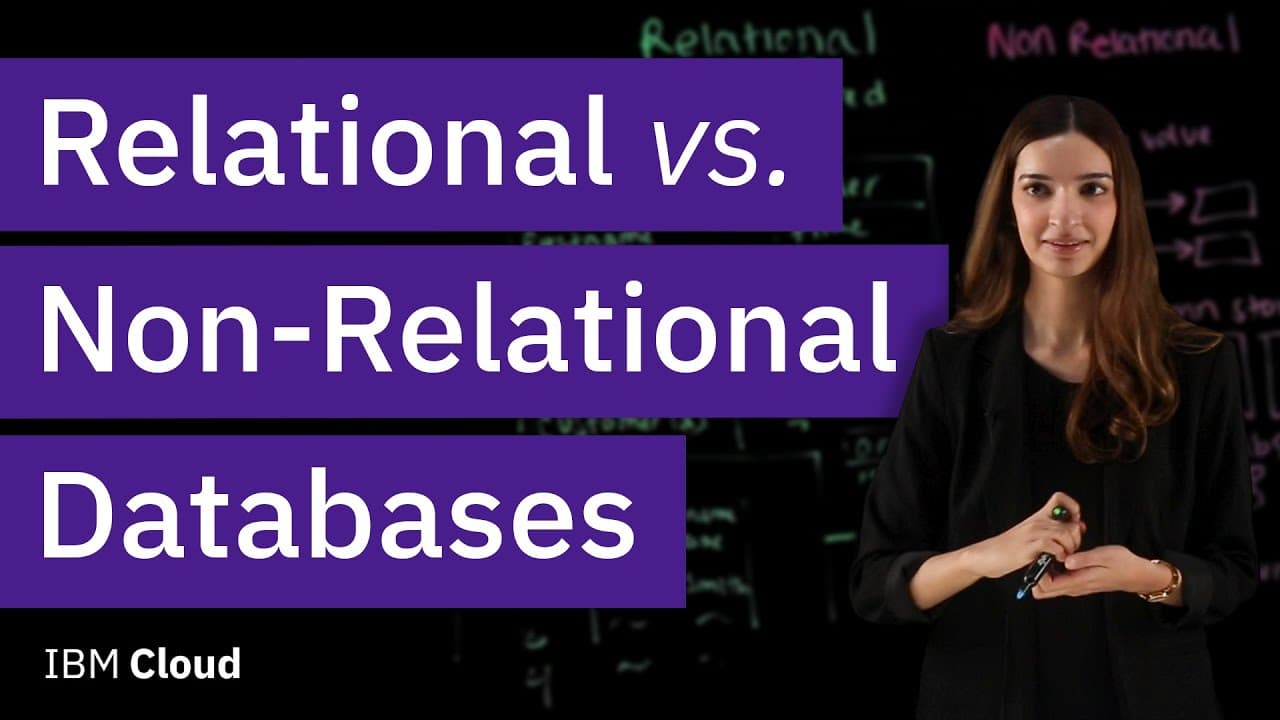
Hi, everyone. Today I'm going to be talking to you about relational versus non-relational databases. These are two different ways in which clients store the data that they have and operationalize it. And we know there is so much data that is coming into every single company today that it's important that customers have options for how they want to ... Read More
Key Insights
- Relational databases store data in tables and connect them via relations, enabling structured data management.
- A primary key uniquely identifies each record in a table, ensuring data integrity across the database.
- Foreign keys link related data across tables, creating a navigable data network.
- Relational databases emphasize data consistency, security, and easy backup and recovery.
- Non relational databases break from rigid structure and offer flexible data models.
- Types of non relational databases include key value, column store, graph, and document stores.
- Non relational options scale horizontally and can be more cost effective at large scale.
- Choosing between relational and non relational depends on workload, application needs, and desired flexibility.
Install to Summarize YouTube Videos and Get Transcripts
Explore YouTube Video Summarizer or Get YouTube Transcript Extractor
Questions & Answers
Q: What is a relational database and how does it organize data?
A relational database organizes data into tables where each table represents an entity, such as a customer or an order. Each table has a primary key that uniquely identifies records, and tables connect through foreign keys that reference the primary keys of related tables. This structure enables precise queries and consistent data relationships across the system.
Q: What role does a primary key play in relational databases?
The primary key uniquely identifies each record in a table, ensuring that no two rows share the same identifier. This uniqueness allows reliable retrieval, updates, and maintenance of data. It also supports establishing relationships with other tables through foreign keys, preserving data integrity across the database.
Q: How do foreign keys work in relational databases?
Foreign keys are fields in one table that reference the primary keys of another table, creating a link between related data. They enforce referential integrity, ensuring that related records exist and that changes in one table maintain consistent relationships with corresponding records in connected tables.
Q: What are the security and backup advantages of relational databases?
Relational databases support structured access controls and encryption across tables to protect sensitive data. The organized schema also makes it easier to perform backups and recover data to a known good state, aiding in data integrity and disaster recovery planning.
Q: What are non relational databases and why are they different?
Non relational databases replace strict table based schemas with flexible data models such as key value pairs, column stores, graphs, and document stores. This flexibility makes it easier to adapt to changing data structures, enables diverse access patterns, and often supports improved horizontal scalability.
Q: What types of non relational databases exist and how do they store data?
Non relational databases include key value databases that map a key to a value, column store databases that organize data by columns for performance, graph databases that model relationships as graphs, and document stores that save data as documents within collections. Each type optimizes different workloads and access patterns.
Q: When should a business choose a relational database?
A business should choose a relational database when data integrity, structured schemas, complex queries, and strict consistency are priorities. Use cases include traditional workloads like point of sale systems or applications requiring clear relationships and reliable transactional behavior.
Q: When should a business consider non relational databases?
A business should consider non relational databases when flexibility, scalability, and varied data models are important. Use cases include evolving applications, large scale data, and workloads that benefit from horizontal scaling, diverse data formats, or graph based relationship analysis.
Summary & Key Takeaways
-
Relational databases organize data in tables with primary and foreign keys, enabling structured queries and strong data integrity. They support controlled access, encryption of sensitive fields, and straightforward backup and recovery, making them suitable for traditional workloads with consistent schemas.
-
Non relational databases provide flexible data models such as key value, column store, graph, and document stores, improving scalability and adaptability for evolving data requirements. They support horizontal scaling and varied use cases where strict schemas are less critical.
-
Both relational and non relational databases offer distinct advantages and can be used together to meet diverse data storage and operational needs, depending on the problem, workload, and scale.
Read in Other Languages (beta)
Share This Summary 📚
Summarize YouTube Videos and Get Video Transcripts with 1-Click
Try YouTube Summary with ChatGPT & Claude or YouTube Transcript Generator
Explore More Summaries from IBM Technology 📚






Summarize YouTube Videos and Get Video Transcripts with 1-Click
Try YouTube Summary with ChatGPT & Claude or YouTube Transcript Generator