How Do Fiber Optic Cables Transmit Data?
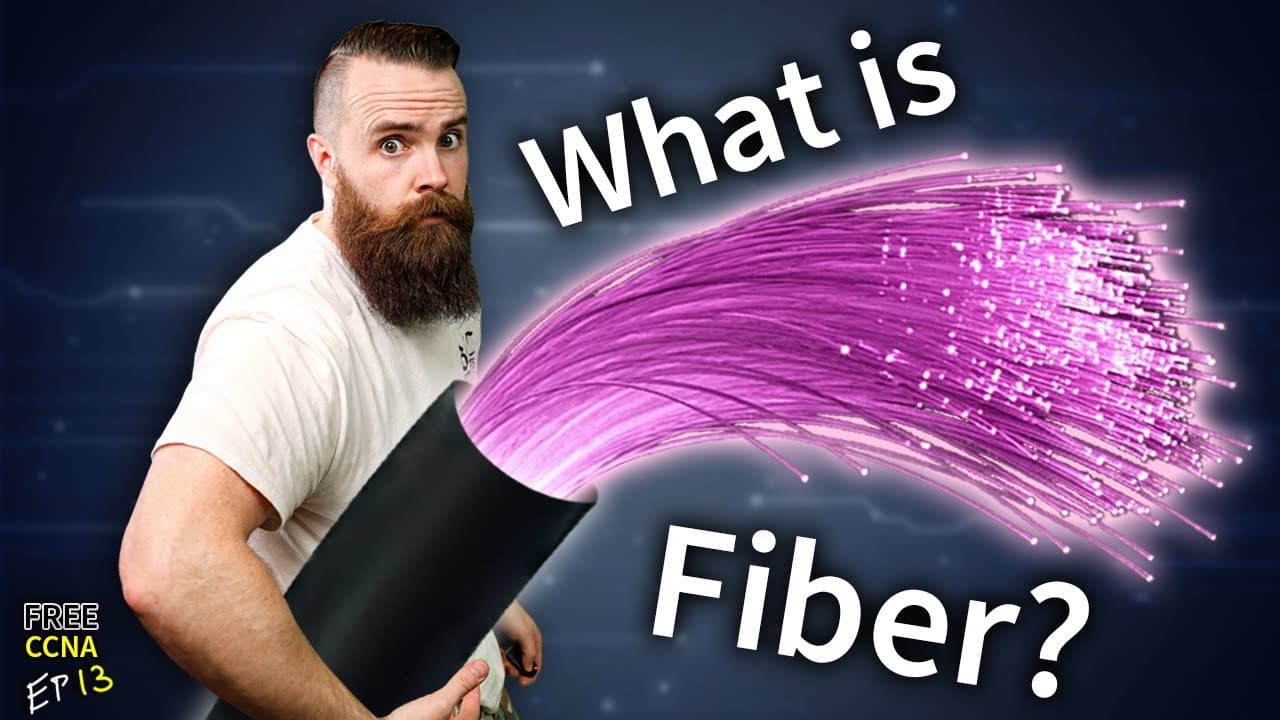
TL;DR
Fiber optic cables transmit data as pulses of light through a tiny core, providing high bandwidth, long reach, low attenuation, and immunity to electromagnetic interference. Multimode fiber uses a larger core and supports shorter distances, while single-mode fiber can reach up to 100 kilometers. Both require careful handling because tight bends can permanently damage the cable.
Transcript
No, I don't mean to brag. Actually I do. I have wicked fast internet because my internet is fiber. Actually. Let me show you. Let's go on a field trip. Come on. Let's go. Okay. So here in my garage, I have at and T fiber coming right to my house. Like here, check it out. This right here is the reason I have fast internet and I just unplugged the in... Read More
Key Insights
- Fiber optic cable transmits data as pulses of light representing ones and zeros, while copper Ethernet uses electrical signals. Sending information through light allows fiber to deliver high speeds, long-distance communication, and reliable transmission without the electromagnetic behavior associated with electricity flowing through copper wires.
- Fiber transmission is about 31% slower than the speed of light in a vacuum because the light passes through glass or plastic rather than empty space. Even with that reduction, the transcript reports measured speeds in the hundreds of terabits per second and describes fiber bandwidth limits as largely theoretical.
- Low attenuation is a major advantage of fiber because its signal weakens slowly over distance. The transcript states that single-mode fiber can run up to 100 kilometers, about 60 miles, while copper Ethernet is normally capped around 100 meters because its electrical signal degrades as cable length increases.
- Fiber optic cable is immune to electromagnetic interference because light does not produce an electromagnetic field. Copper cables carry electricity and can experience crosstalk or interference when placed near other Ethernet cables or electrical equipment, potentially disrupting packets and network traffic.
- Multimode fiber has a core measuring approximately 50 to 62.5 microns, which the transcript describes as about 10 times larger than a single-mode core. Its core is typically plastic, although glass can also be used, and the surrounding cladding is approximately 125 microns.
- Total internal refraction keeps light traveling through the fiber core. When light reaches the boundary at the critical angle, it remains within the core and continues along the cable instead of escaping into another medium, allowing transmission through the cable's gradual curves.
- Multimode fiber has greater attenuation than single-mode fiber because its light follows bouncing paths through the core. The demonstrated multimode cable is labeled for a maximum of 300 meters, which exceeds the typical 100-meter Ethernet limit but remains far shorter than single-mode fiber's stated reach.
- Fiber optic cable is delicate because its functional components are made from glass or plastic. Strengthening material, a jacket, and a buffer protect the core and cladding, but tight bends and kinks can still break the cable, make it unusable, and leave it difficult to repair or remake.
Install to Summarize YouTube Videos and Get Transcripts
Explore YouTube Video Summarizer or Get YouTube Transcript Extractor
Questions & Answers
Q: How do fiber optic cables transmit data?
Fiber optic cables transmit data as pulses of light that represent ones, zeros, and other internet traffic. The light travels through a tiny glass or plastic core rather than through copper conductors carrying electricity. Cladding surrounds the core and helps prevent the light from escaping, while protective strengthening material, a jacket, and a buffer guard the delicate internal structure.
Q: Why is fiber optic internet fast?
Fiber optic internet is fast because it uses light to transport data through its core. Light moves about 31% slower through glass or plastic than it does through a vacuum, but transmission remains extremely fast. The transcript says researchers have measured speeds in the hundreds of terabits per second and characterizes the available bandwidth limits as theoretical rather than a clearly defined cap.
Q: How far can fiber optic cable carry a signal?
Single-mode fiber can carry a signal for up to 100 kilometers, which the transcript equates to about 60 miles, without severely degrading it. This reach comes from fiber's low attenuation, meaning its signal strength decreases slowly over distance. By comparison, copper Ethernet is normally capped at around 100 meters because its electrical signal weakens as the cable becomes longer.
Q: What is attenuation in network cabling?
Attenuation is the rate at which a signal decreases as it travels through a transmission medium. Longer copper Ethernet cables experience degradation in their electrical signal, contributing to the normal limit of around 100 meters. Fiber has much lower attenuation, allowing light signals to travel substantially farther. Multimode fiber still has higher attenuation than single-mode fiber because of how its light moves through the core.
Q: Why is fiber immune to electromagnetic interference?
Fiber is immune to electromagnetic interference because it carries light instead of electricity, and the light does not produce an electromagnetic field. Copper Ethernet uses electrical signals that create fields around its wires. Nearby Ethernet cables or electrical equipment can therefore cause crosstalk and interference in copper, potentially affecting packets and traffic, while fiber avoids those EMI-related problems.
Q: What is the difference between single-mode and multimode fiber?
Single-mode and multimode fiber differ in their core dimensions, light paths, attenuation, and practical distance. The multimode core is usually 50 to 62.5 microns and is about 10 times larger than a single-mode core. Multimode light follows bouncing paths and the demonstrated cable is limited to 300 meters, while single-mode fiber can reach up to 100 kilometers.
Q: How does light stay inside a fiber optic cable?
Light stays inside the core through a process the transcript calls total internal refraction. The light reaches the boundary at a critical angle that keeps it within the same medium, allowing it to continue down the cable rather than escaping. The surrounding cladding also helps contain the light, including as it travels through reasonable curves in the cable's route.
Q: Why should fiber optic cable not be bent tightly?
Fiber optic cable should not be bent tightly because its core and related components are made from delicate glass or plastic. Kinking or sharply looping the cable can break that structure and make the fiber unusable. The jacket, buffer, and strengthening materials offer protection, but they do not eliminate this vulnerability. The transcript recommends keeping extra cable arranged in a gentle spool.
Summary & Key Takeaways
-
Fiber optic cable carries ones and zeros as light pulses instead of the electrical signals used by copper Ethernet. Light travels through a glass or plastic core surrounded by cladding. Although transmission through these materials is about 31% slower than light traveling through a vacuum, fiber still supports extremely high speeds and bandwidth.
-
Fiber offers three principal advantages: speed, distance, and immunity to electromagnetic interference. The transcript cites measured performance in the hundreds of terabits per second and describes bandwidth limits as theoretical. Single-mode fiber can extend up to 100 kilometers, while low attenuation helps preserve its signal over distances that copper Ethernet cannot match.
-
Multimode fiber commonly has a 50 or 62.5 micron core, roughly 10 times larger than a single-mode core, and 125 micron cladding. Its light follows multiple paths through total internal refraction, which increases attenuation and limits distance. Fiber is also delicate, so tight bends or kinks can break it permanently.
Read in Other Languages (beta)
Share This Summary 📚
Summarize YouTube Videos and Get Video Transcripts with 1-Click
Try YouTube Summary with ChatGPT & Claude or YouTube Transcript Generator
Explore More Summaries from NetworkChuck 📚






Summarize YouTube Videos and Get Video Transcripts with 1-Click
Try YouTube Summary with ChatGPT & Claude or YouTube Transcript Generator