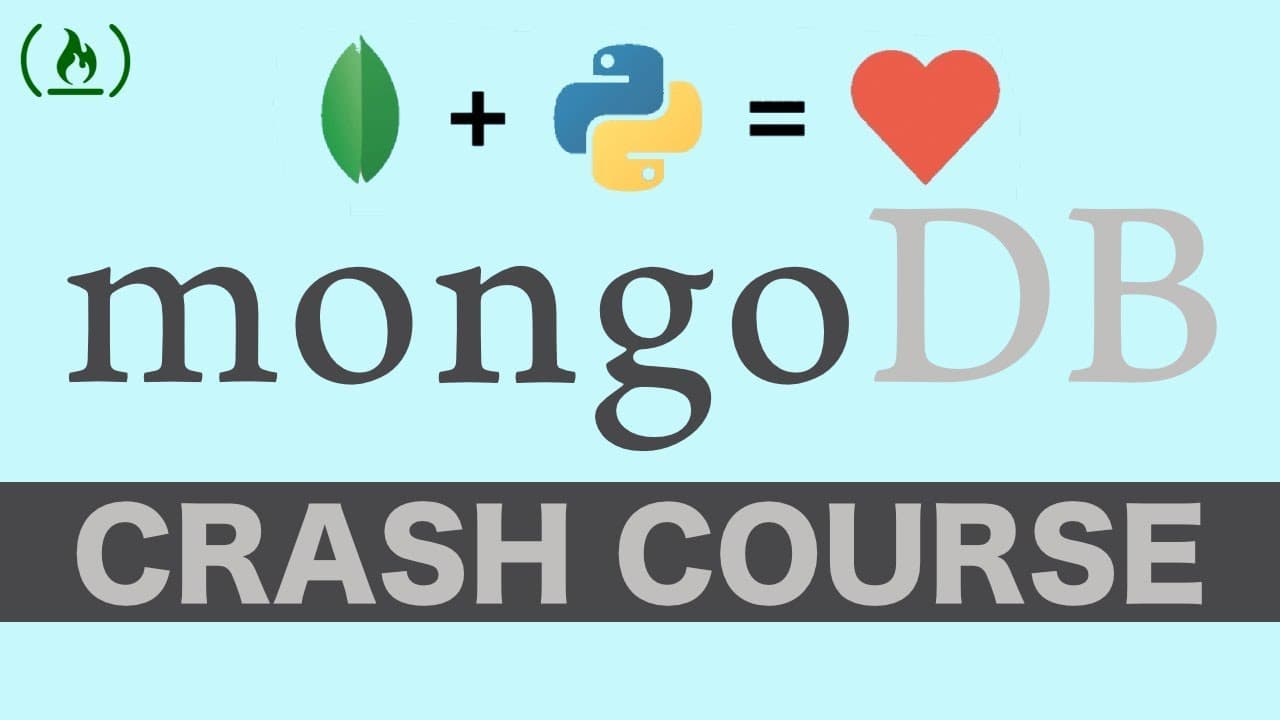
MongoDB with Python Crash Course - Tutorial for Beginners
TL;DR
This crash course teaches how to use MongoDB with Python by modeling and building Snake BnB, an Airbnb-style application for renting snake cages. It covers NoSQL and document-database benefits, modeling techniques and trade-offs, and Python development with the Engine ODM, PyMongo, Robo 3T, and PyCharm. Read on to see how the application turns flexible document modeling into practical code.
Transcript
hello and welcome to mongodb quickstart with python mongodb is one of the most popular and exciting database technologies around python is one of the most popular and fastest growing language there is and these two technologies work great together and that's exactly what this course is about so we're going to quickly get started with mongodb write ... Read More
Key Insights
- 🈸 MongoDB, as a NoSQL database, provides flexible data modeling options compared to traditional relational databases, facilitating dynamic application development.
- 🫠 The concept of embedding versus referencing data allows developers to optimize read performance and tailor data structures to align with application needs.
- 🤢 Effective use of tools like Engine and Robo 3T enhances productivity when working with MongoDB, enabling seamless interaction with the database.
- 🌥️ The popularity of MongoDB as demonstrated in surveys indicates its acceptance and preference among developers, resulting in a large community and extensive resources.
- 🏢 Understanding the performance trade-offs when modeling data in document databases is crucial for building scalable applications that handle increased workload efficiently.
- 👨💻 The course offers not only theoretical knowledge but practical coding skills by encouraging participants to build a functional application, reinforcing learning through experience.
- 👋 Knowledge of MongoDB’s driver and API, along with best practices in data management, equips participants for potential deployment scenarios in real applications.
Install to Summarize YouTube Videos and Get Transcripts
Explore YouTube Video Summarizer or Get YouTube Transcript Extractor
Questions & Answers
Q: How does this crash course teach MongoDB with Python?
The course combines explanations of document databases and data modeling with hands-on Python development. You build Snake BnB, an Airbnb-style application in which cage owners offer cages for rent and pet owners find places for their snakes to stay.
Q: How much Python knowledge is required for the course?
The course assumes that you know a little Python. The instructor says learners who do not already know it will still pick up some Python along the way.
Q: What are the three main areas covered in the MongoDB course?
First, the course explains why NoSQL and document databases matter for schema design, performance, and flexibility. It then examines modeling techniques, trade-offs, and guidelines before moving into writing application code with an object document mapper.
Q: What application do learners build in the course?
Learners build Snake BnB, an Airbnb clone for pet snakes. Cage owners can list cages for rent, while traveling pet owners can find a proper cage for their snakes; the project models many operations found in the real Airbnb application.
Q: Why can MongoDB data modeling be challenging for relational-database developers?
Relational developers may be accustomed to third normal form as a structured method for planning data. Document databases offer much more flexibility, so modeling can initially feel open-ended and more like art than science.
Q: What is Engine, and how is it used with MongoDB?
Engine is the object document mapper used as the course’s primary MongoDB library. Learners use it to create Python classes, model application data, and map those classes to and from MongoDB.
Q: What MongoDB and Python tools does the course use?
The course uses MongoDB, the Engine ODM, and some PyMongo, which the instructor describes as the lower-level official way to communicate with MongoDB. It also demonstrates Robo 3T for command-line and graphical database interaction and PyCharm for writing Python code, although PyCharm is not required.
Q: Who teaches the MongoDB with Python course?
Michael Kennedy teaches the course and identifies himself as the host of the Talk Python to Me podcast. He also says he created the Talk Python training company, wrote Python and MongoDB courses, and has participated for years in the MongoDB Masters program, a group of about 35 external community members.
Summary & Key Takeaways
-
This course provides an introduction to combining MongoDB, a NoSQL database, with Python programming, focusing on rapid application development.
-
Participants will build a whimsical application called "Snake BnB," allowing users to rent cages for their pet snakes while learning data modeling and querying with MongoDB.
-
The course covers various tools and libraries such as Engine and PyCharm, as well as techniques for effective data management and application architecture in a NoSQL environment.
Read in Other Languages (beta)
Share This Summary 📚
Summarize YouTube Videos and Get Video Transcripts with 1-Click
Try YouTube Summary with ChatGPT & Claude or YouTube Transcript Generator
Explore More Summaries from freeCodeCamp.org 📚



Summarize YouTube Videos and Get Video Transcripts with 1-Click
Try YouTube Summary with ChatGPT & Claude or YouTube Transcript Generator