What Are Data Structures and Why Are They Important?
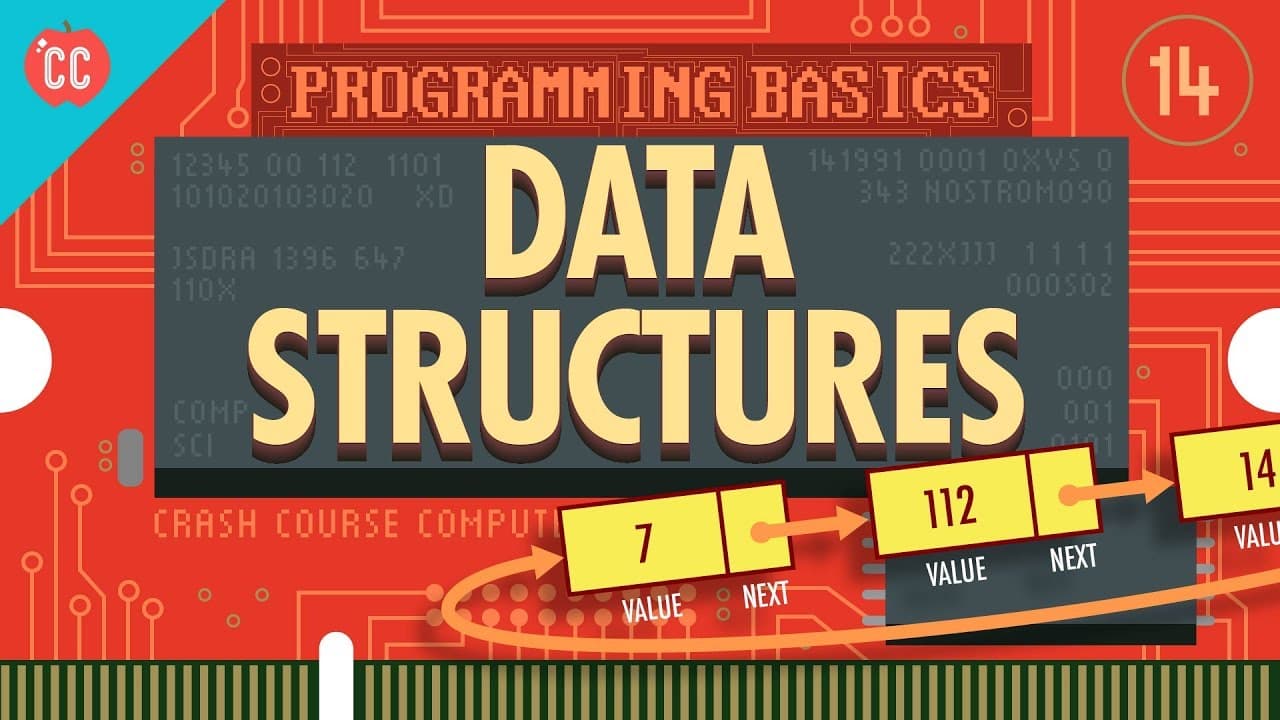
TL;DR
Data structures are essential for organizing and managing data efficiently, ensuring quick storage and retrieval. Key types include arrays for sequential data, linked lists for dynamic data management, and trees and graphs for hierarchical and interconnected data. Choosing the right data structure is critical for optimizing algorithms and improving programming effectiveness.
Transcript
Hi, I'm Carrie Anne, and welcome to Crash Course Computer Science! Last episode, we discussed a few example classic algorithms, like sorting a list of numbers and finding the shortest path in a graph. What we didn’t talk much about, is how the data the algorithms ran on was stored in computer memory. You don’t want your data to be like John Green’s... Read More
Key Insights
- Data structures are essential for organizing data in memory, allowing efficient retrieval and manipulation by algorithms.
- Arrays are fundamental data structures, storing sequences of values and accessed via index, starting from zero in most languages.
- Strings are arrays of characters, ending with a null character to denote the end, allowing functions to handle text efficiently.
- Matrices extend arrays to multiple dimensions, useful for grids or multi-dimensional data, accessed with multiple indexes.
- Structs bundle related variables, enabling compound data structures, and serve as building blocks for more complex structures.
- Linked lists use nodes with pointers to create dynamic, flexible data structures, allowing easy insertion and deletion.
- Queues and stacks, built on linked lists, follow FIFO and LIFO principles, respectively, for managing data order.
- Trees and graphs represent hierarchical and arbitrary data connections, essential for various algorithms and data organization.
Install to Summarize YouTube Videos and Get Transcripts
Explore YouTube Video Summarizer or Get YouTube Transcript Extractor
Questions & Answers
Q: What is the primary purpose of data structures in computer science?
Data structures are designed to organize data efficiently in memory, allowing algorithms to perform operations such as storage, retrieval, and manipulation effectively. They provide a structured way to manage data, enabling programmers to handle complex computations and tasks with ease.
Q: How do arrays differ from linked lists in terms of data storage?
Arrays store data in contiguous memory locations, requiring a fixed size and making it difficult to insert or delete elements. Linked lists, however, use nodes with pointers, allowing dynamic resizing and easy insertion or deletion of elements without the need for contiguous memory allocation.
Q: What role do pointers play in linked lists?
Pointers in linked lists are used to link nodes together, forming a chain of elements. Each node contains a value and a pointer to the next node, allowing the list to grow or shrink dynamically and enabling efficient insertion, deletion, and traversal of elements within the list.
Q: How are strings represented in memory?
Strings are represented as arrays of characters in memory, ending with a null character (binary value 0) to denote the end of the string. This null character is crucial for string functions to determine where the string ends, preventing unintended data from being processed or displayed.
Q: What is the difference between a queue and a stack in data structures?
A queue operates on a First-In First-Out (FIFO) principle, where the first element added is the first to be removed, similar to a line at a post office. In contrast, a stack follows a Last-In First-Out (LIFO) principle, where the last element added is the first to be removed, akin to a stack of pancakes.
Q: In what scenarios are matrices used in data structures?
Matrices are used in scenarios requiring two-dimensional data representation, such as grids in spreadsheets or pixel data in images. They allow data to be organized in rows and columns, facilitating operations like matrix multiplication, transformations, and other mathematical computations involving multi-dimensional data.
Q: How do trees differ from graphs in data structures?
Trees are hierarchical structures with nodes having parent-child relationships, featuring a single root and leaf nodes with no further connections. Graphs, however, represent arbitrary connections between nodes, allowing loops and multiple pathways, making them suitable for modeling networks, relationships, and complex systems.
Q: Why is it important to choose the right data structure for a task?
Choosing the right data structure is crucial as it directly impacts the efficiency of algorithms and operations. The appropriate structure can optimize memory usage, speed up data processing, and simplify complex tasks, enabling programmers to solve problems effectively and efficiently by leveraging the strengths of specific data structures.
Summary & Key Takeaways
-
Data structures are crucial in computer science for organizing data in a structured way, enabling efficient storage and retrieval. Arrays, strings, matrices, and structs are basic structures, while linked lists provide flexibility in data management.
-
Queues and stacks, derived from linked lists, manage data order through FIFO and LIFO principles. Trees and graphs represent hierarchical and arbitrary data connections, supporting complex algorithms and data organization.
-
Choosing the right data structure is vital for efficient programming, and many languages offer libraries with pre-built structures, allowing programmers to focus on higher-level abstractions and problem-solving.
Read in Other Languages (beta)
Share This Summary 📚
Summarize YouTube Videos and Get Video Transcripts with 1-Click
Try YouTube Summary with ChatGPT & Claude or YouTube Transcript Generator
Explore More Summaries from CrashCourse 📚





Summarize YouTube Videos and Get Video Transcripts with 1-Click
Try YouTube Summary with ChatGPT & Claude or YouTube Transcript Generator