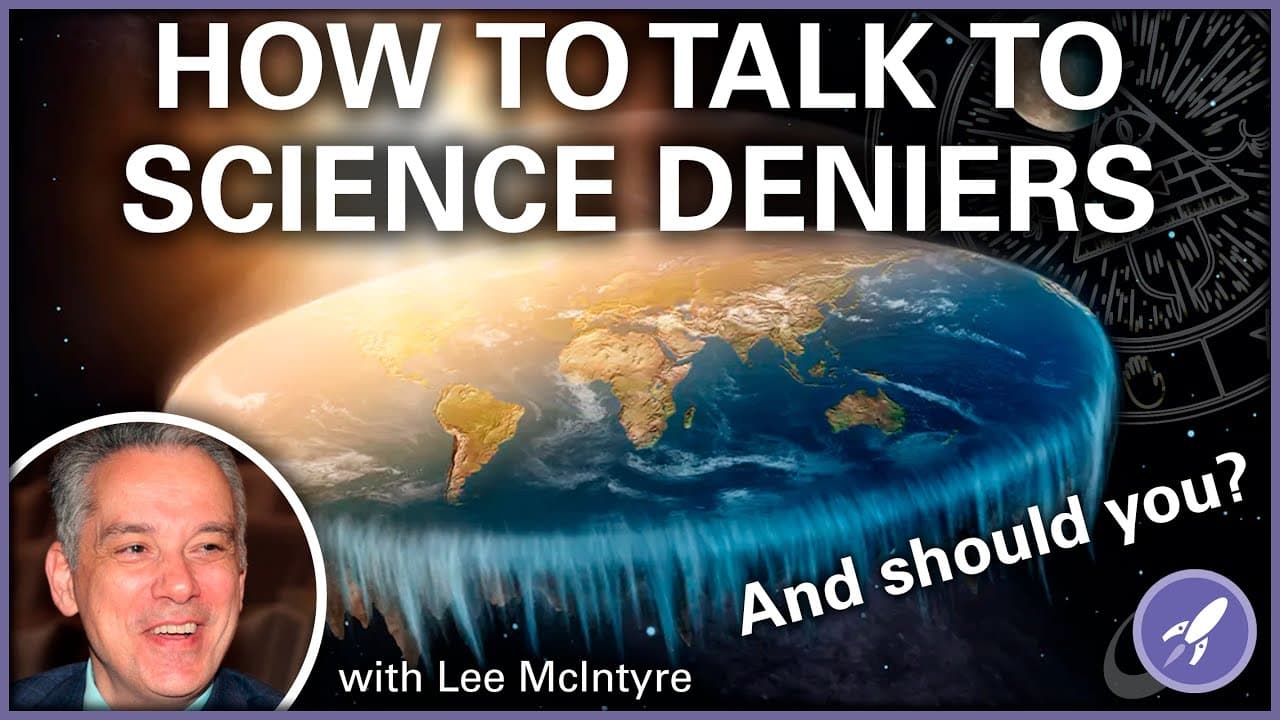
Immune System for Your Mind Against Disinformation with Lee McIntyre
TL;DR
Science denial, fueled by disinformation campaigns, poses a significant threat to society. To combat it, scientists and science communicators must engage in empathetic conversations, promote trust in evidence-based reasoning, and tackle disinformation at its source.
Transcript
Fraser Cain: Ideally, I get to talk about space and astronomy news here on my channel. But in reality, I have to spend some time dealing with science denialism in space and astronomy, but also climate change, and COVID. There's a lot of issues that are currently facing us. And so I thought it would be great to talk to someone who specializes in dea... Read More
Key Insights
- 🧑🏭 Disinformation aims to polarize and create doubt, making it harder for people to trust scientific facts.
- 🌸 Science deniers often rely on flawed reasoning, including conspiracy theories and cherry-picked evidence.
- 🤔 Inoculating individuals against disinformation and building critical thinking skills are crucial aspects of countering science denial.
- 🤯 Scientists should celebrate the ability to change their minds based on new evidence, as it is a fundamental strength of science.
- ℹ️ Combating disinformation requires a multi-pronged approach, including transparent information sharing, trustworthy sources, and responsible platform policies.
- 😑 Disinformation is a pressing threat to democracy, public health, and scientific progress.
- 🌉 Promoting empathy and trust in evidence-based reasoning can help bridge the gap between science deniers and scientific authorities.
Install to Summarize YouTube Videos and Get Transcripts
Explore YouTube Video Summarizer or Get YouTube Transcript Extractor
Questions & Answers
Q: How does disinformation contribute to science denial?
Disinformation campaigns intentionally create doubt and polarize people, making it harder for them to trust reputable sources. They undermine credibility and foster a general atmosphere of distrust towards science and scientists.
Q: How can scientists and science communicators effectively engage with science deniers?
It is important to approach conversations with science deniers in good faith and understand their reasoning patterns. Highlighting flaws in their reasoning, questioning their sources, and making them reflect on the evidence can be effective strategies.
Q: Is uncertainty a weakness in science?
No, uncertainty is intrinsic to science and a strength as it allows for growth and adaptation based on new evidence. Acknowledging uncertainty and actively seeking new information helps scientists refine their understanding.
Q: How can we improve science communication to combat science denial?
Scientists and science communicators should embrace uncertainty and communicate the scientific process openly. Building trust with the public through calm, respectful dialogue and transparency about evidence and sources will help combat science denial effectively.
Summary & Key Takeaways
-
Science denial comes from a combination of deliberate disinformation campaigns, polarization, and distrust of scientific authorities.
-
Scientists and science communicators must address science denial with empathy and a focus on reasoning flaws, rather than just overwhelming deniers with facts.
-
Key strategies to combat science denial include individuals and platforms actively combating disinformation, promoting critical thinking skills, and fostering trust in scientific evidence.
Read in Other Languages (beta)
Share This Summary 📚
Summarize YouTube Videos and Get Video Transcripts with 1-Click
Try YouTube Summary with ChatGPT & Claude or YouTube Transcript Generator
Explore More Summaries from Fraser Cain 📚

Summarize YouTube Videos and Get Video Transcripts with 1-Click
Try YouTube Summary with ChatGPT & Claude or YouTube Transcript Generator