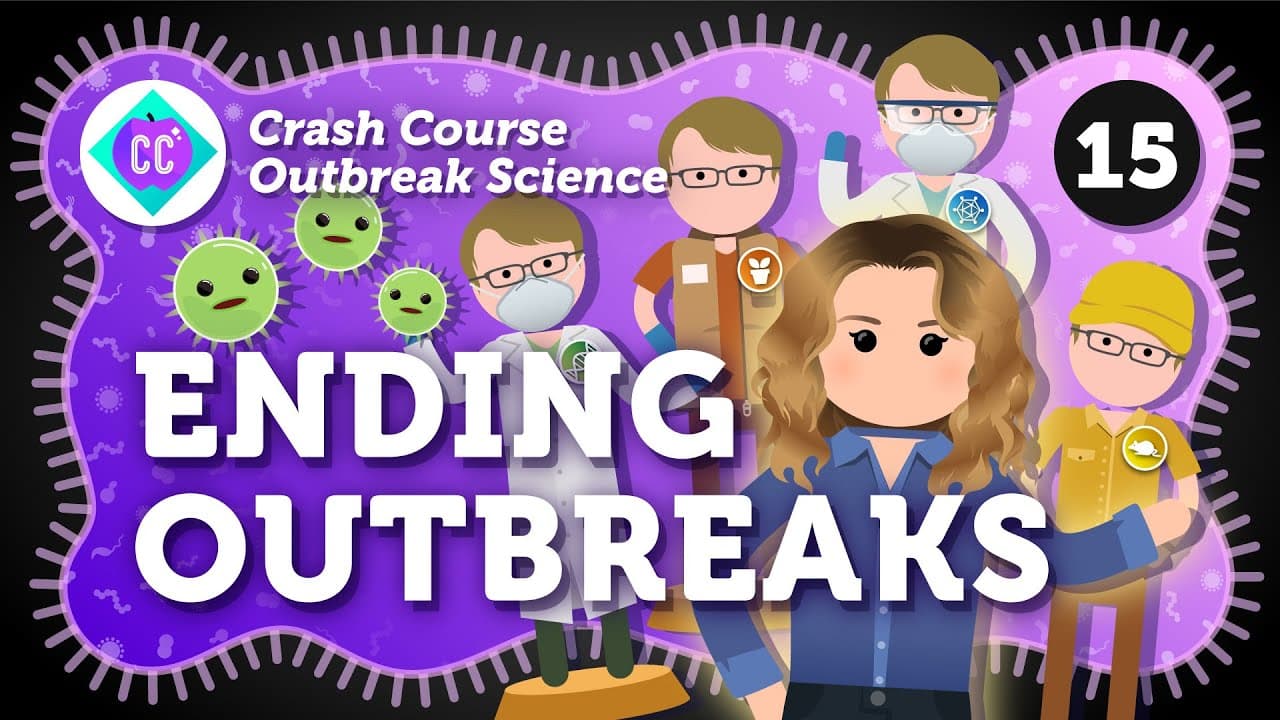
How Are We All Part of Ending Outbreaks? Crash Course Outbreak Science #15
TL;DR
Everyone can help end outbreaks by supporting disease surveillance, following public health guidance, practicing good hygiene, getting vaccinated, volunteering, and advocating for stronger responses. Outbreak science combines biology, epidemiology, sociology, economics, and other disciplines; during India’s 2004 cholera outbreak, medical workers detected cases, epidemiologists traced the outbreak’s origins, and microbiologists identified the pathogen. Read on to see how individual and collective actions fit into this interdisciplinary effort.
Transcript
as we've seen throughout this series outbreak science is really lots of sciences from biology to epidemiology to sociology and even economics we've seen that many approaches can shed light on outbreaks and guide the actions we take in response to them for example during the 2004 cholera outbreak in india we saw it took medical knowledge to detect c... Read More
Key Insights
- 🏑 Outbreak science is an interdisciplinary field that combines various disciplines like biology, epidemiology, sociology, and economics to address outbreaks effectively.
- 🕵️ Disease surveillance is crucial for detecting, tracking, and assessing the impact of outbreaks.
- 🖐️ Geneticists play a vital role in identifying unknown pathogens and tracing the origins of outbreaks.
- 🙅 Individual actions, such as practicing good hygiene and getting vaccinated, contribute to preventing and stopping outbreaks.
- ❓ Collective actions, like volunteering and advocating for better outbreak response, strengthen our capacity to combat infectious diseases.
- 💱 Changing social structures and systems can improve our ability to respond to outbreaks.
- 🖐️ Everyone has a role to play in outbreak science, from scientists to everyday citizens.
Install to Summarize YouTube Videos and Get Transcripts
Explore YouTube Video Summarizer or Get YouTube Transcript Extractor
Questions & Answers
Q: How are we all part of ending outbreaks?
Scientists, healthcare workers, public agencies, and everyday citizens all contribute to preventing and responding to outbreaks. Individuals can practice good hygiene, stay informed, follow public health guidance, get vaccinated, volunteer, and advocate for better outbreak responses.
Q: Why is outbreak science interdisciplinary?
Outbreak science draws on biology, epidemiology, sociology, economics, psychology, medicine, microbiology, genetics, and other fields. Combining these perspectives helps communities understand outbreaks, choose responses, and balance needs such as treatment capacity, communication, trust, safety, and limited budgets.
Q: How did different specialists respond to India’s 2004 cholera outbreak?
Medical knowledge was needed to detect cases during the 2004 cholera outbreak in India. Epidemiologists traced its origins, while microbiologists confirmed which disease-causing pathogen was responsible.
Q: What is disease surveillance?
Disease surveillance means collecting, analyzing, and interpreting data about where diseases are prevalent, whom they affect, and why. It can detect an outbreak by showing that case numbers are higher than usual and help determine where prevention and treatment efforts should be focused.
Q: How does disease surveillance show whether outbreak measures worked?
After measures such as sanitation infrastructure, public health actions, or vaccination of vulnerable groups are introduced, surveillance continues tracking cases. A decline in cases or outbreaks helps confirm whether those measures were effective.
Q: How do geneticists identify an unknown outbreak pathogen?
Geneticists can use genome-sequencing tools to read the DNA or RNA of organisms circulating in patient samples such as blood and saliva. In the transcript’s fictional Hankistan example, this process revealed a unique genome shared by patients and identified a new virus called hankavirus.
Q: How can viral mutations help trace an outbreak’s origin?
Geneticists compare small mutations among viral samples and use the differences to create a family tree. In the Hankistan example, that tree helped identify the earliest infected patients and showed that they lived in the same neighborhood at the edge of Hanksville.
Q: How should a hospital balance treatment capacity and patient communication before an outbreak?
With a fixed budget, a medical perspective may favor stockpiling equipment such as ventilators for additional infected patients. A psychological and social perspective may favor training more medical interpreters to improve clinical decisions and patients’ trust and safety, so both treatment resources and how patients are treated must be considered.
Summary & Key Takeaways
-
Outbreak science involves multiple scientific disciplines, such as biology, epidemiology, sociology, and economics, working together to understand and respond to outbreaks.
-
Disease surveillance is a crucial part of outbreak science, involving the collection, analysis, and interpretation of data to detect and track outbreaks.
-
Geneticists play a significant role in disease surveillance by using genome sequencing tools to identify unknown pathogens and trace the origins of outbreaks.
Read in Other Languages (beta)
Share This Summary 📚
Summarize YouTube Videos and Get Video Transcripts with 1-Click
Try YouTube Summary with ChatGPT & Claude or YouTube Transcript Generator
Explore More Summaries from CrashCourse 📚





Summarize YouTube Videos and Get Video Transcripts with 1-Click
Try YouTube Summary with ChatGPT & Claude or YouTube Transcript Generator