How to Build a Profitable Lifestyle Business Step by Step
TL;DR
A profitable lifestyle business needs a small team where the founder stays out of daily operations and focuses on founder-led growth: pitching, publishing, products, profile, and partnerships. A general manager runs the business day to day. Products are sold as an ecosystem of four connected offers, and the team resets priorities together at a quarterly off-site.
Transcript
This is exactly how to build a highly profitable lifestyle business. By the end of this video, you're going to understand how to build your team, how to develop products, how to have the right weekly activities, and how to run highly profitable, highly successful growth campaigns. I'm going to break it down step by step so that you almost cannot fa... Read More
Key Insights
- A lifestyle boutique is a business with a small team, typically counted in single digits to low double digits, and that size is what lets the founder step out of the technician role while everyone else owns a defined function.
- The founder's role is the key person of influence, meaning the face of the business in marketing, on podcasts, on stage, in books, and in ads, because founder-led growth is what drives businesses in the mid-revenue phase.
- A personal brand cuts through far more effectively than a business brand, and it does not require sharing private life. What must be shared is the value, stories, case studies, and intellectual property of the business.
- The founder's job is the five Ps: pitching the business, publishing content, creating new products, raising profile, and doing strategic joint ventures and partnerships. Everything outside those five is someone else's accountability.
- The general manager runs the business, handling hiring, firing, team management, and daily operations. Candidates who previously ran a cafe, restaurant, nightclub, or hospitality business are affordable and well suited to the role.
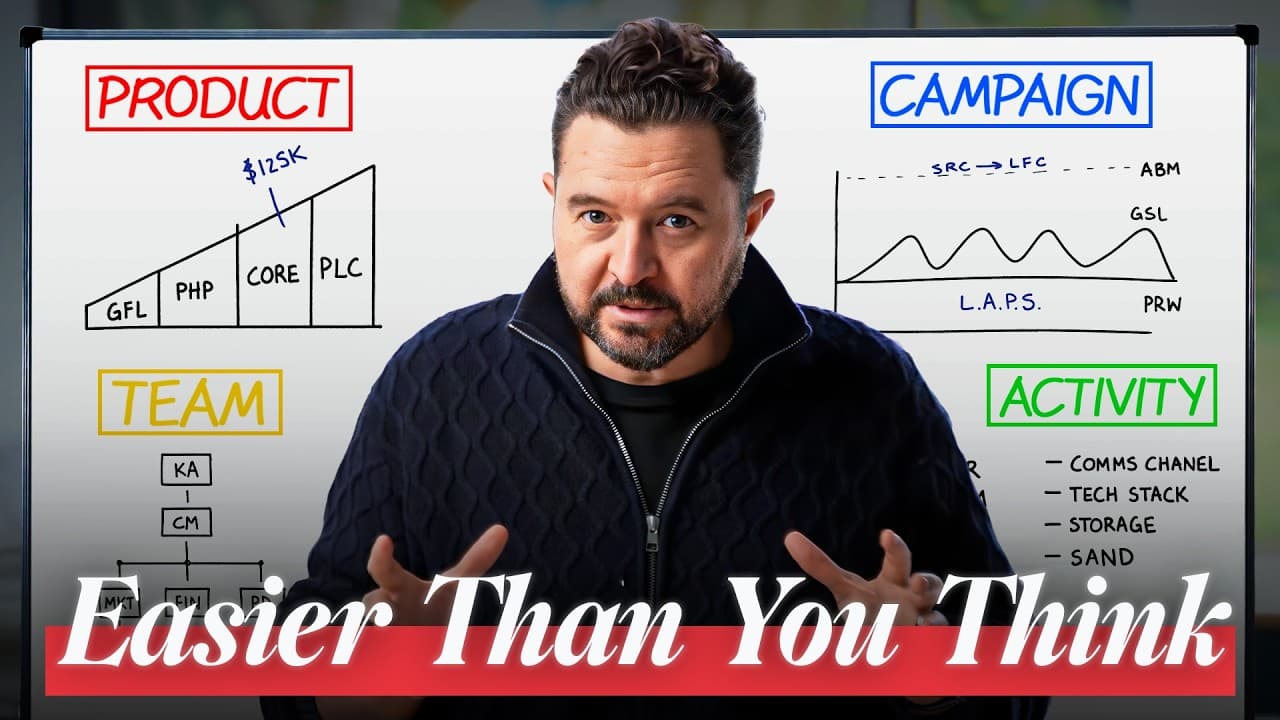
- A business has three functional blocks: demand generation with heads of marketing and sales, operations with finance handling money and IT handling data, and supply with product development, product delivery, and customer success.
- A product ecosystem is four connected offers: a free gift, a low-commitment product for prospects, the core product, and a product for clients such as a subscription, membership, community, or annual retreat.
- Profit sits in the ecosystem rather than in any single product, because each offer does one job: getting attention, building trust, delivering a transformation, and maintaining standards over time.
- An online assessment works well as a product for prospects because it makes the buyer discover a problem they need solved, for example a cyber security assessment that leads into consulting services.
- The quarterly strategic reset is an off-site meeting where the whole team sets priorities for the next ninety days, delegates accountabilities, confirms resources, and gets each member to commit to their role.
Install to Summarize YouTube Videos and Get Transcripts
Explore YouTube Video Summarizer or Get YouTube Transcript Extractor
Questions & Answers
Q: How many people do you need on a lifestyle business team?
A lifestyle boutique runs on a small team, described as a range in the single digits to low double digits. Below that, with only yourself and a handful of helpers, you are a highly paid professional with a support team rather than a business owner. You may earn well, but you cannot take a holiday and the business would stop if something happened to you. Once the team reaches the boutique range, the founder can occupy the founder role and each other person can own an important function within the business.
Q: What is a key person of influence in a business?
The key person of influence is the founder's role and the most important seat on the team. During founder-led growth, the business grows because of what the founder does. In practical terms the founder is the face of the business and the face of the marketing: appearing on podcasts, speaking on stage, possibly writing a book, and featuring in ads explaining what viewers should do next. Skipping the personal brand means leaving the vast majority of your firepower unused, since a personal brand cuts through far more than a business brand does.
Q: What are the five Ps a founder should focus on?
The five Ps are pitching the business, publishing content, creating new products, raising your profile and therefore the profile of the business, and doing strategic joint ventures and partnerships. If a founder does those five things, they are doing their job. What the founder is not doing is running the business, since the general manager handles that. The advice given is not to focus on what you will stop doing but on what you will do, which is founder-led growth through those five activities.
Q: How do you get out of the day-to-day in your business?
Stepping out of the technician role normally happens once you have a few key people on the team. That can be someone who is good at sales, someone who is good at helping deliver the product, or a general manager. Just one or two good hires can set you free. The mental shift matters too: rather than thinking about what you are not going to do, define what you are going to do, which is founder-led growth using the five Ps of pitching, publishing, products, profile, and partnerships.
Q: Who should you hire as a general manager?
You do not need someone to quit a job at Google to run your business. The recommended profile is someone who previously ran a cafe, restaurant, nightclub, or hospitality business. The reasoning is that cafes and restaurants are very hard businesses to run: razor thin margins, a complex variety of products, and lots of young staff needing training. Yet those businesses are often run by a young manager on ordinary pay with a high school qualification. Such people are not crazy expensive but are excellent at hiring, firing, team management, and running operations.
Q: What roles make up a lifestyle business team?
Beyond the founder and the general manager, the team divides across demand generation, supply, and general operations. Demand generation has a head of marketing and a head of sales, and you may end up with two or three salespeople or one or two marketing people. Operations covers finance, which handles everything relating to money, and IT, which handles everything relating to data. The supply side holds the product development and product delivery team plus customer success, which makes sure customers use the product effectively and solves problems that arise.
Q: What is a product ecosystem and why does it matter?
A product ecosystem is four products connected together to form one smooth experience for the customer. It starts with a free gift, then a product for prospects, then the core product, then a product for clients. Each product does a distinct job: one gets attention, one builds trust, one delivers a transformation, and one maintains great standards over time. The profit is not in any particular product but in the ecosystem as a whole. Having only two or three of the four leaves large amounts of money on the table.
Q: What should you offer as a free gift in your funnel?
The gift is something free that people can try with no risk. It might be a download, a free trial, or a free account. The key requirements are that it totally scales because it is digital, that it feels valuable, that as many people as possible can access it, and that it gives an immediate quick win. It sits at the front of the product ecosystem alongside the product for prospects, and its job is to get attention before the prospect makes any commitment of time or money.
Q: What is a product for prospects and what forms can it take?
A product for prospects asks for a small commitment of either time or a small amount of money to get started. Examples include a ninety-minute workshop, committing to a thirty-day trial, or a book someone buys. The presenter's personal favourite is an online assessment on your website. For a cyber security consulting business, a cyber security assessment makes the prospect realise they have a risk that needs solving and therefore need the services to fix it. Its job in the ecosystem is building trust before the core product.
Q: What happens at a quarterly strategic reset?
The quarterly strategic reset is an off-site meeting where the whole team goes into a boardroom and sets up the next ninety days. You get clear about priorities for that period, delegate accountabilities so the right person is doing the right thing, and confirm each person has all the resources needed to get the job done. Each team member then confirms and commits that they will play their role over the coming ninety days and that they see nothing standing in the way of delivering it.
Summary & Key Takeaways
-
Team size determines whether you own a business or a job. With only a few people including yourself, you remain a highly paid professional with support staff, and the business stops if you do. Once the team reaches the lifestyle boutique range, the founder can play the founder role while everyone else owns something important.
-
The founder occupies the key person of influence seat and drives founder-led growth through the five Ps: pitching, publishing, product creation, profile building, and partnerships. Getting out of the day-to-day usually takes only one or two good hires, such as someone strong in sales, someone in delivery, or a general manager.
-
A general manager runs everything operational. The argument made is that complex, thin-margin businesses like cafes and restaurants are run capably by young managers on ordinary pay, so hiring from hospitality rather than headhunting from a big tech company is the realistic path.
-
The rest of the team splits into demand, supply, and operations. Demand covers heads of marketing and sales. Operations covers finance for money and IT for data. Supply covers product development, product delivery, and customer success, which keeps customers using the product and resolves problems.
-
The product ecosystem has four connected offers. A free digital gift scales widely and delivers a quick win. A product for prospects asks for a small commitment of time or money, such as a workshop, trial, book, or online assessment. The core product is the main offering. A product for clients keeps customers subscribed.
-
Activity rhythm starts with the quarterly strategic reset, an off-site session where the team clarifies priorities for the coming ninety days, assigns accountabilities to the right people, confirms they have the resources needed, and has each member commit that nothing stands in the way of delivering their part.
Read in Other Languages (beta)
Share This Summary 📚
Summarize YouTube Videos and Get Video Transcripts with 1-Click
Try YouTube Summary with ChatGPT & Claude or YouTube Transcript Generator
Explore More Summaries from Daniel Priestley 📚
Summarize YouTube Videos and Get Video Transcripts with 1-Click
Try YouTube Summary with ChatGPT & Claude or YouTube Transcript Generator