How to Build an AI Second Brain That Finds Anything
TL;DR
Build an AI second brain by organizing files into an understandable folder structure and using a CLAUDE.md or AGENTS.md file to route agents toward relevant information. Design the system backward from the questions you expect to ask, then choose the lowest of the five levels that solves your actual retrieval problems without adding unnecessary complexity, search effort, or token usage.
Transcript
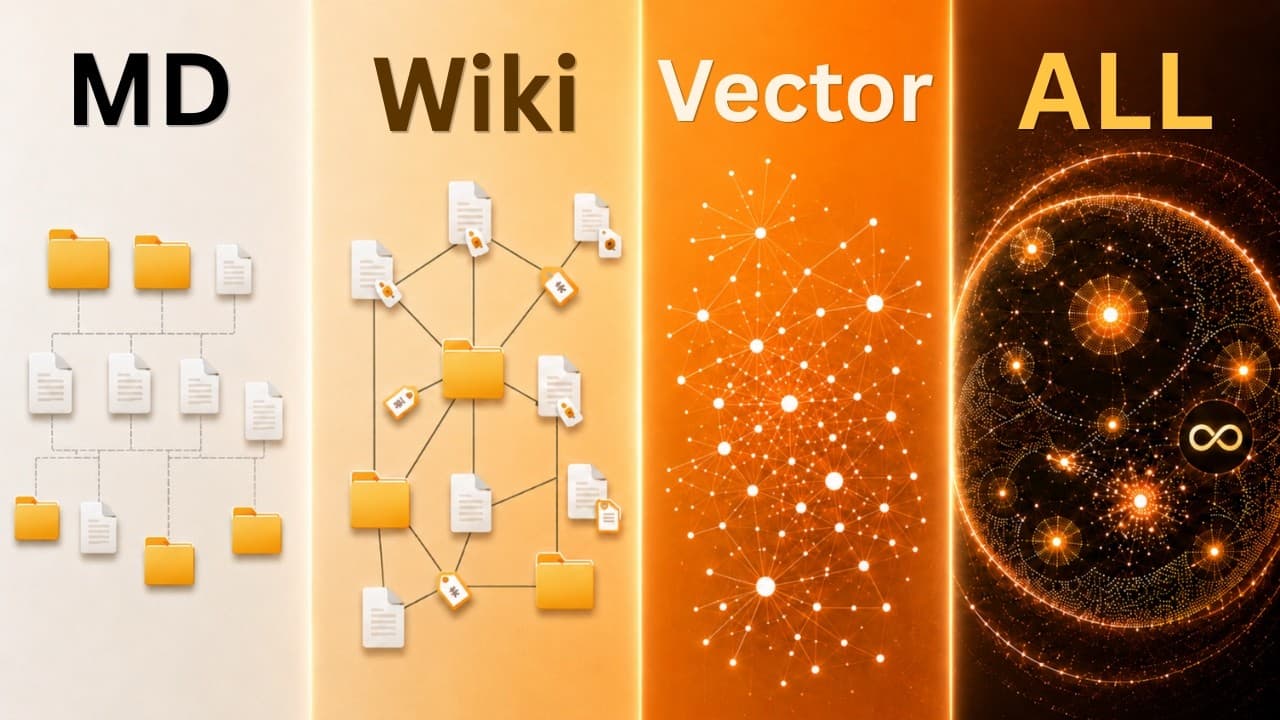
Today I'm going to explain the different levels of building your own AI second brain. You can see here we have a visual of three very different types of data. This one is where we have our context really starting to form and we're starting to see some relationships and we're starting to see some different nodes and entities form. And then as we con... Read More
Key Insights
- An AI second brain is a file-based system for storing notes, meeting recordings, project threads, decisions, and personal or business context so an agent can retrieve and use that information later instead of requiring the user to explain it repeatedly.
- The central test of a second brain is whether both the user and the agent can find stored information again. If either cannot, the system likely needs clearer routing rules, a more understandable folder architecture, or better alignment between storage and future retrieval.
- Second-brain architecture should be reverse engineered from the questions the user expects to ask. The intended access and recall patterns determine how information should be organized when it enters the system, because storage formats must fit their eventual retrieval purpose.
- Level one is based on exact words or names and begins with a CLAUDE.md or AGENTS.md router plus folders and files. The router establishes the agent’s role, important context, working conventions, and explicit instructions about where different categories of information live.
- Level two asks whether the system can pull together everything related to a particular topic. It becomes relevant as the number of files grows and information needs to be gathered across multiple stored items instead of retrieved from one obvious location.
- Level three uses semantic search to retrieve information by meaning when the user’s search terms differ from the original wording. This expands retrieval beyond exact matches and addresses situations where relevant knowledge exists but cannot be located through the same vocabulary used during storage.
- Level four traces relationship chains between topics, allowing a question about one subject to connect back through related information to another subject. Relationship mapping helps show how knowledge pieces fit together instead of treating them merely as files with links between them.
- Level five makes the second brain highly autonomous and always on, but it is not necessarily the correct destination. The preferred level is the lowest one that solves a genuine pain point, because adding architecture without a retrieval problem can create more complexity rather than value.
Install to Summarize YouTube Videos and Get Transcripts
Explore YouTube Video Summarizer or Get YouTube Transcript Extractor
Questions & Answers
Q: How do you build a basic AI second brain?
Start with a CLAUDE.md file for Claude Code or an AGENTS.md file for another agent environment, then create a small set of folders containing organized markdown files. Treat the main instruction file as a router that identifies where personal context, projects, decisions, conversations, and other knowledge live. The structure succeeds when both you and the agent can follow it without searching the entire project.
Q: What is the main purpose of an AI second brain?
The main purpose is to move useful information out of your head and into a system that can store, organize, and retrieve it. That information can include notes, meeting recordings, ClickUp threads, decisions, projects, relationships, and business context. A working second brain lets an agent locate relevant material later, reducing repeated explanations and avoiding wasteful searches through every file.
Q: Why should a second brain be designed backward from questions?
A second brain should be designed backward because the way information will be accessed later determines how it should be stored now. Begin by considering the future questions you want the agent to answer, then choose folders, files, labels, and relationships that support those retrieval patterns. A structure that ignores its eventual use may preserve information while still making it difficult to recall.
Q: What does a CLAUDE.md file do in a second brain?
A CLAUDE.md file loads when Claude Code opens in the project and acts like a combination of system instructions and a knowledge router. It can describe who the user is, how work should be handled, what information matters, and where different materials live. Explicit routing rules tell the agent which folder to inspect instead of expecting it to search the entire codebase automatically.
Q: What are the five levels of an AI second brain?
Level one finds information through exact words or names. Level two gathers everything associated with a topic. Level three uses semantic search to find matching meaning even when the query uses different words. Level four traces relationship chains between connected topics. Level five makes the broader system highly autonomous and always on, although the highest level is not automatically the most appropriate choice.
Q: How should folders be organized in a level-one second brain?
Folders should follow drill-down paths that make sense to both the user and the agent. The example structure includes context files such as personal background, technology choices, and conversations, plus separate areas for projects and decisions. Projects can contain nested folders for clients, ongoing work, or dated material, while the main router explains exactly when the agent should inspect each location.
Q: How can an AI second brain reduce hallucinations and token use?
Clear organization and routing help the agent inspect the most relevant files instead of searching the entire project or guessing when context is missing. The router tells it where specific information lives, while folder architecture narrows the retrieval path. This approach reduces unnecessary search time and token consumption and gives the model stored context it can use instead of relying on unsupported assumptions.
Q: When should you move to a higher second-brain level?
Move to a higher level only when the current structure creates a real retrieval problem. Examples include needing to collect material across a topic, find ideas expressed with different wording, trace relationships between subjects, or automate the system more extensively. If existing routing and folders already let you and the agent find information reliably, additional architecture may create complexity without solving a meaningful pain point.
Summary & Key Takeaways
-
An AI second brain stores notes, meeting recordings, project discussions, decisions, and other knowledge in files that both people and agents can retrieve. Its value depends less on collecting everything than on creating clear routing and folder architecture, so information can be found later without repeated explanations or searches across the entire project.
-
The five levels progress from exact-word retrieval to topic aggregation, semantic search, relationship-chain tracing, and an always-on autonomous system. Higher levels can reveal richer connections, but level five is not automatically best. The recommended target is the simplest level that resolves the user’s current retrieval pain without introducing needless architectural complexity.
-
Level one uses a CLAUDE.md or AGENTS.md file as a project router, supported by understandable folders and markdown files. The router describes the user, working conventions, important context, and information locations. Example folders can hold personal context, projects, conversations, technology choices, and a dated decision log that agents update after significant changes.
Read in Other Languages (beta)
Share This Summary 📚
Summarize YouTube Videos and Get Video Transcripts with 1-Click
Try YouTube Summary with ChatGPT & Claude or YouTube Transcript Generator
Explore More Summaries from Nate Herk | AI Automation 📚




Summarize YouTube Videos and Get Video Transcripts with 1-Click
Try YouTube Summary with ChatGPT & Claude or YouTube Transcript Generator