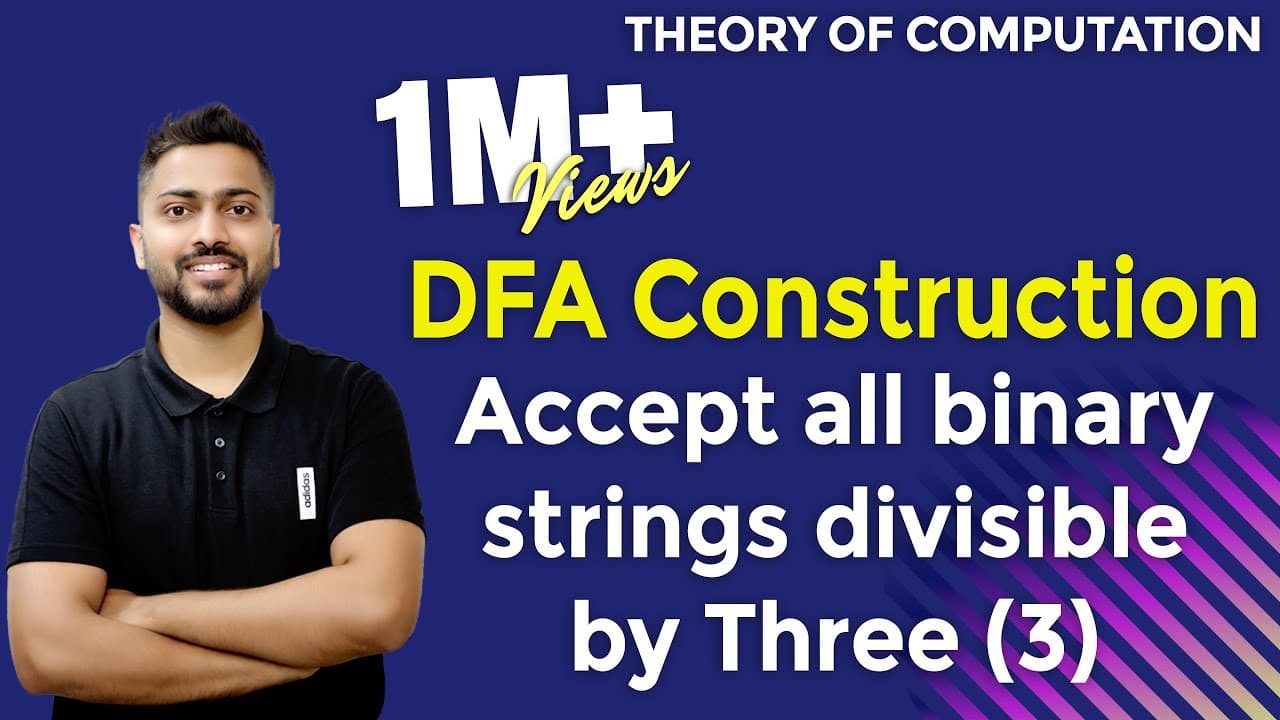
How to build a DFA for binary strings divisible by 3
TL;DR
A DFA for binary strings divisible by 3 uses three states to track the remainder when reading bits. It starts in the initial state, transitions based on input 0 or 1, and marks the remainder 0 state as accepting. The construction ensures every accepted string leaves a remainder of zero after the entire input is consumed.
Transcript
hello those so great smashes make us forget their next example is construct a DFA which has hacked a language of all binary strings divisible by three over the alphabet 0 & 1 2 GB a proportionate divisible by 3 it visible by 2 5 ome popco is typing questions go chemically a simple symmetric apparently a checker lo que a Kissimmee number code divisi... Read More
Key Insights
- The DFA for binary strings divisible by 3 is built with three states representing remainders 0, 1, and 2.
- The initial state corresponds to a remainder of 0 and is accepting, indicating current prefix is divisible by 3.
- Transitions update the remainder according to the next bit read, maintaining correctness for divisibility checks.
- The language consists of all binary strings whose total value leaves remainder 0 when divided by 3.
- This construction is an example of a minimal automaton for a simple modular property in binary.
- The DFA is deterministic, with a defined next-state for each input symbol from each state.
- The design uses left-to-right reading of bits, updating the remainder after each step.
- The acceptance condition is solely determined by ending in the remainder 0 state after the full input.
- More videos from this channel:
- More from this channel: Gate Smashers
Install to Summarize YouTube Videos and Get Transcripts
Explore YouTube Video Summarizer or Get YouTube Transcript Extractor
Questions & Answers
Q: What is the number of states in the DFA for binary strings divisible by 3?
The DFA uses three states, each representing a possible remainder when a binary number is divided by 3: 0, 1, or 2. This minimal state set suffices to uniquely determine whether any given binary string is divisible by three, based on the accumulated remainder as bits are read.
Q: What is the start state in this DFA and why?
The start state represents a remainder of zero, meaning an empty string is already divisible by 3. It is the default initial condition before any bits are processed and is typically marked as an accepting state since zero remainder means divisibility by 3.
Q: How are transitions defined for input bit 0?
When reading a 0, the DFA updates the current remainder by effectively doubling the value of the prefix. This changes the remainder modulo 3 according to the established transition table, moving to the appropriate next state that represents the new remainder.
Q: How are transitions defined for input bit 1?
Reading a 1 increases the current value by one before applying modulo 3. The corresponding transition moves the DFA to the state that represents this new remainder, preserving the property that the entire string will be divisible by 3 if it ends in the remainder 0 state.
Q: What makes this DFA minimal for the task?
Three states are necessary and sufficient to distinguish all possible remainders modulo 3. Any smaller automaton would fail to distinguish all residues, while adding more states would not reduce complexity for the exact modular property being tested.
Q: What is the accepting condition for the DFA?
A string is accepted if, after processing all input bits, the DFA is in the state that represents remainder 0. This indicates that the numerical value of the binary string is divisible by 3.
Q: Can you read the input bits left to right?
Yes, the DFA processes bits from left to right, updating the current remainder after reading each bit. This online processing allows immediate determination of divisibility without needing to know the entire string in advance.
Q: What kind of language does this DFA recognize?
It recognizes the set of binary strings whose numeric value is a multiple of 3. The automaton accepts precisely those strings that, under standard binary interpretation, yield a remainder of zero when divided by three.
Summary & Key Takeaways
-
A three-state DFA tracks remainders 0, 1, and 2 as bits are read, ensuring acceptance only when the final remainder is zero.
-
The start state represents remainder 0 and is accepting, while transitions correspond to updating the remainder modulo 3 after each bit.
-
The approach demonstrates a concrete method to recognize binary strings divisible by 3 using a minimal automaton.
Read in Other Languages (beta)
Share This Summary 📚
Summarize YouTube Videos and Get Video Transcripts with 1-Click
Try YouTube Summary with ChatGPT & Claude or YouTube Transcript Generator
Explore More Summaries from Gate Smashers 📚






Summarize YouTube Videos and Get Video Transcripts with 1-Click
Try YouTube Summary with ChatGPT & Claude or YouTube Transcript Generator