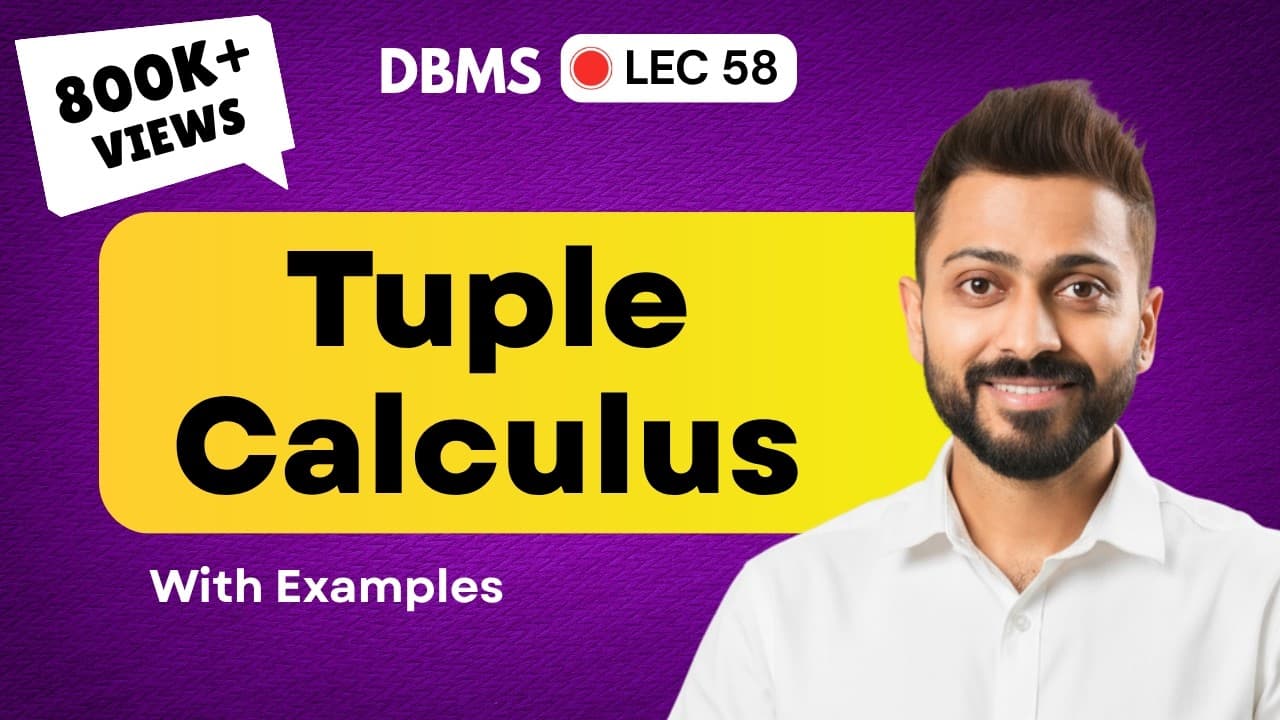
How to Understand Tuple Relational Calculus in DBMS
TL;DR
Tuple relational calculus is a non procedural query language that uses a variable to denote tuples and a predicate to filter results. It contrasts with relational algebra by being non procedural and emphasizes using first order logic with existential and universal quantifiers. Expressions can be unsafe if they create infinite results.
Transcript
Hello friends welcome to DBMS class in this class we are going to discuss tuple relational calculus so if we talk about this exam 99.99% chances are there for questions to come from sequel or from relational algebra. but as they have mentioned in the syllabus on TRC so we will do a little discussion on this also so first of all if we talk tuple rel... Read More
Key Insights
- TRC is a non procedural query language that focuses on tuples rather than attributes, using a tuple variable to scan all tuples in a relation.
- A predicate or formula defines the condition that tuples must satisfy, and the final output consists of tuples that satisfy the predicate.
- Existential quantification asserts that there exists at least one tuple that meets the condition, while universal quantification requires the condition to hold for all tuples.
- The concept of unsafe expressions arises when an expression could produce infinite or undefined results, making them unusable in TRC and relational algebra.
- Atomic formulas operate on a single tuple and a single variable, while composite formulas involve multiple conditions.
- Relational algebra and TRC have the same expressive power, but SQL adds more features that extend practical capabilities beyond these formalisms.
- Free variables are used to reference attributes from available relations and determine which attributes appear in the final output.
- In practice, TRC can simulate SQL style queries by iterating over tuples and applying predicates, illustrating a bridge between theoretical and practical query languages.
- More videos from this channel:
- More from this channel: Gate Smashers
Install to Summarize YouTube Videos and Get Transcripts
Explore YouTube Video Summarizer or Get YouTube Transcript Extractor
Questions & Answers
Q: A real search query question about the video (e.g. 'How to...', 'What is...', 'Why does...'). Question 1
What is Tuple Relational Calculus and how does it differ from relational algebra in terms of procedure and focus on tuples rather than attributes? Tuple Relational Calculus is a non procedural query language where queries describe what results are sought using a tuple variable and a predicate. Unlike relational algebra, it does not specify a step by step plan for how to obtain those results, but instead states the conditions that must hold for the resulting tuples. This distinction is fundamental to understanding how TRC can express the same queries as relational algebra while maintaining a different expressive approach.
Q: Question 2
How do existential and universal quantifiers function in Tuple Relational Calculus, and what is an example of their use with a simple table like ages or supplier data? Existential quantification asserts that there exists at least one tuple that satisfies a condition, for example there exists a tuple with age greater than 20. Universal quantification requires the condition to hold for all tuples, such as all ages being greater than zero. These quantifiers shape the truth of a TRC predicate and determine which tuples appear in the final result.
Q: Question 3
What makes an expression in TRC unsafe, and why is avoiding unsafe expressions important for equivalence with relational algebra? An unsafe expression could allow infinite results or produce ambiguous outputs, such as expressing a negation without a bounded domain or referencing a relation in a way that does not constrain the output. Avoiding unsafe expressions ensures the TRC query remains well defined and aligns with the safe, finite results expected from relational algebra.
Q: Question 4
How are variables and predicates used together to filter results in TRC, and what role does a simple example play in illustrating this process? In TRC a tuple variable, like t, ranges over all tuples in a relation, and a predicate defines the condition these tuples must satisfy to be included in the output. The result is the set of tuples in which the predicate holds true. Simple examples with age or name fields help illustrate how the predicate constrains the output and how to construct a query that retrieves desired values.
Q: Question 5
What is meant by a free variable in TRC and how does it affect the final projection of results? A free variable is a variable that appears in the query without being bound by a quantifier. It determines which attributes will appear in the final output and can influence the selection of tuples by the predicate. Free variables define what the output should look like and guide the construction of the final select-like portion of a TRC expression.
Q: Question 6
How does TRC relate to SQL in terms of expressiveness and translating concepts between the two languages? TRC and relational algebra have the same expressive power in theory, meaning equivalent queries can be written in either form. SQL adds practical extensions and functions beyond TRC and algebra, enabling more complex operations and features in real databases. Translating TRC ideas into SQL typically involves converting the tuple based predicates into join and selection clauses.
Q: Question 7
What is the significance of using a tuple variable to scan all tuples in a relation in TRC, and how does this mechanism drive query evaluation? The tuple variable represents each row in turn, allowing the predicate to be evaluated on that row. This scanning mechanism is essential because it defines how TRC determines which tuples satisfy the given conditions and hence what is returned as the final result. It mirrors a for each over rows in a relational table.
Q: Question 8
How are simple queries like printing supplier names or IDs derived using TRC, and what does this illustrate about the practical use of the language? By binding a tuple variable to the supplier relation and applying a predicate on attributes such as supplier name or ID, the final projection selects the required fields. This demonstrates a direct approach to extracting specific information with TRC, highlighting how predicates govern what data is included in the result and how free variables determine the output schema.
Summary & Key Takeaways
-
Tuple relational calculus is introduced as a non procedural language that operates on tuples rather than attributes, using predicates to define the final result set. The lecture explains the role of variables like t, the meaning of predicates, and how existential and universal quantifiers affect query evaluation. It compares TRC with relational algebra in expressive power and highlights unsafe expressions.
-
The content demonstrates how to write simple TRC expressions to retrieve supplier and catalogue information, such as printing supplier names or IDs, and how to handle multiple conditions with conjunctions and negation. It also discusses the equivalence of TRC with relational algebra in terms of expressive power and cautions about unsafe constructs.
-
Finally, the video presents examples of translating TRC ideas into SQL queries, showing how to express the same queries in SQL by using predicates over supplier and catalogue tables, and discusses free variables and their role in query formulation.
Read in Other Languages (beta)
Share This Summary 📚
Summarize YouTube Videos and Get Video Transcripts with 1-Click
Try YouTube Summary with ChatGPT & Claude or YouTube Transcript Generator
Explore More Summaries from Gate Smashers 📚



Summarize YouTube Videos and Get Video Transcripts with 1-Click
Try YouTube Summary with ChatGPT & Claude or YouTube Transcript Generator