How Does Context Switching Work in Operating Systems?
TL;DR
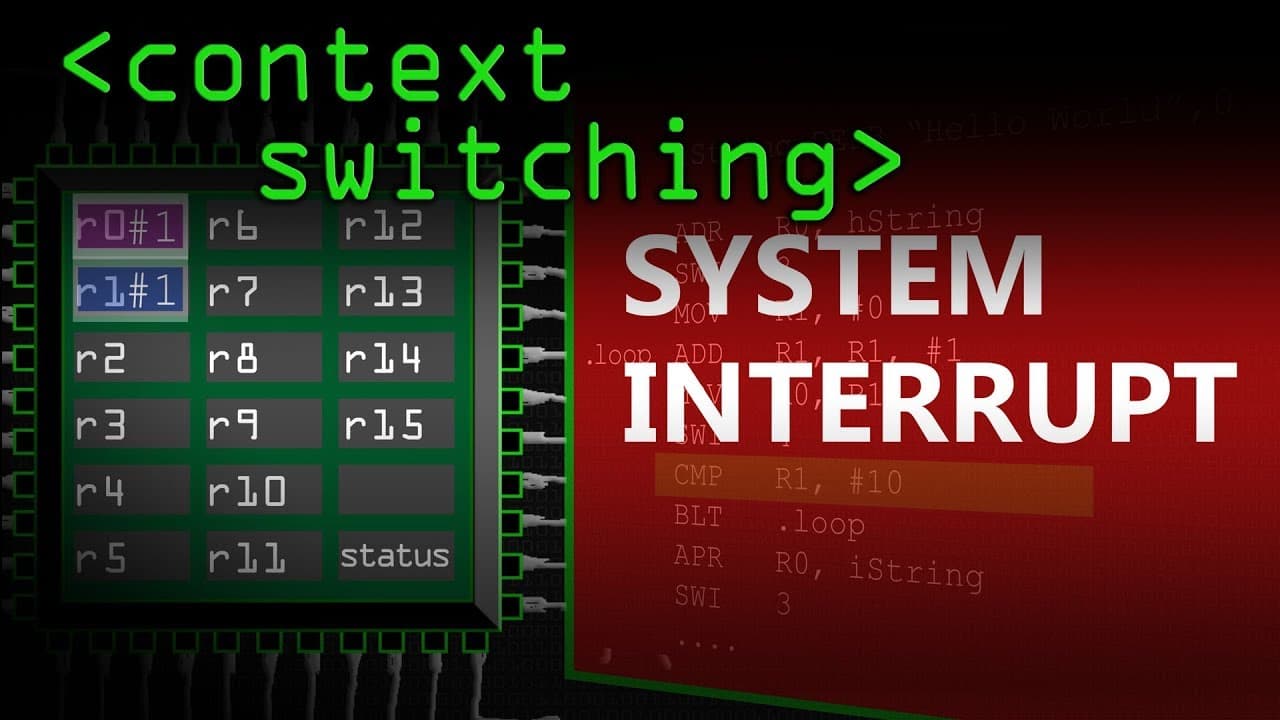
Context switching enables multiple processes to run concurrently by temporarily halting one process and switching to another. This involves saving the state of the current process, including register values, and loading the state of the next process. Context switching occurs during operating system calls or through hardware-generated interrupts.
Transcript
right so in the previous video we looked at how we can build an operating system that can switch between multiple processes to create the illusion that they're running at the same time and we saw with the demo we got here we had this model that enabled us to conceive how we had different processes running at the same time so we always have one that... Read More
Key Insights
- 🛟 Context switching involves preserving the state of a process, including register values and the program counter, before switching to another process.
- 🤙 Context switching can occur during operating system calls or through interrupts generated by hardware.
- 🥹 The process control block holds the necessary information for context switching, such as register values and the program counter.
- ⏲️ Timing considerations are crucial in context switching to ensure that critical operations in programs relying on time or the clock are not interrupted.
Install to Summarize YouTube Videos and Get Transcripts
Explore YouTube Video Summarizer or Get YouTube Transcript Extractor
Questions & Answers
Q: What is context switching in operating systems?
Context switching is the process of switching between different processes running on an operating system, allowing them to appear to run simultaneously. It involves preserving the state of the current process and loading the state of the next process.
Q: How does context switching work at the machine code level?
At the machine code level, each instruction in a program depends on the values in the registers, regardless of how they were obtained. Context switching involves storing the values of registers, the program counter, and the status register of a process before loading the values of the next process.
Q: When does context switching occur?
Context switching can occur during operating system calls, where the operating system decides to switch to another process after the current one finishes its task. It can also occur through interrupts generated by hardware, such as a regular timer interrupt.
Q: How does context switching handle programs that rely on time or the clock?
In programs that rely on time or the clock, the scheduling of processes becomes crucial. The operating system needs to ensure that context switching does not interrupt critical operations in these programs. The scheduling algorithm takes into account the timing requirements of such programs to avoid any disruptions.
Summary & Key Takeaways
-
Context switching allows multiple processes to appear to run simultaneously by quickly switching between them.
-
The process control block stores the state of a process, including register values and the program counter.
-
Context switching can occur during operating system calls or through interrupts generated by hardware.
Read in Other Languages (beta)
Share This Summary 📚
Summarize YouTube Videos and Get Video Transcripts with 1-Click
Try YouTube Summary with ChatGPT & Claude or YouTube Transcript Generator
Explore More Summaries from Computerphile 📚





Summarize YouTube Videos and Get Video Transcripts with 1-Click
Try YouTube Summary with ChatGPT & Claude or YouTube Transcript Generator