How to Read Company Strategy From Job Postings With AI
TL;DR
AI can extract company strategy from public job postings alone. By feeding an LLM a strategic prompt over a set of listings, you can infer product roadmaps, B2B sales gaps, technical weaknesses, and career openings. What was once trivial 'waste data' is now a powerful competitive intelligence lens for job seekers, operators, and investors alike.
Transcript
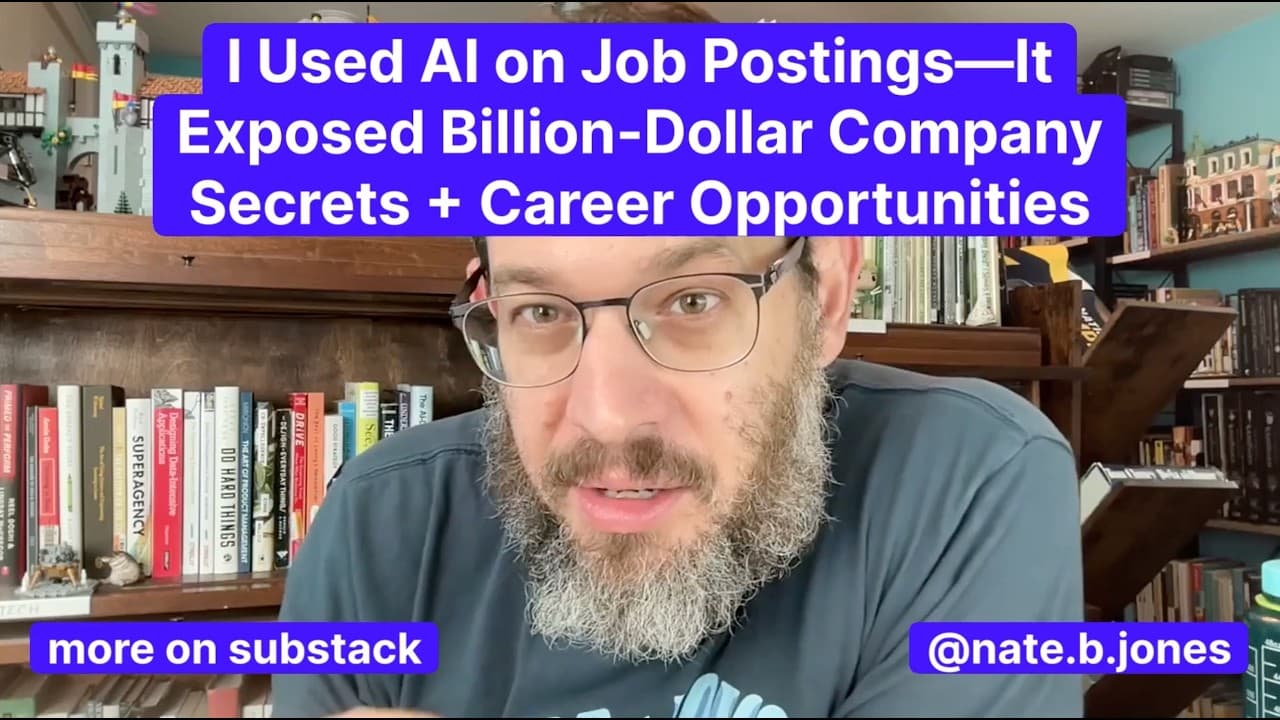
In the next 10 minutes together, we are going to crack the code on reading job postings. It's a lost art and it's one that we can absolutely transform in the era of AI. And I don't just mean for job seekers, although that's obviously a huge benefit. You also can infer company strategy, B2B sales approaches, and all kinds of other things just from r... Read More
Key Insights
- Reading job postings is a lost art that AI can transform, letting you infer company strategy, B2B sales approaches, and career opportunities from listings alone, rather than just scanning them for open roles.
- LLMs replace the old manual review process where you would gather 100+ postings, categorize them, spot commonalities and weak points, and note what was not posted, doing all of it in a single prompt.
- AI plays both a volume game and a strategy game: you give the LLM a strategic prompt telling it to reason and infer in a particular way over postings it searches, and it returns a strategic view.
- In the Anthropic example, the model inferred a product strategy of doubling down on core AI, flagged a lack of fresh platform engineering hires, and read alignment science and model welfare roles as tackling safety problems.
- A B2B sales opportunity can be inferred from hiring gaps: Anthropic's postings suggested startup-stage account management, little dedicated sales engineering, and no post-sales technical support, signaling a stressed sales team open to solutions.
- The absence of internships, entry-level roles, and platform engineering hires can signal technical debt risk as a company scales, which the speaker links to Anthropic's recent outages and possible need for capital injection.
- A strong analysis shows its work: the model provides a table with what it read, the link, its reasoning, and the claims it confirms, all sourced from recent postings rather than old ones, so you can audit it.
- AI creates a new class of valuable data from what was previously trivial 'waste data': public selfies can reveal location through image recognition, so job postings are just one of many newly analyzable data sources.
Install to Summarize YouTube Videos and Get Transcripts
Explore YouTube Video Summarizer or Get YouTube Transcript Extractor
Questions & Answers
Q: How can AI read a company's strategy from job postings?
You give an LLM a strategic prompt and tell it to reason and infer in a particular way over a set of job postings that it searches, and it returns a strategic view. Rather than manually gathering 100+ postings, categorizing them, and spotting commonalities and weak points, the LLM does all of that in one prompt. It can infer product strategy, B2B sales approaches, company weaknesses, and career opportunities, playing both a volume game and a strategy game.
Q: What did the AI infer about Anthropic from its job postings?
The analysis inferred a product strategy of doubling down on core AI, flagged a lack of fresh platform engineering hires suggesting a focus on scaling existing tech, and read alignment science and model welfare roles as a willingness to tackle unsolved safety and ethics problems. It also inferred a B2B push for rapid enterprise adoption with little dedicated sales engineering, plus weaknesses in PM, QA, and customer support, underlining the company's research roots.
Q: How can you infer a B2B sales approach from hiring gaps?
By reading which roles are missing, you can spot opportunities. In Anthropic's case, the postings signaled a push for rapid enterprise adoption based on startup account management and B2B marketing, but showed little evidence of dedicated sales engineers or post-sales technical support. This indicates a sales team probably under stress, creating an opportunity for someone to come in and offer solutions, all inferred just from public job listings.
Q: What can job seekers learn from a company's job postings?
Job seekers can learn about risks and timing. For Anthropic, the analysis noted no internships or entry-level roles posted and very few platform engineering roles, which sets up a potential technical debt risk as the company scales. The career-focused version surfaced a rapidly growing Seattle office and an NYC hub, insane AI comp, and receipts showing the reasoning, giving candidates a clear read on where the company is investing.
Q: Why is job posting data now considered competitive intelligence?
We are in a world where an entire new class of data previously considered trivial, not worth hiding or securing because nobody had time to analyze it, is now open season. Job listings are publicly shared, so plugging them into an LLM gives a full competitive readout on a competitor without doing anything inappropriate. Investors, PMs, sales guides, buyers, and job seekers can all extract strategic understanding from this now-analyzable data.
Q: What tools can you use to analyze job postings with AI?
The speaker built a custom app in Lovable to showcase the capability, which engineers can use with an API key and which anyone can remix into a career-focused or intelligence-focused version. You do not need the app, though: you can run the same analysis directly in ChatGPT or in a search engine like Perplexity using shared prompts. The quality depends on your ability to ask very clearly for exactly what is important to you.
Q: How does the AI show its reasoning is trustworthy?
The part the speaker loves most is that the model shows why it reached its conclusions. It provides a table stating what it read, the link to the source, its reasoning, and the claims it is confirming. The Perplexity version emphasizes proving how it got there, showing the grounds or inputs first. Everything is recent stuff rather than old postings, so you can verify the analysis is not perfect but is well grounded.
Q: What other trivial data becomes useful in the age of AI?
The speaker offers a safety tip: publicly available selfies taken outside. With reasoning models and ChatGPT image recognition, LLMs are extremely good at knowing where a photograph was taken. If your Instagram feed is public and you post outdoor selfies, your location can be inferred even without revealing it. This illustrates that LLMs are turning previously worthless waste data into useful information, with job postings being one of the most useful examples.
Summary & Key Takeaways
-
AI transforms how we read job postings, turning a lost art into a strategic tool. Instead of manually reviewing hundreds of listings to categorize roles and spot patterns, a single strategic prompt lets an LLM search, reason, and infer over postings, returning a comprehensive view of a company's strategy in minutes.
-
Using a Lovable app and prompts for ChatGPT and Perplexity, the speaker analyzed Anthropic. The output inferred product strategy, a B2B sales push with gaps in sales engineering, company weaknesses in platform engineering and PM/QA/support, and career details like a growing Seattle office, NYC hub, and high AI comp.
-
The larger lesson is that LLMs make a whole new class of previously trivial data useful for analysis. Job postings, public selfies revealing location, and similar data are now open for strategic understanding. This benefits job seekers, PMs, sales teams, buyers, and investors who can cross-check listings against company claims.
Read in Other Languages (beta)
Share This Summary 📚
Summarize YouTube Videos and Get Video Transcripts with 1-Click
Try YouTube Summary with ChatGPT & Claude or YouTube Transcript Generator
Explore More Summaries from AI News & Strategy Daily | Nate B Jones 📚






Summarize YouTube Videos and Get Video Transcripts with 1-Click
Try YouTube Summary with ChatGPT & Claude or YouTube Transcript Generator