Black Holes Explained | Martin Rees and Lex Fridman
TL;DR
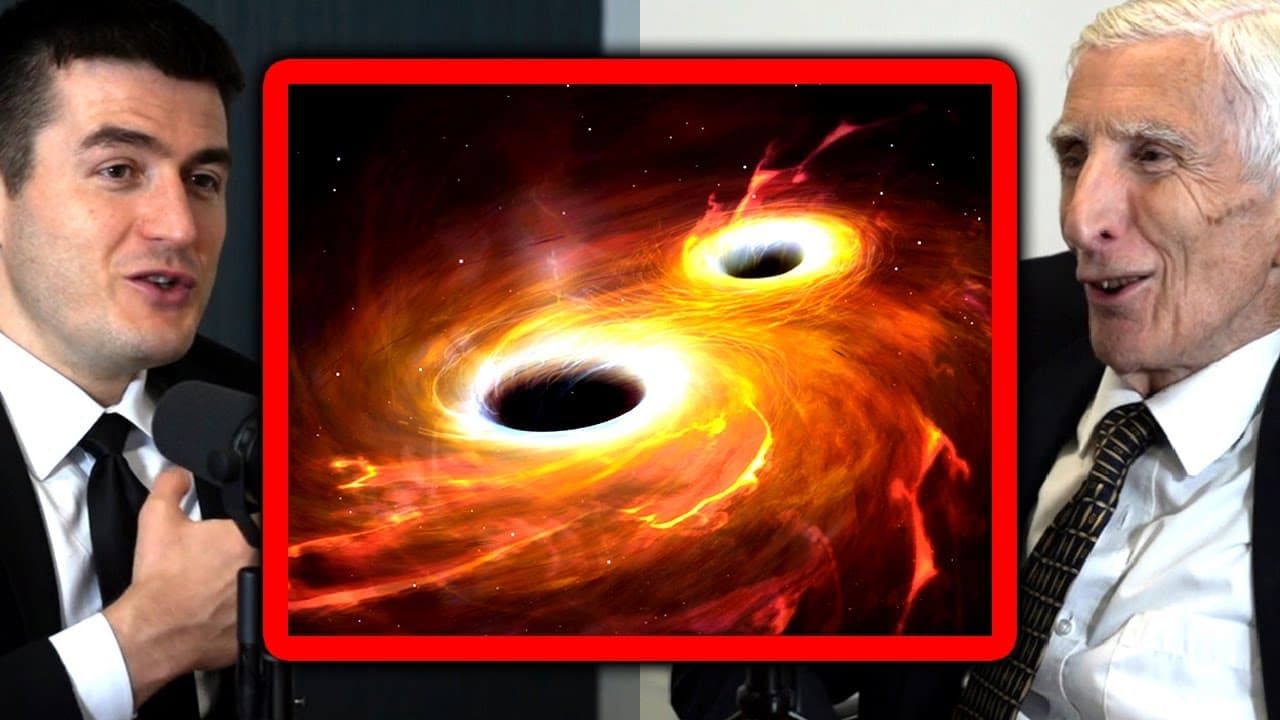
Black holes are well-defined objects with mass and spin, formed from the collapse of massive stars. They can lead to various phenomena, including neutron stars and quasars.
Transcript
what are black holes what do we humans understand about black holes and what's still unknown einstein's theory extended by people like roger penrose tells us that um black holes are in a sense well the simple things basically because uh they are um solutions of einstein's equations um and the thing that was shown in the 1960s by roger penrose in pa... Read More
Key Insights
- 🖤 Black holes are defined by their mass and spin, making them well-defined objects in the universe.
- ✴️ The formation of black holes results from the collapse of massive stars, leading to highly dense objects.
- ✴️ Neutron stars and quasars provide valuable insights into the extreme physics of black holes.
- ✴️ Quasars are galaxies where the central black hole emits intense radiation, outshining all the stars in the galaxy.
- 🖤 Most galaxies are believed to have black holes, but their activity and visibility can vary.
- 🥺 Black hole collisions can occur when galaxies merge, leading to bursts of gravitational waves.
- 🤩 The merging of galaxies does not significantly affect the spacing between stars and planets, so the chances of collisions in our solar system remain small.
- 🎙️ More videos with Martin Rees:
Install to Summarize YouTube Videos and Get Transcripts
Explore YouTube Video Summarizer or Get YouTube Transcript Extractor
Questions & Answers
Q: How do stars evolve differently based on their mass?
Stars evolve differently depending on their mass, with more massive stars burning up their fuel more quickly and eventually exploding. This process synthesizes atoms, including those found in our bodies, inside the star.
Q: What is a neutron star and how is it related to black holes?
Neutron stars are extremely dense objects, where the mass of a star is compressed into a size of about 10 miles. They are related to black holes as a possible outcome of the collapse of massive stars, representing an intermediate stage before black hole formation.
Q: How were black holes first detected?
Black holes were first detected when astronomers observed objects that appeared like stars but emitted significantly more energy than an entire galaxy. It was discovered that these objects were black holes capturing and heating up gas, which then emitted intense radiation.
Q: Do all galaxies have black holes?
Most galaxies are suspected to have black holes in their centers. However, the activity of these black holes varies, with some galaxies going through a quasar phase where the black hole captures gas and becomes extremely bright.
Summary & Key Takeaways
-
Black holes are solutions of Einstein's equations and are defined by their mass and spin.
-
The formation of black holes is a messy and complicated process, resulting from the collapse of massive stars.
-
Phenomena attributed to black holes include neutron stars and quasars, which have provided valuable insights into physics.
Read in Other Languages (beta)
Share This Summary 📚
Summarize YouTube Videos and Get Video Transcripts with 1-Click
Try YouTube Summary with ChatGPT & Claude or YouTube Transcript Generator
Explore More Summaries from Lex Clips 📚



Summarize YouTube Videos and Get Video Transcripts with 1-Click
Try YouTube Summary with ChatGPT & Claude or YouTube Transcript Generator