How to remember everything you read efficiently
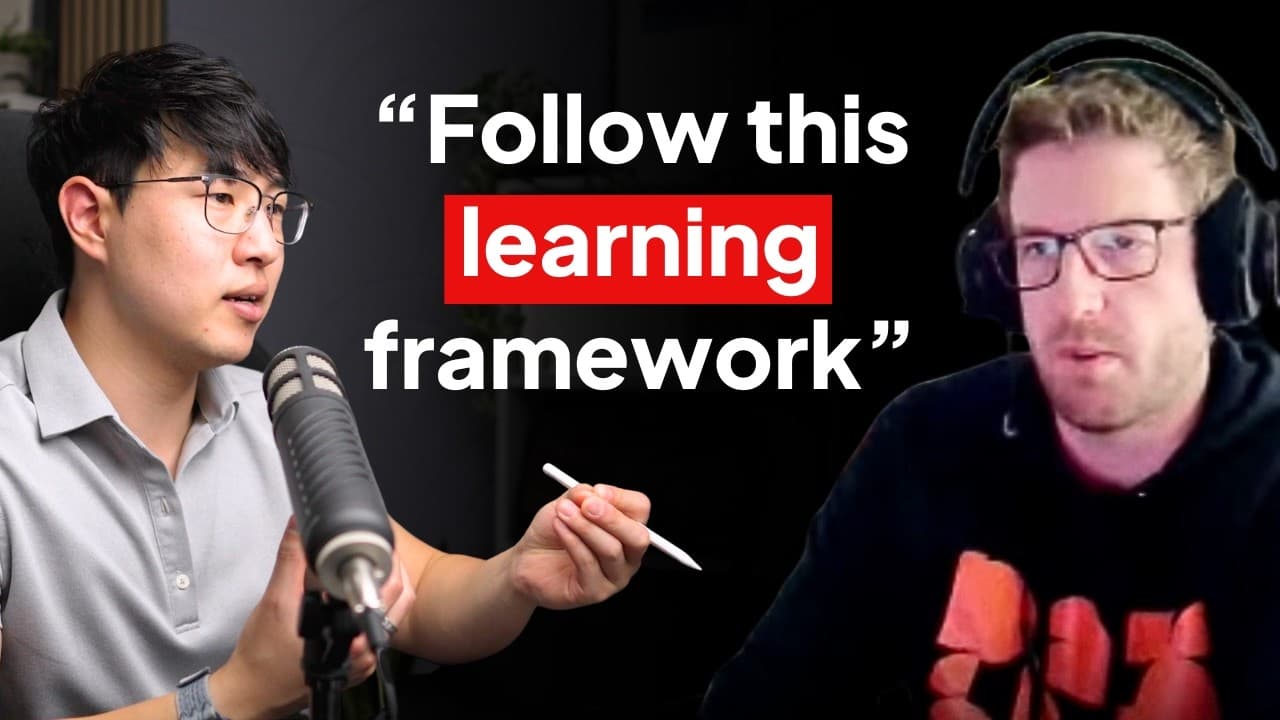
TL;DR
Effective learning hinges on creating fast, deep connections between new information and existing knowledge. Start by recognizing overwhelm as the right starting point, then use strategies that gradually lower cognitive load while building interconnected understanding. Avoid isolation and the illusion of learning by reinforcing meaningful links and testable recall to convert knowledge into usable expertise.
Transcript
As a learning coach for the past 13 years, I've worked with over 30,000 students and professionals. And everyone I work with pretty much has the same problem. There's too much to learn and not enough time. Recently, Dan, a software engineer and actually one of my employees came to me with this very problem. Especially in software, there's constantl... Read More
Key Insights
- Overwhelm is a normal starting point in effective learning.
- A snowball learning process creates initial connections that cascade into broader knowledge.
- Isolated information becomes learning debt unless linked to others.
- The illusion of learning arises when understanding feels deeper but isn’t interconnected.
- Avoid passive strategies that reduce cognitive load too much, as they hinder integration.
- Avoid trying to connect all pieces at once; balance cognitive load to progress.
- Functional expertise comes from organized, recallable knowledge rather than mere comprehension.
- Recognize and manage cognitive load to move learning from overload to mastery.
- More videos from this channel:
- More from this channel: Justin Sung
Install to Summarize YouTube Videos and Get Transcripts
Explore YouTube Video Summarizer or Get YouTube Transcript Extractor
Questions & Answers
Q: How to start remembering a large amount of information quickly
To begin, acknowledge that a high information load is normal and use it as a starting signal. Focus on creating initial connections between pieces of information rather than attempting to memorize everything in one go. This creates a foundation where new ideas can attach and expand, accelerating long term retention.
Q: What is snowball learning
Snowball learning refers to building small, initial connections that attract more related information over time, like magnets forming a growing ball. Start with a few core concepts, then connect related ideas, examples, and rules. As connections multiply, you gain a dense, readily retrievable knowledge network that supports faster recall and application.
Q: Why is isolation of information problematic
Isolation leaves knowledge as meaningless fragments that do not support practical use. Isolated pieces fail to form a usable network, so you spend more time relearning when you need to apply the knowledge. Building connections converts isolated facts into a learning asset you can recall and deploy under real conditions.
Q: What is the illusion of learning and how to avoid it
The illusion of learning happens when you feel you understand something because it seems familiar or you have written notes, but you cannot apply it reliably. To avoid this, regularly test recall in context, strive to connect concepts, and ensure you can explain or implement ideas without prompts.
Q: How to manage cognitive load during learning
Manage cognitive load by choosing strategies that progressively reduce overload rather than explode it. Start with high level organization, then gradually increase integration. Avoid trying to fully map every connection at once while also avoiding rote memorization that doesn’t support practical use.
Q: What is meant by learning debt
Learning debt occurs when effort spent on acquiring information does not translate into usable knowledge. Pieces are understood superficially or remain isolated, leading to later relearning or incorrect decisions. The remedy is to connect new information into a coherent, retrievable network that supports action.
Q: Why is understanding not enough for true expertise
Understanding alone is not enough because knowledge must be organized and retrievable in the moment of need. True expertise requires that information be integrated into a network that supports problem solving and decision making. Without connections, even deep understanding can fade under real world pressure.
Q: How to convert learning into faster performance
Convert learning into faster performance by ensuring information is stored as interconnected, retrievable knowledge. Build a dense mental map where each piece links to others, practice recall in realistic contexts, and continually reinforce these connections. This makes applying knowledge quicker and more reliable under pressure.
Summary & Key Takeaways
-
A professional learning coach explains that massive volumes of information can be learned faster by creating initial connections quickly and preventing isolated knowledge that evaporates. The approach emphasizes recognizing overwhelm as a starting signal and choosing strategies that increase organization without overloading the brain. This turns information into durable learning assets.
-
The discussion mirrors a jigsaw metaphor: pieces must be organized so the big picture emerges, not merely memorized. It warns against passive rote methods that reduce cognitive effort but fail to interlink concepts. The goal is functional expertise achieved through structured integration and recall.
-
The speaker outlines a practical framework: identify overload, apply scaffolding techniques, and progressively connect pieces into a dense, usable network. This prevents learning debt and the illusion of knowledge, guiding learners toward genuine competence and faster performance in professional tasks using memory-enabled strategies.
Read in Other Languages (beta)
Share This Summary 📚
Summarize YouTube Videos and Get Video Transcripts with 1-Click
Try YouTube Summary with ChatGPT & Claude or YouTube Transcript Generator
Explore More Summaries from Justin Sung 📚


Summarize YouTube Videos and Get Video Transcripts with 1-Click
Try YouTube Summary with ChatGPT & Claude or YouTube Transcript Generator