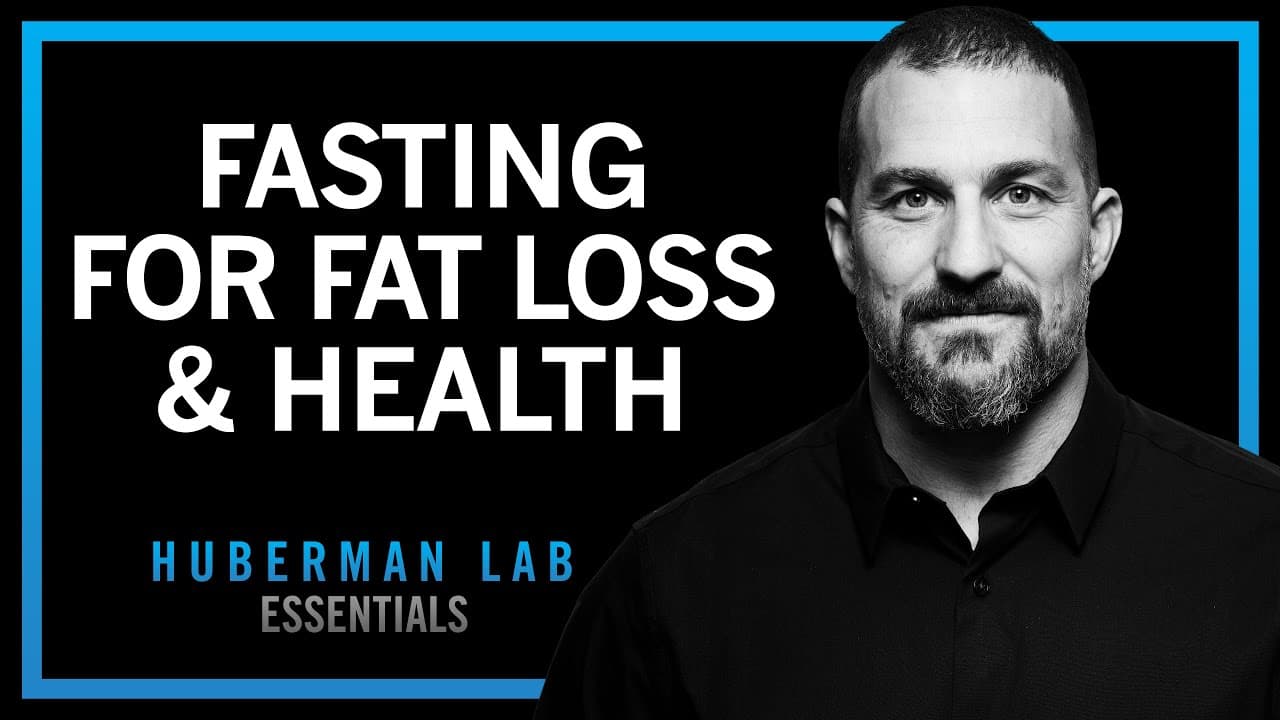
How Does Time-Restricted Eating Affect Fat Loss and Health? | Huberman Lab Essentials
TL;DR
Time-restricted eating can support fat loss and improve health parameters by maintaining the fasted state and anchoring circadian rhythms. In mice consuming identical calories from a high-fat diet, an 8-hour eating window prevented obesity and improved health compared with around-the-clock access. Andrew Huberman also explains why calorie balance remains foundational and how insulin, glucagon, exercise, hormones, and NEAT influence the outcome. Read on to understand the mechanisms and evidence.
Transcript
Welcome to Huberman Lab Essentials, where we revisit past episodes for the most potent and actionable science-based tools for mental health, physical health, and performance. I'm Andrew Huberman, and I'm a professor of neurobiology and opthalmology at Stanford School of Medicine. What we're going to talk about today is how intermittent fasting aka ... Read More
Key Insights
- Weight loss depends mainly on caloric balance: a 2018 JAMA study by Chris Gardner found no significant weight difference over 12 months between a healthy low-fat and a healthy low-carbohydrate diet, showing what you eat matters less than how much for weight loss alone.
- Basal metabolic rate is not fixed. Non-exercise induced thermogenesis (NEAT) means people who fidget and move can burn 800 to 2,000 extra calories per day, raising the calories-out side of the equation well beyond stationary individuals.
- Hormones profoundly influence calories burned. Thyroid hormone, insulin, growth hormone, testosterone, and estrogen all shift the calories-out component, so calories in versus calories out is a foundational truth but not the whole story.
- Eating raises blood glucose and insulin, and the size of that rise depends on the food. Simple sugars raise them most, then complex carbs like breads and pastas, then fibrous carbs like broccoli, with protein moderate and fat lowest.
- Fasting shifts hormones toward energy mobilization. When blood glucose is low, glucagon and GLP-1 rise, triggering lipolysis to release fat and drawing on carbohydrates and potentially muscle as energy sources.
- Health benefits of fasting are time-dependent. Insulin and glucose stay elevated for a period after eating and take time to fall, so benefits appear only when fasted-state conditions are maintained in the body for a sufficient duration.
- In mice on a high-fat diet, timing beat total intake. Mice eating the same calories within a restricted 8-hour window maintained or lost weight, while mice with around-the-clock access to identical food gained weight, became obese, and got sick.
- Restricted feeding stabilizes circadian biology. About 80% of the genes in the body and brain run on a 24-hour schedule, and confining eating to one phase of the cycle anchors these gene systems, improving health markers and even reversing prior negative effects.
Install to Summarize YouTube Videos and Get Transcripts
Explore YouTube Video Summarizer or Get YouTube Transcript Extractor
Questions & Answers
Q: How does time-restricted eating affect fat loss and health?
Time-restricted eating limits food intake to a defined part of each 24-hour cycle, creating a sustained fasted period. The transcript says animal and human studies show positive effects on weight loss, fat loss, and various health parameters, while a cited mouse study found that an 8-hour eating window prevented obesity and improved health markers despite identical calorie intake.
Q: Does what you eat or how much you eat matter more for weight loss?
For weight loss specifically, total calorie balance matters more than whether a diet is healthy low-fat or healthy low-carbohydrate. A 2018 JAMA study led by Chris Gardner followed participants for 12 months and found no significant difference in weight change between those two diets.
Q: Why is calories in versus calories out not the whole story?
Calorie balance is foundational, but exercise, basal metabolic rate, movement, and hormones all affect the calories-burned side. Thyroid hormone, insulin, growth hormone, testosterone, and estrogen can profoundly influence energy expenditure, so the biological context of a diet also matters.
Q: How much can fidgeting and everyday movement affect calorie expenditure?
Non-exercise induced thermogenesis, or NEAT, includes activities such as bouncing around and fidgeting. According to the transcript, people who fidget frequently can burn anywhere from 800 to 2,000 calories per day, giving them higher daily energy expenditure than more stationary people.
Q: What happens to blood glucose and insulin after eating?
Blood glucose and insulin typically rise after a meal, with the size of the increase depending on what and how much is eaten. Simple sugars raise them more than complex carbohydrates such as grains, breads, and pastas, while the existing page content describes fibrous carbohydrates, protein, and fat as producing progressively smaller effects.
Q: What happens metabolically during fasting?
As blood glucose and insulin fall during fasting, glucagon and GLP-1 rise and help mobilize stored energy. This includes releasing fat through lipolysis and drawing on carbohydrates and potentially muscle, distinguishing the fasted state from the elevated-glucose and elevated-insulin state after eating.
Q: Why does the timing of meals matter?
Insulin and glucose remain elevated for a period after eating, so the body needs enough time without food to establish and maintain fasted-state conditions. In the cited mouse study, animals given the same high-fat food and calories within an 8-hour window maintained or lost weight, whereas those with around-the-clock access gained weight, became obese, and got sick.
Q: How can time-restricted eating affect circadian rhythms and genes?
About 80% of genes in the body and brain operate on a 24-hour schedule, with their levels changing across the day. Restricting eating to one phase of that cycle can anchor these gene systems and stabilize circadian rhythms; in mice, this was associated with improved health markers and reversal of some prior negative effects.
Summary & Key Takeaways
-
Diet and nutrition are highly controversial, so terms must be defined precisely. The 2018 Gardner JAMA study showed that for weight loss over 12 months, a healthy low-fat and a healthy low-carbohydrate diet produced no significant difference, meaning caloric intake matters more than food type for weight loss.
-
The calories-out side of the equation is shaped by exercise, basal metabolic rate, NEAT (which can vary 800 to 2,000 calories per day from fidgeting), and hormones like thyroid, insulin, growth hormone, testosterone and estrogen. Eating raises blood glucose and insulin, while fasting raises glucagon and GLP-1 to mobilize fat.
-
A landmark mouse study titled 'time-restricted feeding without reducing caloric intake prevents metabolic diseases in mice fed a high-fat diet' showed that when mice ate mattered more than what. An 8-hour eating window prevented obesity, improved health markers, reversed prior damage, and anchored the roughly 80% of genes on a 24-hour rhythm.
Read in Other Languages (beta)
Share This Summary 📚
Summarize YouTube Videos and Get Video Transcripts with 1-Click
Try YouTube Summary with ChatGPT & Claude or YouTube Transcript Generator
Explore More Summaries from Andrew Huberman 📚





Summarize YouTube Videos and Get Video Transcripts with 1-Click
Try YouTube Summary with ChatGPT & Claude or YouTube Transcript Generator