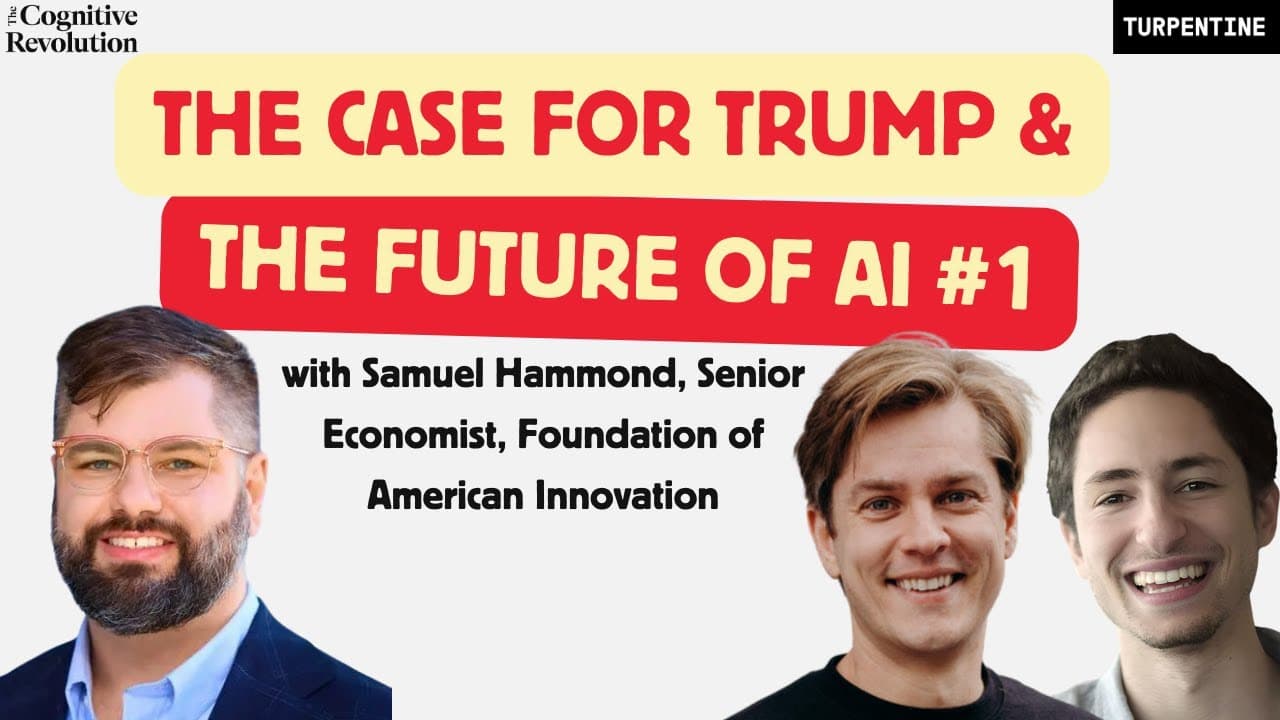
How Will the 2024 Election Impact AI Development?
TL;DR
The 2024 election could significantly influence AI development in the U.S., with Trump potentially accelerating AI through deregulation and a focus on American dominance. However, concerns about his leadership style and approach to U.S.-China relations raise questions about stability and global cooperation. Kamala Harris, despite some reservations, is seen as a more stable choice for managing AI's societal impacts.
Transcript
hello and welcome to the cognitive Revolution where we interview Visionary researchers entrepreneurs and Builders working on the frontier of artificial intelligence each week we'll explore their revolutionary ideas and together we'll build a picture of how AI technology will transform work life and Society in the coming years I'm Nathan lens joined... Read More
Key Insights
- AI policy under Trump might focus on deregulation and American dominance, potentially accelerating development.
- Concerns about Trump's leadership style include unpredictability and prioritizing political interests over global cooperation.
- A stable leadership approach is crucial during pivotal moments in AI development, potentially favoring Kamala Harris.
- The U.S.-China relationship is a significant factor, with Trump seen as more likely to escalate tensions.
- The AI era requires a positive-sum mindset, focusing on global benefits rather than zero-sum competition.
- The 2024 election is viewed as a referendum on Trump, with AI policy as a key issue for voters to consider.
- There are differing opinions on the impact of Trump's potential policies, with some seeing high variance as beneficial.
- The Democratic approach to AI may involve more stakeholder-driven processes, potentially slowing innovation.
Install to Summarize YouTube Videos and Get Transcripts
Explore YouTube Video Summarizer or Get YouTube Transcript Extractor
Questions & Answers
Q: How might Trump's AI policy differ from Kamala Harris's?
Trump's AI policy might focus on deregulation and a push for American dominance, potentially speeding up AI development. His approach may involve fewer stakeholder-driven processes and more emphasis on rapid innovation. In contrast, Kamala Harris might adopt a more cautious approach, emphasizing stakeholder involvement and potentially slower, more regulated AI progress.
Q: What are the concerns about Trump's leadership style in relation to AI?
Concerns about Trump's leadership style include unpredictability, a tendency to prioritize narrow political interests, and potential escalation of U.S.-China tensions. These factors raise questions about his ability to manage AI's societal impacts and navigate global cooperation, crucial for addressing AI's transformative effects and ensuring a positive-sum mindset.
Q: Why is the U.S.-China relationship significant for AI development?
The U.S.-China relationship is significant for AI development because both countries are major players in AI research and deployment. Tensions between the two could lead to an arms race in AI capabilities, increasing global risks. A cooperative approach could foster innovation and address global challenges, making the nature of this relationship critical for AI's future.
Q: What is meant by a positive-sum mindset in the AI era?
A positive-sum mindset in the AI era refers to focusing on global benefits and cooperation rather than zero-sum competition. It involves prioritizing shared progress and inclusive growth, ensuring AI advancements contribute to the well-being of all humanity. This approach contrasts with viewing AI development as a race for dominance, which could exacerbate global tensions.
Q: How does the 2024 election serve as a referendum on Trump?
The 2024 election is seen as a referendum on Trump, particularly regarding his approach to AI policy. Voters are considering whether his high-variance, deregulation-focused strategy is preferable to a more stable, regulated approach under Kamala Harris. The election outcome could significantly impact the direction of AI development and its societal implications.
Q: What are the potential benefits of Trump's high-variance approach to AI?
Trump's high-variance approach to AI could lead to rapid innovation and development by reducing regulatory barriers and emphasizing American dominance. This strategy might accelerate AI advancements and position the U.S. as a global leader in AI technology. However, it also carries risks of instability and increased tensions with other countries, particularly China.
Q: Why might Kamala Harris be considered a more stable choice for AI governance?
Kamala Harris might be considered a more stable choice for AI governance due to her likely emphasis on stakeholder involvement and regulated development. Her approach could provide a more predictable and balanced framework for managing AI's societal impacts, fostering global cooperation, and addressing potential risks. This stability is seen as crucial during pivotal moments in AI development.
Q: What are the implications of the Democratic approach to AI policy?
The Democratic approach to AI policy may involve more stakeholder-driven processes, potentially leading to slower but more balanced development. This approach could ensure that AI advancements consider societal impacts and ethical considerations. However, it might also hinder rapid innovation, contrasting with a more deregulation-focused strategy that prioritizes speed and American dominance.
Summary & Key Takeaways
-
The 2024 election could shape AI development in the U.S., with Trump potentially accelerating progress through deregulation and a focus on American dominance. However, his leadership style raises concerns about stability and global cooperation, particularly with China. Kamala Harris is seen as a more stable choice for managing AI's societal impacts, despite some reservations.
-
AI policy under Trump might emphasize deregulation and American supremacy, potentially speeding up development. Yet, concerns about his unpredictable leadership style and approach to U.S.-China relations highlight the need for stable leadership. Kamala Harris, while not perfect, is viewed as a more reliable choice for navigating AI's transformative effects.
-
The election is viewed as a referendum on Trump, with AI policy as a key consideration for voters. While Trump's approach might accelerate AI development, his leadership style and potential to escalate tensions with China raise questions. Kamala Harris offers a more stable alternative, emphasizing the importance of a positive-sum mindset in the AI era.
Read in Other Languages (beta)
Share This Summary 📚
Summarize YouTube Videos and Get Video Transcripts with 1-Click
Try YouTube Summary with ChatGPT & Claude or YouTube Transcript Generator
Explore More Summaries from Cognitive Revolution "How AI Changes Everything" 📚





Summarize YouTube Videos and Get Video Transcripts with 1-Click
Try YouTube Summary with ChatGPT & Claude or YouTube Transcript Generator