What Are the Limits of Deep Learning in AI?
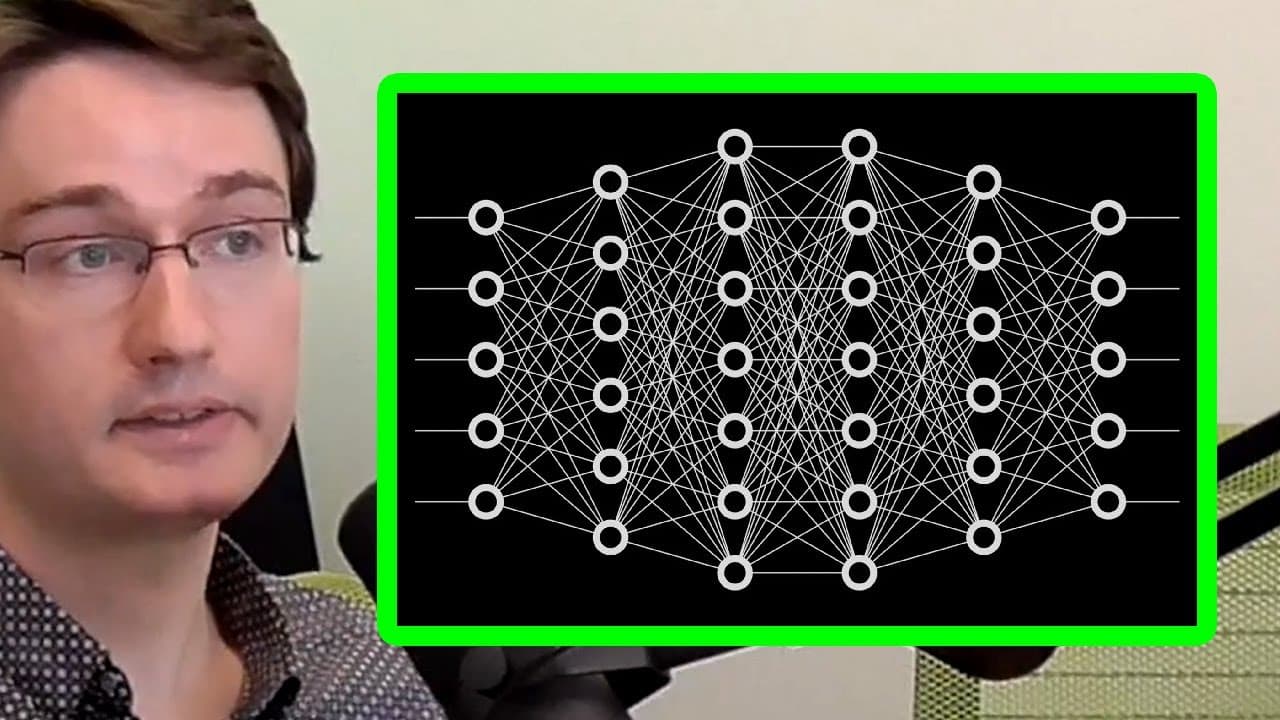
TL;DR
Deep learning models struggle with generalization due to their reliance on point-by-point learning, making them limited to familiar inputs. In contrast, symbolic AI excels at generalization through abstract rules, suggesting that future advancements in AI will benefit from combining these two approaches into hybrid systems.
Transcript
what do you think of the current limits of deep learning if we look specifically at these function approximator x' that tries to generalize from data they've you've talked about local versus extreme generalization you mentioned the neural networks don't generalize well humans do so there's this gap so and you've also mentioned that generalization e... Read More
Key Insights
- 🔍 Deep learning models are limited in their generalization because they can only make sense of points in experience space that are similar to what they have already seen and trained on.
- 🧠 Human intelligence and simple rule algorithms are capable of better generalization because they rely on abstract rules rather than point-by-point mapping like deep learning.
- 🔮 The future lies in combining deep learning with symbolic AI to create hybrid systems that can leverage the strengths of both approaches.
- 🚗 Successful AI systems, such as self-driving cars, already employ a combination of deep learning for perception and symbolic AI for planning and modeling.
- 🖥️ Dense sampling of input-output space is challenging and expensive, making it difficult to train deep neural networks for complex real-world problems.
- 💬 Natural language dialogue and solving the Turing test is not easily achievable with deep learning alone, as it requires more than just mimicking human behavior.
- 🌐 Perception problems are a good fit for deep learning, while problems that require explicit and crafted rules or exhaustive search benefit from symbolic AI.
- 🌍 Understanding the physics and relationships in a scene may require abstraction and reasoning, which can be done more efficiently with symbolic AI rather than deep learning.
Install to Summarize YouTube Videos and Get Transcripts
Explore YouTube Video Summarizer or Get YouTube Transcript Extractor
Questions & Answers
Q: How can deep learning and symbolic AI be combined to build more advanced AI systems?
The integration of deep learning and symbolic AI can happen at different levels, with successful AI systems already using both approaches. For example, in self-driving cars, deep learning is used for perception while symbolic AI is employed for planning algorithms. Finding the right balance and level of integration is still an ongoing research problem in the field.
Q: Can deep learning models solve complex tasks like steering in self-driving cars?
Solving tasks like steering in self-driving cars with deep learning models is challenging due to the need for dense sampling and a rich search space. While it's not impossible, it would require a massive amount of data and computations, making it highly impractical. Other approaches, such as rule-based symbolic AI, are more suitable for such tasks.
Q: Can neural networks alone pass the Turing Test?
Passing the Turing Test, which involves tricking people into believing they are interacting with a human, is difficult with neural networks alone. Mimicking human behavior is not the same as true intelligence. However, for shorter conversations or dialogue systems focused on maintaining engaging conversations, neural networks can be used, although it remains a challenging problem.
Q: Can larger deep learning networks understand the physics and relationships in a scene?
While it's possible to solve perception problems with deep learning, understanding the physics and relationships within a scene is a more complex task. Deep learning models would require dense mapping, but symbolic AI with explicit rule-based models would be more efficient and compressed in representing physics. Automatic generation of such rule-based programs is a research problem, but possible through techniques like program synthesis.
Summary & Key Takeaways
-
Deep learning models are limited by their point-by-point learning approach and can only make sense of points close to what they have seen before.
-
Symbolic AI, on the other hand, can generalize well due to its abstract nature and rules-based approach.
-
Successful AI systems today are already hybrid systems that combine deep learning for perception with symbolic AI for planning algorithms and explicit models.
Read in Other Languages (beta)
Share This Summary 📚
Summarize YouTube Videos and Get Video Transcripts with 1-Click
Try YouTube Summary with ChatGPT & Claude or YouTube Transcript Generator
Explore More Summaries from Lex Fridman 📚

Summarize YouTube Videos and Get Video Transcripts with 1-Click
Try YouTube Summary with ChatGPT & Claude or YouTube Transcript Generator