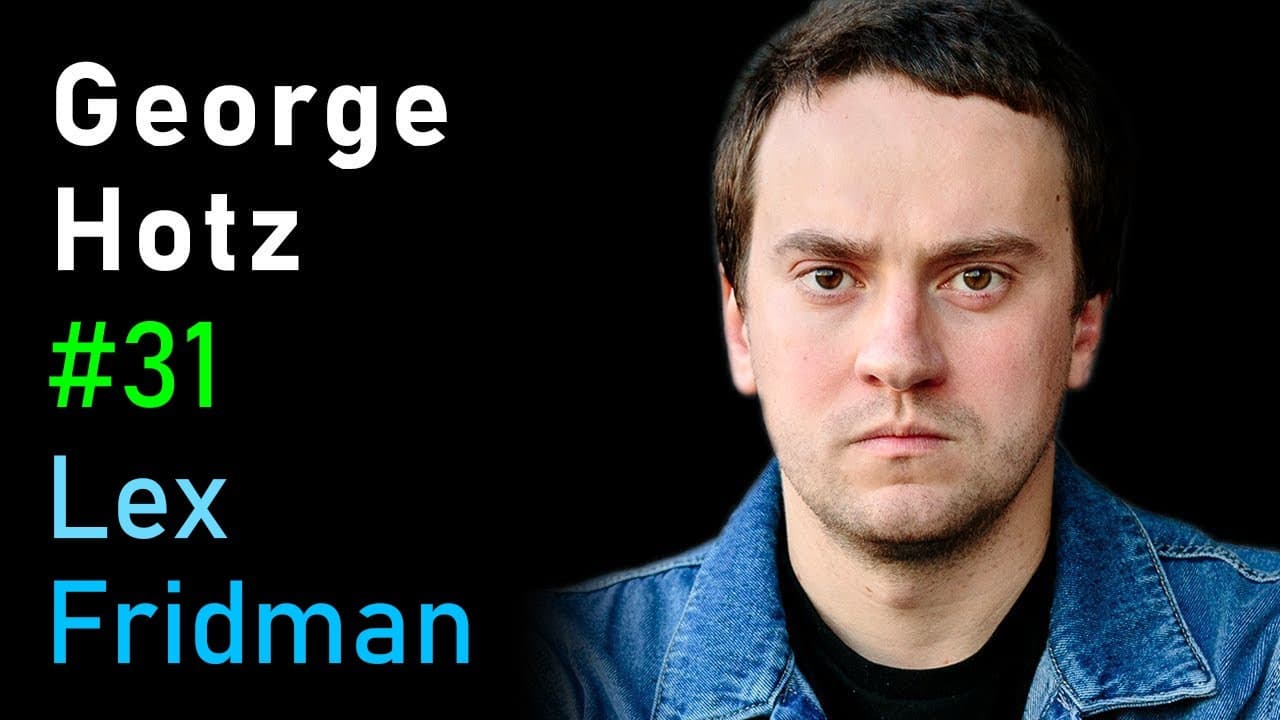
George Hotz: Comma.ai, OpenPilot, and Autonomous Vehicles | Lex Fridman Podcast #31
TL;DR
George Hotz posits that we might be living in a simulation, but the idea remains unfalsifiable. He elaborates on the intricacies of hacking such a simulation and suggests that a shift towards optimistic thinking could lead to innovative breakthroughs in areas like virtual reality and space exploration.
Transcript
the following is a conversation with George Hotz he's the founder of comma AI a machine learning based vehicle automation company he is most certainly an outspoken personality in the field of AI and technology in general he first gained recognition for being the first person to carry or unlock an iPhone and since then he's done quite a few interest... Read More
Key Insights
- 👍 Living in a simulation may be unfalsifiable, making it impossible to prove or disprove.
- 🎨 Hacking a simulation would require deep knowledge of the underlying system, and a well-designed simulation may be undetectable.
- 🤔 Thinking upwards and focusing on positive progress could inspire breakthrough ideas in various fields such as virtual reality and space exploration.
- ✈️ Hotz believes that lane-keeping in autonomous vehicles offers significant value as it removes the stress of staying in a lane.
- 🎙️ More videos with George Hotz:
Install to Summarize YouTube Videos and Get Transcripts
Explore YouTube Video Summarizer or Get YouTube Transcript Extractor
Questions & Answers
Q: Do you think we are living in a simulation?
Hotz believes that we may be living in a simulation but acknowledges that it is currently unfalsifiable to prove or disprove this theory due to the limitations of our understanding and the nature of the simulation.
Q: How would you approach hacking a simulation?
Hotz suggests that hacking a simulation would require deep knowledge of the underlying system and its programming language. If the simulation is well-designed, it may be impossible to detect whether we are in a simulation or not.
Q: What breakthrough ideas could thinking in an upward trajectory inspire?
Hotz believes that an upward trajectory of thinking, such as exploring space and virtual reality, could lead to new narratives and advancements for humanity. He suggests that focusing on positive progress and challenging the status quo could lead to a brighter future.
Q: How did George Hotz get into hacking and programming?
Hotz gained recognition for being the first person to unlock and carry an iPhone. He started with hardware hacking and gradually learned programming by trial and error. He interned at Google and gradually improved his coding skills through practice and feedback from experienced programmers.
Key Insights:
- Living in a simulation may be unfalsifiable, making it impossible to prove or disprove.
- Hacking a simulation would require deep knowledge of the underlying system, and a well-designed simulation may be undetectable.
- Thinking upwards and focusing on positive progress could inspire breakthrough ideas in various fields such as virtual reality and space exploration.
- Hotz believes that lane-keeping in autonomous vehicles offers significant value as it removes the stress of staying in a lane.
- Driver monitoring is crucial for safety in level 2 autonomy, and Hotz aims to ensure that cheating is not possible in the driver monitoring system.
Summary
This conversation is with George Hotz, the founder of comma AI, a machine learning-based vehicle automation company. Hotz discusses topics ranging from whether we live in a simulation to his thoughts on hacking and his experiences in the field of AI and technology. He also talks about his work with open pilot, the hardware and software specifications, and the challenges they face in developing autonomous driving technology.
Questions & Answers
Q: Do you think we're living in a simulation?
Hotz believes that we may be living in a simulation, but it is unfalsifiable. He explains that if the simulation is designed in such a way that no information can get in or out, it would be impossible to prove whether we are in a simulation or not.
Q: What does it mean for a simulation to be unfalsifiable?
An unfalsifiable simulation means that there is no way to prove or disprove its existence or nature. Hotz gives the example of a simulation designed as a closed system, where no information can escape or enter, making it impossible to determine whether it is a simulation or reality.
Q: How does this relate to well-designed virtual machines?
Hotz compares this concept to the idea of a well-designed virtual machine (VM), where the user cannot detect if they are operating within a VM or not. He explains that if the simulation is running within a virtual machine, it is possible that the simulation is written in a language that ensures correctness, similar to how a typed language ensures code correctness.
Q: Can a simulation be written in a sufficiently expressive language?
Hotz suggests that a simulation could be written in a language that guarantees code correctness, such as a dependently typed language. He acknowledges that some people may argue that such languages are not expressive enough, but he believes it is possible for a simulation to be written using these languages.
Q: Is it possible for a simulation to have a scheduled end date?
Hotz speculates that a simulation could have a scheduled end date, similar to how entropy suggests that the universe will eventually reach a state of maximum disorder. However, he also recognizes that the complexity of the universe may make it difficult to prove or disprove the existence of a simulation.
Q: If a simulation were hackable, what would you change?
Hotz discusses his talk on escaping a simulation, clarifying that it was not a practical guide but a way to reframe the narrative around technology. He explains that if he were able to hack a simulation, he would acquire more intelligence in the process, which could lead to significant changes in his approach to hacking the simulation.
Q: What breakthrough ideas could arise from thinking upwards?
Hotz suggests that thinking upwards, particularly in terms of space exploration and colonization, could inspire new narratives and ideas. He explains that the space narrative has evolved since the race to space, and he hopes for postmodern narratives that replace it, encompassing areas like virtual reality and artificial intelligence.
Q: Are you interested in the virtual world?
Hotz expresses his desire to physically move to a virtual reality world, stating that the apartments he can rent in the cloud are superior to those in the physical world. He believes that the virtual world could offer better living conditions and expresses enthusiasm for its potential.
Q: How did you get into hacking, and what was the first system you discovered vulnerabilities for?
Hotz recalls his first foray into hacking when he unlocked the iPhone back in 2007. He explains that his initial hacking involved physical modifications to the iPhone and that his knowledge of software exploitation developed in the following years. He also mentions his interest in electronics before he delved into software hacking.
Q: How did you learn to program, and what is your journey as a programmer?
Hotz attributes his development as a programmer to practice and experience. He mentions his internship at Google and how feedback from colleagues helped him improve his coding skills. Additionally, he shares his motivation to build tools that allowed for better debugging and visualization of code, which eventually led to the development of Kira, a debugger and visualization tool.
Q: How hard did you think it would be to solve autonomous driving when you first started?
Hotz initially believed that solving autonomous driving would involve cloning Mobileye's system, which provided lane-keeping assistance. He did not expect to achieve level 5 autonomous driving but aimed to develop a vision system that could match Mobileye's performance.
Q: How has comma AI progressed with their autopilot compared to Tesla?
Hotz believes that comma AI has kept pace with Tesla's autopilot advancements. He mentions that open pilot, their autopilot product, has superior lane-keeping capabilities compared to Tesla's navigator autopilot. However, he acknowledges that Tesla's data collection scale gives them an advantage.
Q: How hard is it to build a level 4 autonomous driving system?
Hotz states that comma AI is currently focused on level 2 autonomy and expects to be one to two years behind Tesla in achieving level 5 autonomy. He explains that transitioning from level 2 (lane-keeping) to level 4 (full autonomy) is a significant challenge that requires ensuring 100% driver monitoring and developing robust driver-assistance features.
Q: What do you think about Tesla's approach to autonomy compared to other companies?
Hotz praises Tesla's approach, particularly their over-the-air software updates and data collection capabilities. He believes that Tesla's strategy of gathering data from real users and continuously improving their software is the most effective way to achieve true autonomy.
Q: Do you worry about the human factor in level 2 autonomy, such as drivers becoming complacent or distracted?
Hotz acknowledges the concerns around driver complacency and stress the importance of driver monitoring. He mentions that open pilot is not considered a 1.0 release until they have robust driver monitoring that cannot be cheated. He also discusses plans to detect phone usage and monitor driver alertness.
Q: What are the hardware and software specifications of open pilot?
Hotz describes open pilot as a phone in a plastic case without software. It runs on a Snapdragon 820 processor with an IMX 298 forward-facing camera and driver monitoring camera. The software communicates with the car through three CAN buses via a device called "pandas." Currently, open pilot does not support all cars but notably works well with Honda, Toyota, GM, and Subaru models.
Q: How does open pilot control vehicles?
Hotz explains that open pilot works by proxying existing lane-keeping assist systems in vehicles that have drive-by-wire capabilities. The system sends commands to the vehicle's steering system, effectively controlling the steering. He mentions that open pilot currently supports around 45 different makes of cars.
Q: What is the goal of open pilot's driver monitoring system?
Hotz explains that the goal of open pilot's driver monitoring system is to ensure that the driver is attentive and not engaged in distracting activities. They are working to improve the system to detect phone usage and monitor driver alertness more effectively.
Q: What is a successful driver monitoring system?
Hotz describes a successful driver monitoring system as one that monitors the driver's head and eye movements to ensure they are focused on the road. Beyond visual cues, he mentions the possibility of detecting phones in the frame and monitoring driver fatigue.
Takeaways
In this conversation, George Hotz discusses various topics such as whether we live in a simulation, hacking, and open pilot, comma AI's autopilot product. He shares his perspectives on the challenges and advancements in autonomous driving technology, as well as his thoughts on the future of technology, space exploration, and virtual reality. Hotz emphasizes the importance of driver monitoring and the incremental approach to achieving level 5 autonomy. Overall, the conversation provides insights into Hotz's experiences and views in the field of AI and technology.
Summary & Key Takeaways
-
George Hotz shares his belief that we may be living in a simulation and explores the concept of proving or disproving its existence.
-
He discusses the challenges of hacking a simulation and how advanced systems can be designed to be unfalsifiable.
-
Hotz also delves into the potential benefits and breakthrough ideas that could come from thinking in an upward trajectory, such as exploring virtual reality and space.
Read in Other Languages (beta)
Share This Summary 📚
Summarize YouTube Videos and Get Video Transcripts with 1-Click
Try YouTube Summary with ChatGPT & Claude or YouTube Transcript Generator
Explore More Summaries from Lex Fridman Podcast 📚


Summarize YouTube Videos and Get Video Transcripts with 1-Click
Try YouTube Summary with ChatGPT & Claude or YouTube Transcript Generator