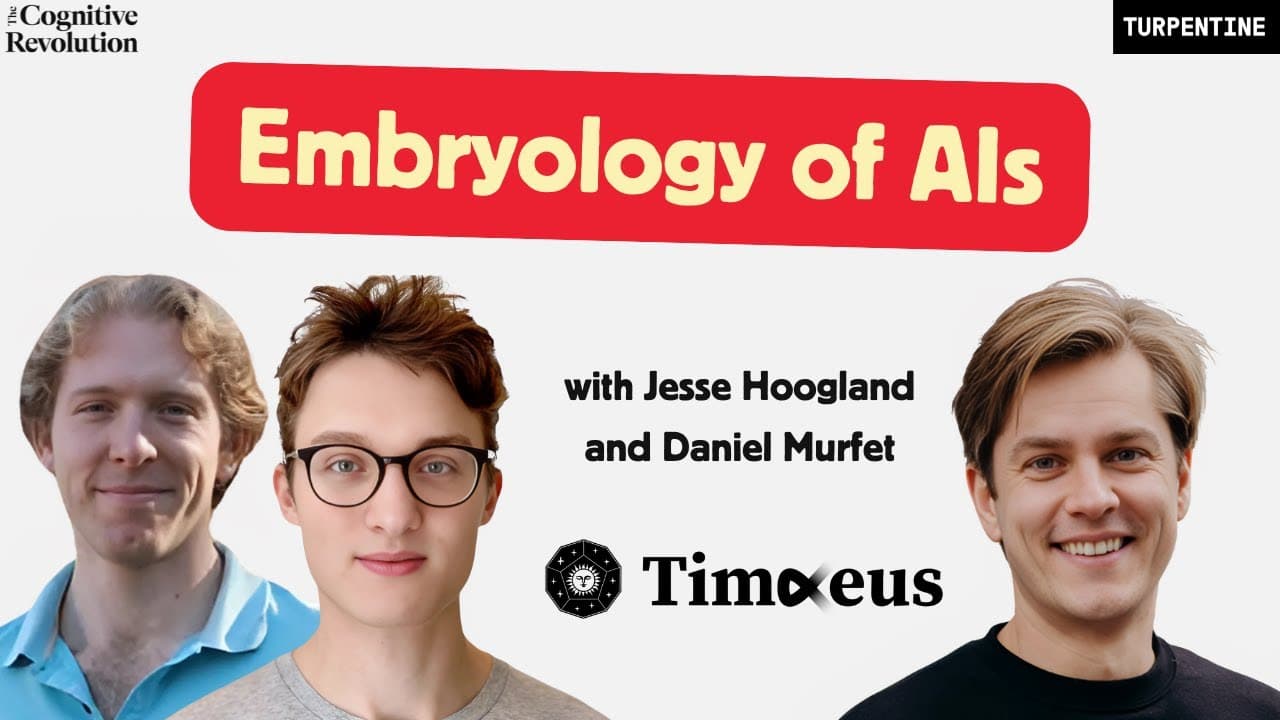
Embryology of AI: How Training Data Shapes AI Development w/ Timaeus' Jesse Hoogland & Daniel Murfet
TL;DR
Timaeus founders discuss AI safety via Singular Learning Theory.
Transcript
Hello and welcome back to the cognitive revolution. Today I'm excited to share my conversation with Jesse Hoolland and Daniel Murph, founders of Tmus, an AI safety and alignment research nonprofit that's pursuing an ambitious, mathematically rigorous, and fascinating approach to understanding the development and function of neural networks. Named a... Read More
Key Insights
- Timaeus, founded by Jesse Hoogland and Daniel Murfet, focuses on AI safety using a mathematical approach called developmental interpretability, based on Singular Learning Theory (SLT).
- SLT suggests that neural network loss landscapes are complex and full of singularities, which can cause models to change internally without affecting external behavior.
- The Local Learning Coefficient is a measure developed to identify critical phase changes during the training of neural networks, which can help in understanding model behavior.
- The approach aims to transition from trial-and-error neural network training to a principled engineering discipline, potentially identifying safety issues during training.
- The developmental interpretability technique is seen as complementary to mechanistic interpretability, offering a broader understanding of neural network evolution.
- The founders emphasize the importance of understanding the mapping from training data to model behavior, which is crucial for AI alignment and safety.
- Current AI training is likened to alchemy, with hopes to evolve it into a more controlled and scientific process similar to industrial chemical manufacturing.
- The discussion includes the potential for this approach to prevent issues like those observed in the Claude 4 system, where missing data led to unexpected model behavior.
Install to Summarize YouTube Videos and Get Transcripts
Explore YouTube Video Summarizer or Get YouTube Transcript Extractor
Questions & Answers
Q: What is the core focus of Timaeus' approach to AI safety?
Timaeus focuses on AI safety through a mathematically rigorous approach known as developmental interpretability, based on Singular Learning Theory (SLT). This method aims to understand neural network behavior by examining the complex, jagged surfaces of loss landscapes, which contain singularities where models can change internally without affecting external behavior, potentially masking dangerous misalignment.
Q: How does Singular Learning Theory (SLT) contribute to understanding neural networks?
SLT contributes by suggesting that the geometry of neural network loss landscapes, characterized by singularities, plays a crucial role in understanding model behavior. These singularities are directions in weight space that a model can change without altering its external behavior, which can be critical for identifying internal changes that might affect generalization and alignment.
Q: What is the Local Learning Coefficient (LLC) and its significance?
The Local Learning Coefficient (LLC) is a measure developed by Timaeus to identify critical phase changes during neural network training. It helps understand the internal dynamics of models, offering insights into how training data influences the final behavior of neural networks. This measure is significant for improving AI safety by providing a deeper understanding of model evolution.
Q: What are the potential benefits of developmental interpretability?
Developmental interpretability offers the potential to move beyond trial-and-error neural network training toward a more principled engineering discipline. By understanding the internal phase changes and dynamics of models, it can help identify safety issues during training, rather than after deployment, leading to more reliable and aligned AI systems.
Q: How does Timaeus' approach differ from mechanistic interpretability?
Timaeus' approach, based on developmental interpretability, focuses on understanding the evolution of neural networks through training, using the geometry of loss landscapes. This is complementary to mechanistic interpretability, which often focuses on understanding the static structures and circuits within trained models. Timaeus aims to provide a broader understanding of model behavior and alignment.
Q: What is the envisioned future of AI training according to Timaeus?
Timaeus envisions a future where AI training is akin to industrial chemical manufacturing, with precise control over the training process. This involves knowing exactly which data sets to use at specific times to achieve desired behaviors, moving away from the current trial-and-error approach and ensuring more reliable and aligned AI outcomes.
Q: How does the Claude 4 system example illustrate the need for developmental interpretability?
The Claude 4 system example illustrates the need for developmental interpretability by showing how missing a specific data set during training led to unexpected behavior. This highlights the importance of understanding the training process and data influences to prevent such issues, which developmental interpretability aims to address by offering insights into model evolution and alignment.
Q: What are the main challenges in scaling Timaeus' approach to larger models?
Scaling Timaeus' approach to larger models involves overcoming computational challenges, as more compute is needed to apply perturbations and analyze model structures effectively. The approach requires a detailed understanding of internal dynamics, which becomes more complex with larger models. Progress in scaling techniques and computational resources is essential for applying developmental interpretability to frontier models.
Summary & Key Takeaways
-
Jesse Hoogland and Daniel Murfet introduce Timaeus' approach to AI safety, focusing on developmental interpretability through Singular Learning Theory. They explore how neural network loss landscapes are complex, with singularities that can mask misalignment. Their Local Learning Coefficient helps identify phase changes in training, offering a complementary approach to mechanistic interpretability.
-
The discussion highlights the importance of understanding the mapping from training data to model behavior for AI alignment. The founders envision a future where AI training is as controlled as industrial chemical manufacturing, reducing reliance on trial-and-error methods and potentially preventing safety issues during training.
-
Current AI training is likened to alchemy, and the founders aim to evolve it into a more scientific process. They discuss the potential for developmental interpretability to prevent issues like those seen in the Claude 4 system, where missing data led to unexpected behavior, demonstrating the need for a principled engineering approach.
Read in Other Languages (beta)
Share This Summary 📚
Summarize YouTube Videos and Get Video Transcripts with 1-Click
Try YouTube Summary with ChatGPT & Claude or YouTube Transcript Generator
Explore More Summaries from Cognitive Revolution "How AI Changes Everything" 📚



Summarize YouTube Videos and Get Video Transcripts with 1-Click
Try YouTube Summary with ChatGPT & Claude or YouTube Transcript Generator