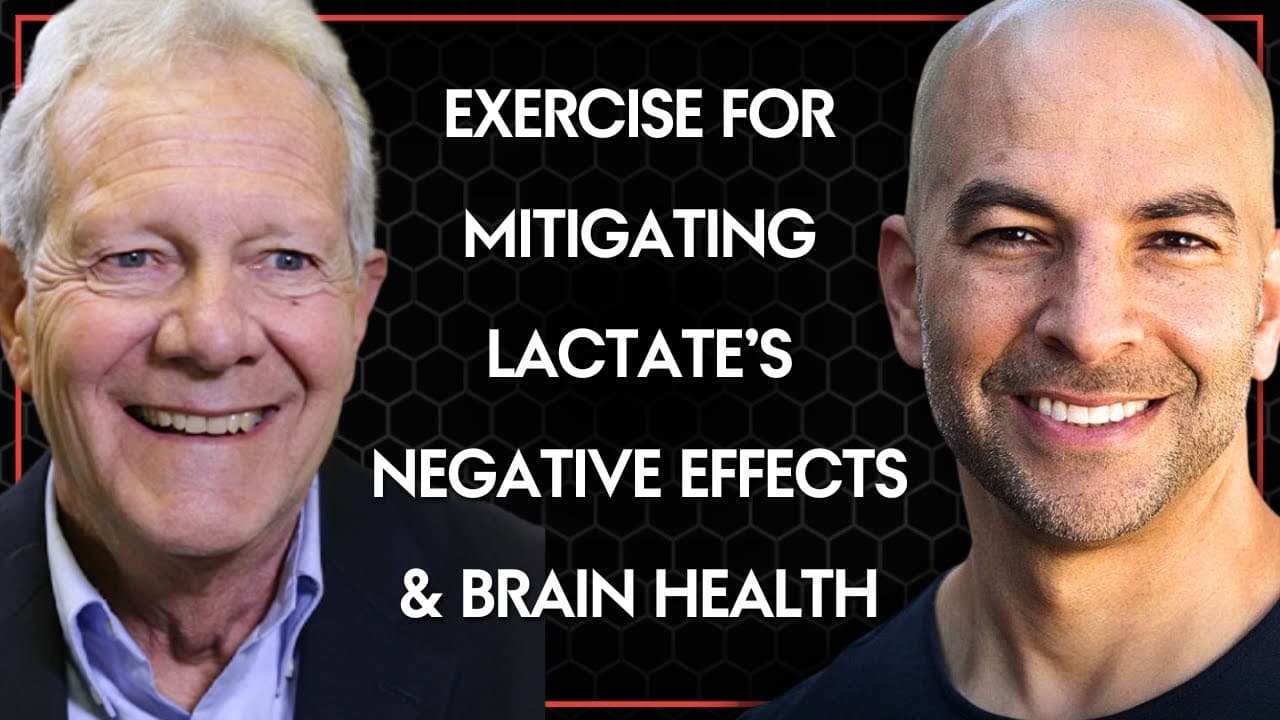
How Does Exercise Affect Lactate and Brain Health?
TL;DR
Exercise increases lactate flow and clearance, which may reduce the risks associated with lactate accumulation when clearance is ineffective. Physical activity may also support brain blood flow, substrate delivery, and lactate-linked neurogenesis, while intravenous lactate after traumatic brain injury remains a testable but unconfirmed therapeutic idea. In sepsis, standard assays may miss potentially toxic D-lactate produced by gut microbes.
Transcript
we've talked a little bit about well quite a bit about lactate in athletic performance I have a much better understanding of that we you've talked about something very very tantalizing with respect to brain health and TBI and I'm very much hoping that that this is being investigated I mean again TBI is something where uh fortunately people are so m... Read More
Key Insights
- Exercise is the principal method identified for increasing lactate flow and lactate clearance. The cancer concern is framed less as lactate accumulation alone and more as accumulation occurring without an effective mechanism to clear and reuse lactate.
- Lactate may have carcinogenic effects, but the discussion does not treat lactate as uniformly harmful. Its biological impact appears connected to whether the body can maintain effective lactate turnover, making exercise-related clearance a potentially important protective mechanism.
- Physical activity is presented as potentially protective for aging brains and health span. Proposed mechanisms include increased brain blood flow, better delivery of metabolic substrates, and lactate-related stimulation of neurogenesis, particularly the development of new brain cells in the dentate gyrus.
- Brain cells undergo turnover and renewal, contrary to the older belief that people are born with a permanently fixed number. Problems may arise when progenitor cells are injured, damaged, or insufficiently stimulated, creating a possible research role for physical activity.
- Intravenous lactate after concussion is described as a testable therapeutic hypothesis rather than an established treatment. The proposed research direction would examine whether scheduled lactate administration can provide metabolic support following traumatic brain injury.
- Elevated lactate in sepsis is described as a response or marker of physiological strain, not necessarily proof that a specific tissue is hypoxic. Clinicians may observe substantial lactatemia without being able to identify a corresponding anoxic or hypoxic region.
- Gut microbes may contribute to lactate generation during sepsis, according to Brooks's hypothesis. These microbes can produce lactate regardless of oxygen availability, which challenges the assumption that every rise in measured lactate must result from ischemia or inadequate oxygen.
- D-lactate is characterized as neurotoxic and pro-inflammatory, while most hospital analyzers primarily measure L-lactate. Specialized analysis would therefore be required to determine whether clinically important D-lactate is present but hidden during routine testing of septic patients.
Install to Summarize YouTube Videos and Get Transcripts
Explore YouTube Video Summarizer or Get YouTube Transcript Extractor
Questions & Answers
Q: How does exercise improve lactate clearance?
Exercise increases both lactate flow and lactate clearance, according to the discussion. This matters because the larger concern is not simply that lactate exists or accumulates, but that it accumulates without an effective clearance mechanism. Regular physical activity therefore supports the movement, utilization, and removal of lactate rather than allowing poor lactate handling to persist.
Q: How might exercise mitigate lactate's carcinogenic effects?
Exercise may mitigate the concern by improving lactate flow and clearance. The discussion acknowledges that lactate may be carcinogenic, but emphasizes that accumulation in the absence of effective clearance is the bigger problem. Exercise is repeatedly identified as the necessary tool for increasing clearance, although the transcript does not establish a specific exercise prescription or claim that exercise treats cancer.
Q: How may physical exercise support brain health?
Physical exercise may support brain health by increasing brain blood flow, improving the delivery of metabolic substrates, and potentially allowing lactate to stimulate neurogenesis in the dentate gyrus. These effects could help maintain brain-cell renewal during aging. The discussion presents physical activity as a promising area for research into dementia, aging, and the extension of health span.
Q: Can lactate help treat concussion or traumatic brain injury?
Intravenous lactate is proposed as a potentially testable metabolic intervention after concussion or traumatic brain injury. The idea is that lactate might provide metabolic support to the injured brain through a structured administration protocol. However, the discussion describes this as a hypothesis deserving investigation, not as an established therapy, proven concussion protocol, or current clinical recommendation.
Q: Does the adult brain generate new brain cells?
The discussion states that brain cells undergo turnover and renewal, rejecting the older idea that people are born with a fixed number of brain cells that can never be replaced. Neurogenesis may occur in the dentate gyrus, and lactate may help stimulate it. Renewal can be impaired when progenitor cells are damaged, injured, or insufficiently stimulated.
Q: Why does lactate rise in patients with sepsis?
Rising lactate in sepsis may reflect the body's response to physiological stress or strain rather than direct evidence of a clearly identifiable hypoxic region. Brooks also hypothesizes that gut microbes contribute to lactate production and can generate it regardless of oxygen availability. The measured elevation therefore signals a serious disturbance without necessarily revealing its precise source.
Q: What is the difference between L-lactate and D-lactate in sepsis?
L-lactate is the form the body usually produces and utilizes, and it is the form measured by most hospital analyzers, blood-gas devices, portable instruments, and common enzyme techniques. D-lactate is a mirror-image form that may be produced by microbes in the lower bowel. It is described as neurotoxic and pro-inflammatory, yet routine testing may not detect it.
Q: Can standard hospital tests detect D-lactate?
Most standard hospital analyzers measure L-lactate rather than D-lactate. Detecting D-lactate would require a specialized analyzer or measurement method that is not commonly available in routine clinical settings. This limitation could cause clinicians to underestimate total lactatemia in sepsis if gut microbes are producing substantial D-lactate alongside the L-lactate shown by ordinary assays.
Summary & Key Takeaways
-
Lactate may become problematic in cancer when it accumulates without an effective clearance mechanism. Exercise repeatedly emerges as the practical way to increase both lactate flow and clearance, suggesting that lactate handling, rather than its mere presence, is central to understanding its possible carcinogenic effects and broader role in disease.
-
Physical exercise may protect brain health through improved blood flow, substrate delivery, and stimulation of neurogenesis in the dentate gyrus. The discussion also proposes intravenous lactate as a testable metabolic treatment after concussion or traumatic brain injury, although the transcript provides no evidence that such a clinical protocol has been validated.
-
Rising lactate in sepsis may be a response to physiological strain rather than direct proof of tissue hypoxia. Brooks hypothesizes that gut microbes produce both L-lactate and D-lactate, while common hospital analyzers measure mainly L-lactate. Consequently, potentially neurotoxic and pro-inflammatory D-lactate could remain undetected without specialized measurement methods.
Read in Other Languages (beta)
Share This Summary 📚
Summarize YouTube Videos and Get Video Transcripts with 1-Click
Try YouTube Summary with ChatGPT & Claude or YouTube Transcript Generator
Explore More Summaries from Peter Attia MD 📚


Summarize YouTube Videos and Get Video Transcripts with 1-Click
Try YouTube Summary with ChatGPT & Claude or YouTube Transcript Generator