What Was the War of the Bucket?
TL;DR
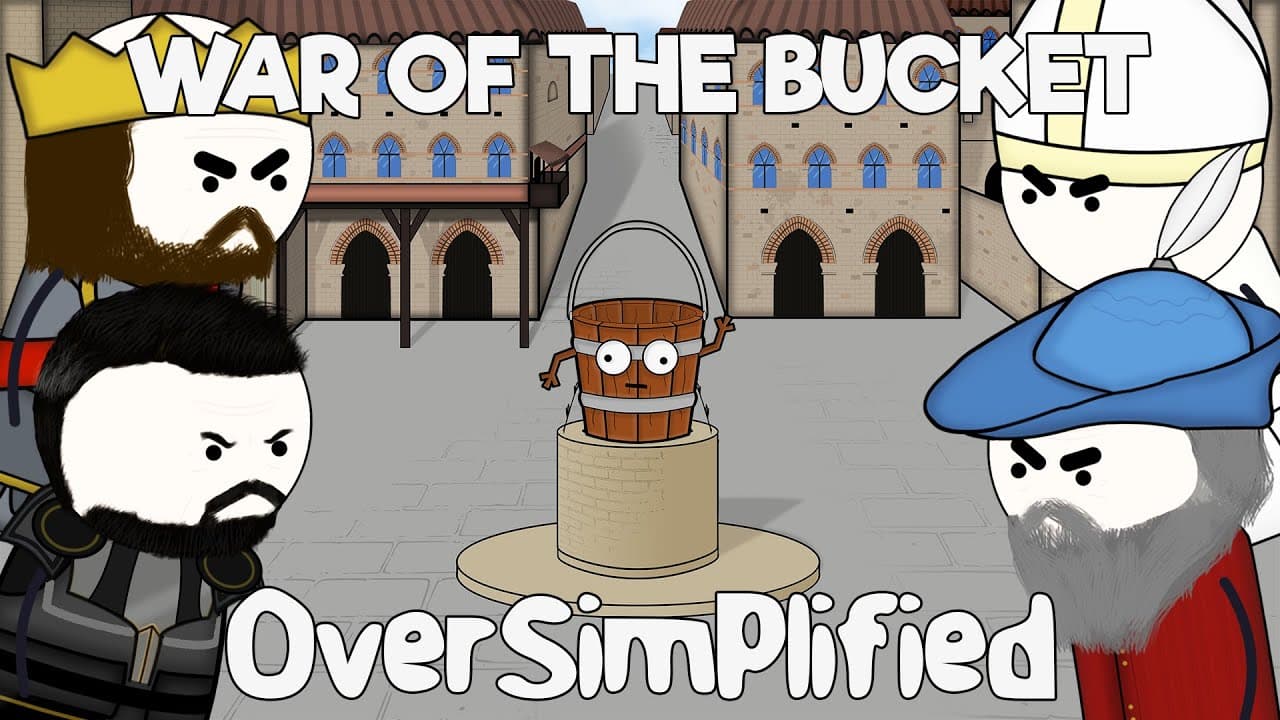
The War of the Bucket was a conflict between Modena and Bologna in 1325, largely driven by political and factional tensions rather than the theft of a bucket. The war highlighted the ongoing power struggle between the Pope and the Holy Roman Emperor, influencing the political landscape of medieval Italy and contributing to the eventual separation of church and state in Europe.
Transcript
- [Narrator] Hey, you! Yeah, you! New merch available now, including a supremely uncool T-shirt and a glorious new character pin. Link in the description down below. (angelic harp music) "All right, folks, gather round. I've got some good news and some bad news." "Did you say good news and glad news?" "No. I said good news and bad news, very bad ne... Read More
Key Insights
- The War of the Bucket was not actually started by the theft of a bucket as commonly believed.
- The conflict was part of the larger power struggle between the Pope and the Holy Roman Emperor.
- Modena and Bologna were on opposing sides, with Modena supporting the Emperor and Bologna supporting the Pope.
- The Bolognese had a larger force but were defeated by the strategic surprise attack of the Modenese.
- The Modenese victory led to the capture of Bologna's symbolic bucket, which remains in Modena to this day.
- The Investiture Controversy was a key element in the power dynamics between the church and the state.
- The conflict contributed to the eventual separation of church and state in Europe.
- Italian city-states were deeply divided between the Guelphs and Ghibellines, representing papal and imperial interests respectively.
Install to Summarize YouTube Videos and Get Transcripts
Explore YouTube Video Summarizer or Get YouTube Transcript Extractor
Questions & Answers
Q: What caused the War of the Bucket?
The War of the Bucket was primarily caused by ongoing political and factional tensions between Modena and Bologna, rather than the theft of a bucket. The cities were on opposing sides of the larger power struggle between the Pope and the Holy Roman Emperor, with Modena supporting the Emperor and Bologna supporting the Pope. This rivalry was part of the broader Guelph-Ghibelline conflict in Italy.
Q: Did the War of the Bucket start because of a stolen bucket?
No, the War of the Bucket did not start because of a stolen bucket. The bucket was taken as a trophy after Modena's victory, but the conflict itself was driven by long-standing hostilities and political tensions between the two cities, as well as their alignment with opposing factions in the papal-imperial power struggle.
Q: What was the outcome of the War of the Bucket?
The outcome of the War of the Bucket was a decisive victory for Modena, which led to the capture of Bologna's symbolic bucket. Although Modena won the battle, the overall power dynamics in the region remained largely unchanged. Bologna had to pay heavy war reparations, but Modena returned the conquered territories, keeping only the bucket as a trophy.
Q: How did the War of the Bucket relate to the Investiture Controversy?
The War of the Bucket was part of the larger Investiture Controversy, which was a power struggle between the Pope and the Holy Roman Emperor over the appointment of church officials. This conflict influenced the political landscape of medieval Italy, as city-states like Modena and Bologna aligned themselves with either the papal or imperial cause, contributing to the ongoing Guelph-Ghibelline rivalry.
Q: What were the Guelphs and Ghibellines?
The Guelphs and Ghibellines were two opposing factions in medieval Italy, representing the papal and imperial interests respectively. The Guelphs supported the Pope, while the Ghibellines supported the Holy Roman Emperor. This division deeply affected Italian society, leading to conflicts between city-states and even within families, as they aligned themselves with either faction based on political and economic interests.
Q: Why was the bucket significant in the War of the Bucket?
The bucket became significant in the War of the Bucket as a symbolic trophy of Modena's victory over Bologna. Although it was not the cause of the war, the bucket's capture and display in Modena served as a lasting emblem of their triumph. It remains on display in Modena to this day, highlighting the enduring impact of the conflict on local history and identity.
Q: What impact did the War of the Bucket have on Italian city-states?
The War of the Bucket highlighted the deep divisions between Italian city-states during the medieval period, as they were often caught between the opposing interests of the Pope and the Holy Roman Emperor. The conflict exemplified the Guelph-Ghibelline rivalry, which affected political alliances and contributed to ongoing instability in the region. It also demonstrated the complexities of power dynamics within the Holy Roman Empire.
Q: How did the War of the Bucket influence the separation of church and state?
The War of the Bucket was part of the broader Investiture Controversy, which involved a struggle between the Pope and the Holy Roman Emperor over control of church appointments. This conflict, along with others like it, contributed to the eventual separation of church and state in Europe by highlighting the need for distinct boundaries between religious and secular authority. It set the stage for future developments, such as the Protestant Reformation.
Summary & Key Takeaways
-
The War of the Bucket was a conflict between Modena and Bologna in 1325, driven by political and factional tensions. Contrary to popular belief, the war did not start because of a stolen bucket, but rather due to long-standing hostilities and power struggles between the Pope and the Holy Roman Emperor. Modena's victory was a strategic surprise, and they captured Bologna's symbolic bucket, which remains in Modena today.
-
The conflict was part of the larger Investiture Controversy, which involved a power struggle between the Pope and the Holy Roman Emperor over the appointment of church officials. This struggle influenced many significant events in medieval history, such as the Crusades and the Protestant Reformation, and eventually led to the separation of church and state in Europe.
-
The rivalry between Modena and Bologna was emblematic of the broader division in Italy between the Guelphs, who supported the Pope, and the Ghibellines, who supported the Emperor. This division infiltrated society deeply, affecting both political alliances and personal relationships, and led to ongoing conflicts between Italian city-states.
Read in Other Languages (beta)
Share This Summary 📚
Summarize YouTube Videos and Get Video Transcripts with 1-Click
Try YouTube Summary with ChatGPT & Claude or YouTube Transcript Generator
Explore More Summaries from OverSimplified 📚





Summarize YouTube Videos and Get Video Transcripts with 1-Click
Try YouTube Summary with ChatGPT & Claude or YouTube Transcript Generator