How Does a Multitape Turing Machine Work?
TL;DR
A multitape Turing machine has the same recognition power as a single-tape Turing machine because every multitape computation can be simulated on one tape. The simulation stores each virtual tape in a separate hash-delimited section, marks the positions of its tape heads, scans those marked symbols, and replaces each multitape transition with one or more single-tape moves.
Transcript
in the previous lectures we have been studying about during machines and we have seen many examples of Turing machines and we have also seen how the Turing machines actually work now if you have noticed so far in all the Turing machines that we have discussed we have seen that all those Turing machines they have just a single tape we know that duri... Read More
Key Insights
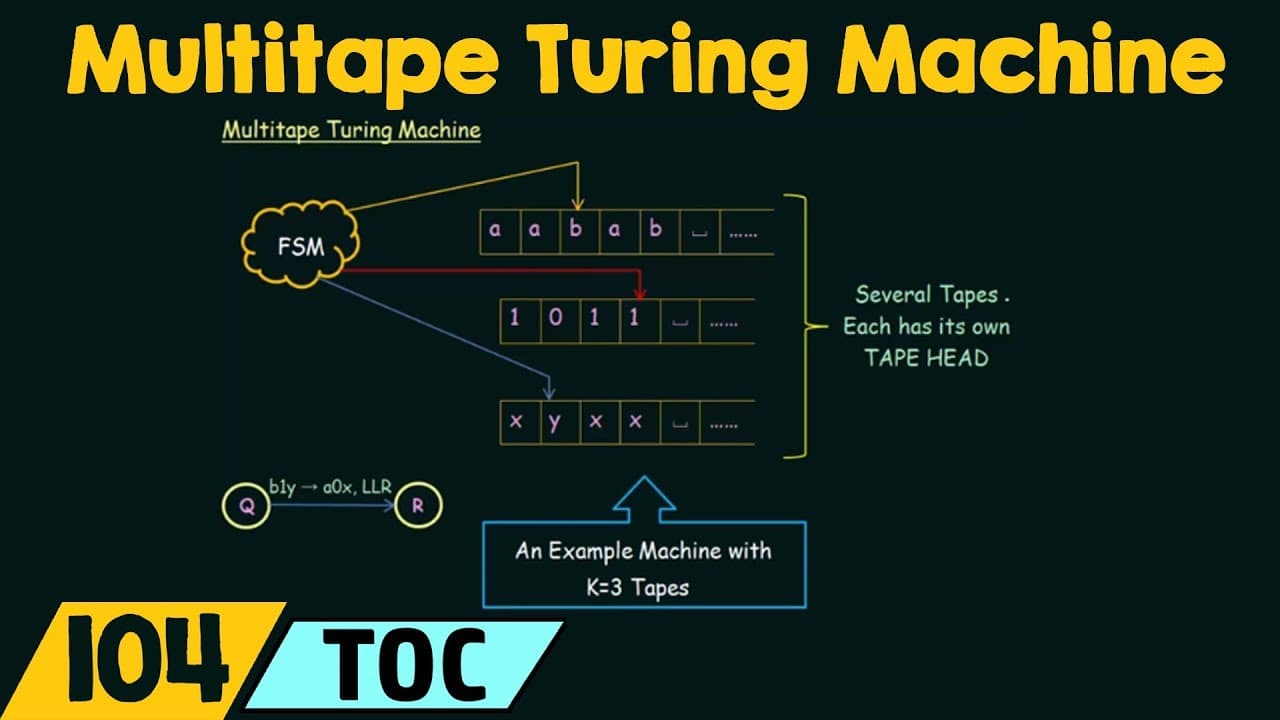
- A multitape Turing machine is a Turing machine with more than one tape, and every individual tape has its own tape head. This arrangement allows a transition to inspect, replace, and move relative to several tape positions as part of the same computational step.
- Every multitape Turing machine has an equivalent single-tape Turing machine. The equivalent machine can perform the same task or recognize exactly the same language, establishing that adding tapes does not increase the recognition power described in the lecture.
- Equivalence is about computational capability rather than execution speed or programming convenience. A multitape machine may execute a computation faster or make its programming technique easier, while a single-tape simulation still remains equivalent because it can recognize the same language.
- The first requirement for a single-tape simulation is storing all virtual tapes on one physical tape. The construction places each tape's symbols into a distinct section and inserts hash symbols between sections so the simulator can identify their boundaries.
- The second requirement is preserving the location of every virtual tape head. The single-tape machine marks the symbol currently scanned by each head, using dots or another marking technique to retain this information within the encoded tape contents.
- The third requirement is transforming each multitape move into one or more single-tape moves. Because the simulator has only one physical head, it must scan across the encoded sections to inspect symbols, make updates, and reproduce the different virtual head movements.
- A three-tape transition can inspect B, 1, and Y under three respective heads. In the example, it replaces those symbols with A, 0, and X, while the first two heads move left and the third head moves right.
- A single-tape transition simulation begins by scanning the encoded tape to determine which symbols carry head-position marks. Those marked symbols provide the same information that the multitape machine obtains directly from its separate tape heads before choosing a transition.
Install to Summarize YouTube Videos and Get Transcripts
Explore YouTube Video Summarizer or Get YouTube Transcript Extractor
Questions & Answers
Q: What is a multitape Turing machine?
A multitape Turing machine is a Turing machine that has more than one tape. Each tape has its own tape head, which points to a particular cell. During a transition, the machine can inspect the symbols under the individual heads, replace those symbols, and move each head in its specified direction, including different directions for different tapes.
Q: Are multitape and single-tape Turing machines equivalent?
Every multitape Turing machine has an equivalent single-tape Turing machine. In this context, equivalent means that the constructed single-tape machine can perform the same task or recognize exactly the same language as the original multitape machine. The claim concerns their computational or recognition power, not whether both machines complete the computation with the same speed.
Q: What does equivalence mean for Turing machines?
Equivalence means that two Turing machines can perform the same kind of task or recognize exactly the same language. It does not mean that their computations are equally fast or that their programs are equally easy to design. A multitape machine may be faster or easier to program while remaining equivalent in power to a single-tape machine.
Q: How can multiple Turing machine tapes be stored on one tape?
The single-tape simulator places the contents of all the multitape machine's tapes onto one long tape. Each virtual tape occupies its own section, and hash symbols separate consecutive sections. In the three-tape example, the first tape's symbols are followed by a hash, then the second tape's symbols, another hash, and the third tape's symbols.
Q: How are multiple tape-head positions represented on one tape?
The position of each virtual tape head is represented by marking the symbol that the corresponding head currently scans. The example uses a dot on or below that symbol. These marks preserve the head-location information after all virtual tapes have been combined onto one tape, allowing the simulator to identify the active cell in every encoded section.
Q: How does a single-tape machine simulate a multitape transition?
The single-tape machine scans its encoded tape to determine which symbols are marked as being under the virtual tape heads. It uses those symbols to identify the applicable transition, then updates the represented tape contents and adjusts the head-position marks. A single transition of the multitape machine can therefore require one or more moves by the single-tape simulator.
Q: What happens in the three-tape transition example?
The example moves from state Q to state R when the three tape heads point to B, 1, and Y, respectively. The transition replaces B with A, replaces 1 with 0, and replaces Y with X. It then moves the first head left, the second head left, and the third head right.
Q: Why does a single-tape simulation require repeated scanning?
A single-tape machine has only one physical tape head, while the simulated multitape machine has a separate head for each tape. To discover the symbols under all virtual heads, the simulator scans across the hash-separated tape sections and finds their marked symbols. It must then perform further moves to update the symbols and represent the required head movements.
Summary & Key Takeaways
-
A multitape Turing machine uses more than one tape, with a separate tape head operating on each tape. Its transitions can inspect several symbols, update the corresponding tape cells, and move the individual heads in different directions. The lecture asks whether this arrangement provides more computational power than one tape.
-
Every multitape Turing machine has an equivalent single-tape Turing machine. Equivalence means that both machines can perform the same task or recognize the same language. It does not require equal speed or equally simple programming, since the multitape design may be faster or easier to program than its simulation.
-
The single-tape construction stores the contents of every simulated tape in one long tape, using hash symbols to separate them. Marked symbols record the positions of the individual virtual tape heads. To simulate a transition, the machine scans the tape, identifies the marked symbols, updates them, and reproduces the required head movements.
Read in Other Languages (beta)
Share This Summary 📚
Summarize YouTube Videos and Get Video Transcripts with 1-Click
Try YouTube Summary with ChatGPT & Claude or YouTube Transcript Generator
Explore More Summaries from Neso Academy 📚




Summarize YouTube Videos and Get Video Transcripts with 1-Click
Try YouTube Summary with ChatGPT & Claude or YouTube Transcript Generator