Who Really Leads the Global AI Race Today?
TL;DR
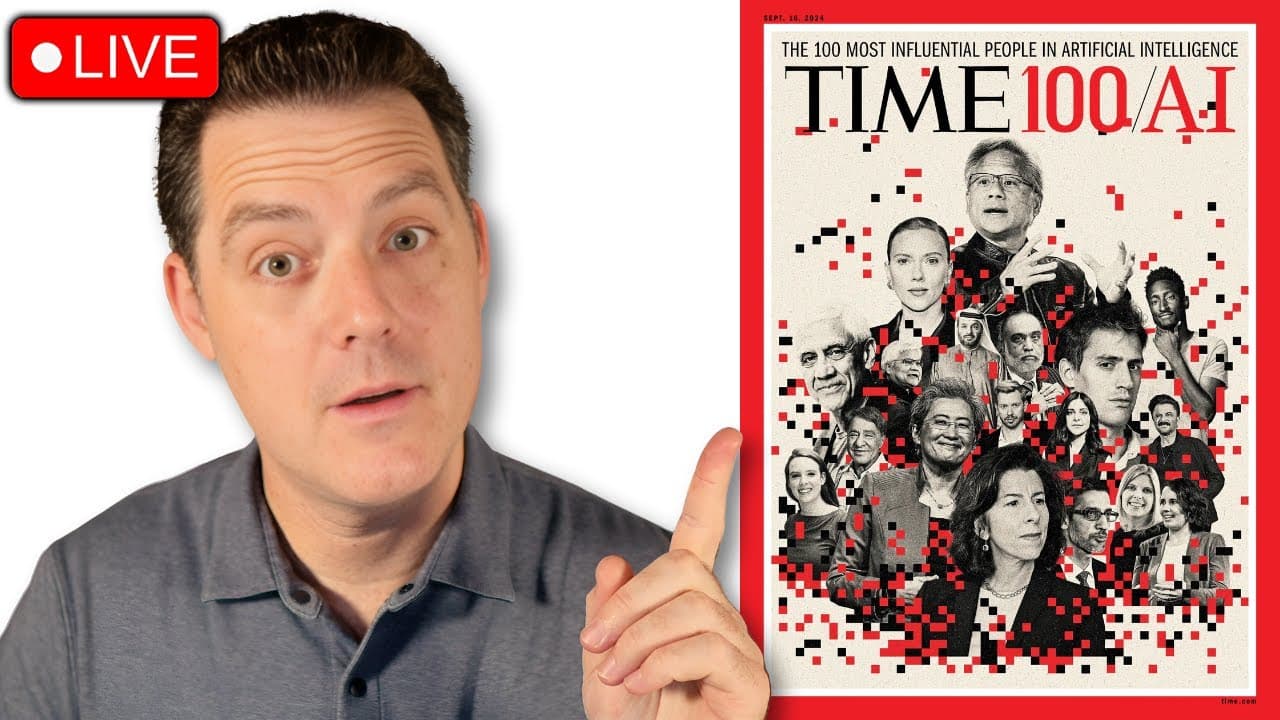
Microsoft appears better positioned than Google in the current AI race because Satya Nadella has backed OpenAI, cloud computing, and other AI companies, while Google has been playing catchup since ChatGPT launched. The discussion also questions Time's selection process, especially its prominent treatment of Sundar Pichai and its omission of Elon Musk and anyone from xAI.
Transcript
all right hello yes we're doing a random live stream I had no intention of doing this but we're doing it anyways we're going to be talking about the 100 most influential people in AI according to Time Magazine uh I am going to bring uh my buddy my editor channel manager thumbnail Creator Alexon in a moment and this gonna be something a little diffe... Read More
Key Insights
- Time's AI list is presented as a curated collection of influential figures divided into groups such as leaders, but the discussion questions whether prominence within the presentation reflects influence accurately or reveals editorial bias.
- Sundar Pichai is featured prominently even though Time's own profile acknowledges that ChatGPT, created by Microsoft-backed OpenAI, started the current AI boom and left Google playing catchup rather than symbolically leading the race.
- Google's search business produces hundreds of billions of dollars in yearly revenue, but alternatives such as ChatGPT and Perplexity have reduced the host's personal reliance on traditional Google searches by about 90 percent.
- Google's AI-first pivot began in 2016 and brought useful intelligence to products such as Google Photos, where natural-language queries could search extensive photo collections, but those capabilities were different from the generative AI wave that followed ChatGPT.
- Google's cautious emphasis on security and safety is identified as a possible reason it became a laggard, while OpenAI gained momentum by releasing products faster than Google could match.
- AI Overviews works by using a large language model to produce an overview grounded in Google's ranking system, according to Pichai's interview, rather than generating an answer solely through the language model.
- Satya Nadella is portrayed as a stronger candidate for the most prominent position because he moved Microsoft beyond the Ballmer era of stagnation and made wide-ranging bets across cloud computing and artificial intelligence.
- Elon Musk and xAI are notable omissions from Time's selection, according to the discussion, because Musk has launched a massive compute cluster and has a record of building ambitious companies, rockets, and automobiles.
Install to Summarize YouTube Videos and Get Transcripts
Explore YouTube Video Summarizer or Get YouTube Transcript Extractor
Questions & Answers
Q: Why does the discussion question Sundar Pichai's prominence on Time's AI list?
The discussion questions Sundar Pichai's prominence because Google was not the company that initiated the current generative AI boom. Time's own profile says ChatGPT came from Microsoft-backed OpenAI and left Google playing catchup. Although Google remains highly influential and reaches billions of people, the host considers its front-and-center placement difficult to reconcile with its position in the current race.
Q: How has generative AI affected the host's use of Google Search?
Generative AI tools have sharply reduced the host's dependence on Google Search. He says his personal Google search volume has fallen by about 90 percent because he uses ChatGPT daily and has increasingly adopted Perplexity. Google is still useful in some situations, but he reports that the number of times he needs to visit it continues to decline.
Q: What is the difference between Google's earlier AI work and the current AI wave?
Google's earlier AI work placed intelligent features inside existing products after its 2016 shift toward becoming an AI-first company. Google Photos, for example, allowed users to search large photo collections with natural language. The discussion argues that these capabilities were impressive but were not generative AI, which became the defining feature of the current wave after ChatGPT appeared in late 2022.
Q: How do Google's AI Overviews generate search summaries?
According to Pichai's interview as quoted in the discussion, AI Overviews do not simply ask a large language model to generate an answer by itself. Google uses the language model to create an overview while grounding it in the company's ranking system. The host says this approach makes sense, although his personal experience is that it is still not as good as Perplexity.
Q: Why does the host describe Google as playing catchup in AI?
The host describes Google as playing catchup because ChatGPT launched the current generative AI boom through OpenAI, a startup backed by Microsoft's major competitor. He also argues that Google's strong focus on safety and security prevented it from shipping products quickly enough. Google has responded with AI Overviews and voice capabilities, but the host considers its products slower or less natural than competing offerings.
Q: Why is Satya Nadella considered a leading AI figure?
Satya Nadella is considered a leading AI figure because the discussion credits him with moving Microsoft beyond the Ballmer era of stagnation and turning it into a major force in cloud computing and artificial intelligence. Microsoft made bets across the sector, including acquiring Inflection AI and holding what the host describes as a 50 percent stake in OpenAI, giving Nadella a strong claim to top prominence.
Q: Why are Elon Musk and xAI viewed as important omissions?
The discussion treats Elon Musk and anyone from xAI as conspicuous omissions because excluding them suggests an incomplete picture of influence in artificial intelligence. The host points to Musk's massive compute cluster and his record of launching rockets, changing the automobile industry, and starting several companies. Although the host says he is not an Elon fanboy, he would not bet against Musk's ability to compete.
Q: Does Time's collection rank its 100 AI figures from first to last?
The discussion indicates that the collection is not formally ranked, even though some people receive more prominent treatment than others. Sundar Pichai appears front and center and receives a profile described as a 10-minute read, while Satya Nadella receives a two-minute read. That unequal presentation leads the host to question Time's editorial priorities despite the absence of explicit numerical rankings.
Summary & Key Takeaways
-
Time divided its selection of influential AI figures into categories and placed Google CEO Sundar Pichai prominently among the leaders. The discussion accepts Google's enormous reach and long-standing search dominance but questions whether Pichai deserves such emphasis when Google has been responding to, rather than leading, the generative AI surge initiated by ChatGPT.
-
Google began pursuing an AI-first strategy in 2016 and integrated AI into products such as Google Photos. However, the discussion distinguishes those capabilities from generative AI and argues that Google's focus on security and safety slowed product releases. Google has since introduced AI Overviews and reached the market first with an end-to-end voice product.
-
Satya Nadella is presented as a stronger candidate for the most prominent position because he transformed Microsoft after the Ballmer era and made broad investments in cloud computing and artificial intelligence. The discussion highlights Microsoft's relationship with OpenAI and its acquisition of Inflection AI while also identifying Sam Altman as another plausible leading figure.
Read in Other Languages (beta)
Share This Summary 📚
Summarize YouTube Videos and Get Video Transcripts with 1-Click
Try YouTube Summary with ChatGPT & Claude or YouTube Transcript Generator
Explore More Summaries from Matthew Berman 📚





Summarize YouTube Videos and Get Video Transcripts with 1-Click
Try YouTube Summary with ChatGPT & Claude or YouTube Transcript Generator