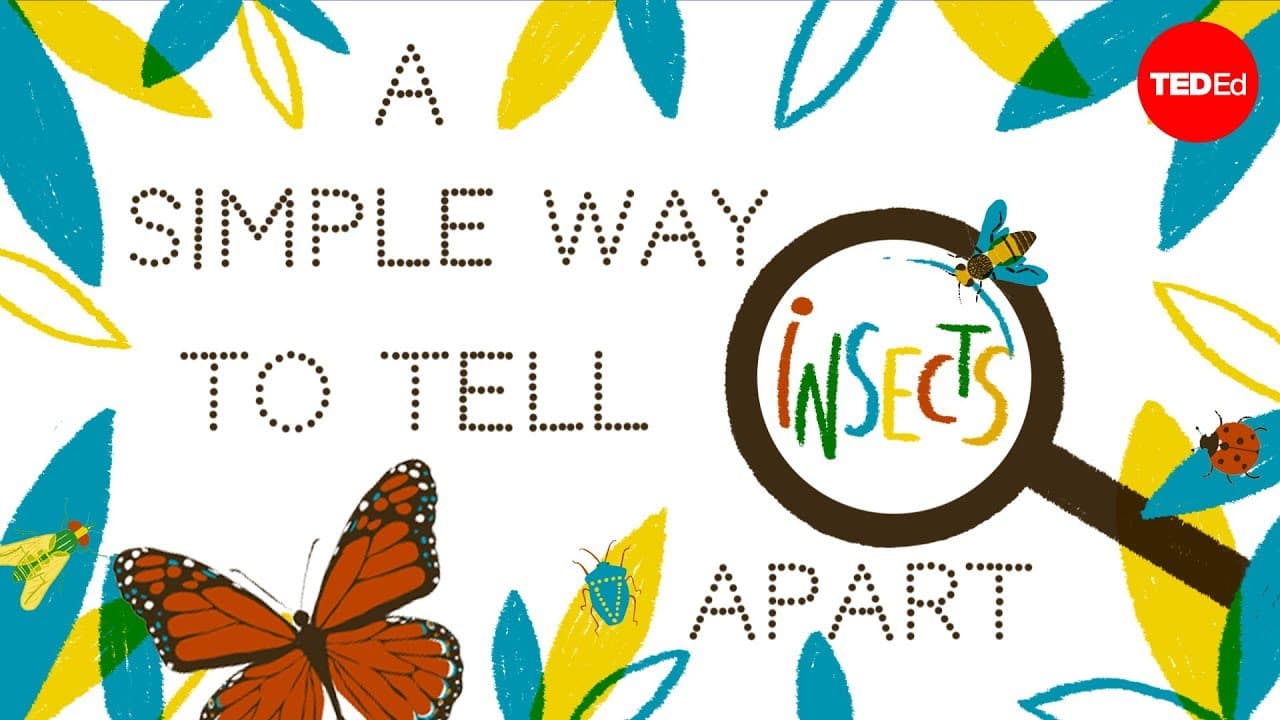
A simple way to tell insects apart - Anika Hazra
TL;DR
The content discusses the five common types of insect mouthparts - chewing, piercing-sucking, siphoning, sponging, and chewing-lapping - and their functions.
Transcript
A whip-like straw. Powerful, crushing blades. A pointed, piercing tube. There are nearly a million known insect species in the world, but most have one of just five common types of mouthparts. And that’s extremely useful to scientists because when they encounter an unfamiliar insect in the wild, they can learn a lot about it just by examining h... Read More
Key Insights
- 🤱 Insect mouthparts are used to identify the order an insect belongs to and provide clues about its feeding habits and evolutionary history.
- ❓ Chewing mouthparts are the most common and primitive.
- 🛌 Piercing-sucking mouthparts are found in insects like bed bugs, cicadas, aphids, and leafhoppers.
- 🦣 Siphoning mouthparts are used by butterflies and moths for nectar consumption.
- 🫦 Sponging mouthparts are unique to non-biting insects of the Diptera order.
- 🪽 Biting flies within Diptera have piercing-sucking mouthparts.
- 👏 Chewing-lapping mouthparts are used by bees and wasps for pollen-collecting and nectar consumption.
Install to Summarize YouTube Videos and Get Transcripts
Explore YouTube Video Summarizer or Get YouTube Transcript Extractor
Questions & Answers
Q: What are the five common types of insect mouthparts?
The five common types of insect mouthparts are chewing, piercing-sucking, siphoning, sponging, and chewing-lapping.
Q: What is the function of the chewing mouthpart?
The chewing mouthpart cuts and crushes solid foods using toothed jaws, allowing insects to consume leaves or other insects.
Q: How does the piercing-sucking mouthpart work?
The piercing-sucking mouthpart has a beak-like structure that pierces tissues and can suck up liquids like sap or blood. It can also secrete saliva with digestive enzymes for easier food consumption.
Q: Which insects have siphoning mouthparts?
Insects of the Lepidoptera order, such as butterflies and moths, have siphoning mouthparts. They use a proboscis to unfurl and suck up nectar from flowers.
Q: What is unique about the sponging mouthpart?
The sponging mouthpart in insects like house flies and fruit flies consists of a tube ending in two spongy lobes. It uses capillary action to soak up fluids and dissolved foods.
Q: What is the purpose of the mandibles in the chewing-lapping mouthpart?
In insects like bees and wasps, the mandibles serve as tools for pollen-collecting and wax-molding. The tongue-like structure at the tip of the proboscis is then used for lapping up nectar.
Summary & Key Takeaways
-
There are five common types of insect mouthparts: chewing, piercing-sucking, siphoning, sponging, and chewing-lapping.
-
The chewing mouthpart is the most primitive and features toothed jaws that cut and crush solid foods.
-
The piercing-sucking mouthpart has a beak-like structure that pierces tissues and sucks up liquids.
-
The siphoning mouthpart works like a straw to suck up nectar from flowers.
-
The sponging mouthpart has two lobes that soak up fluids using capillary action.
-
The chewing-lapping mouthpart combines a tongue-like structure with mandibles and is used for nectar consumption.
Read in Other Languages (beta)
Share This Summary 📚
Summarize YouTube Videos and Get Video Transcripts with 1-Click
Try YouTube Summary with ChatGPT & Claude or YouTube Transcript Generator
Explore More Summaries from TED-Ed 📚





Summarize YouTube Videos and Get Video Transcripts with 1-Click
Try YouTube Summary with ChatGPT & Claude or YouTube Transcript Generator