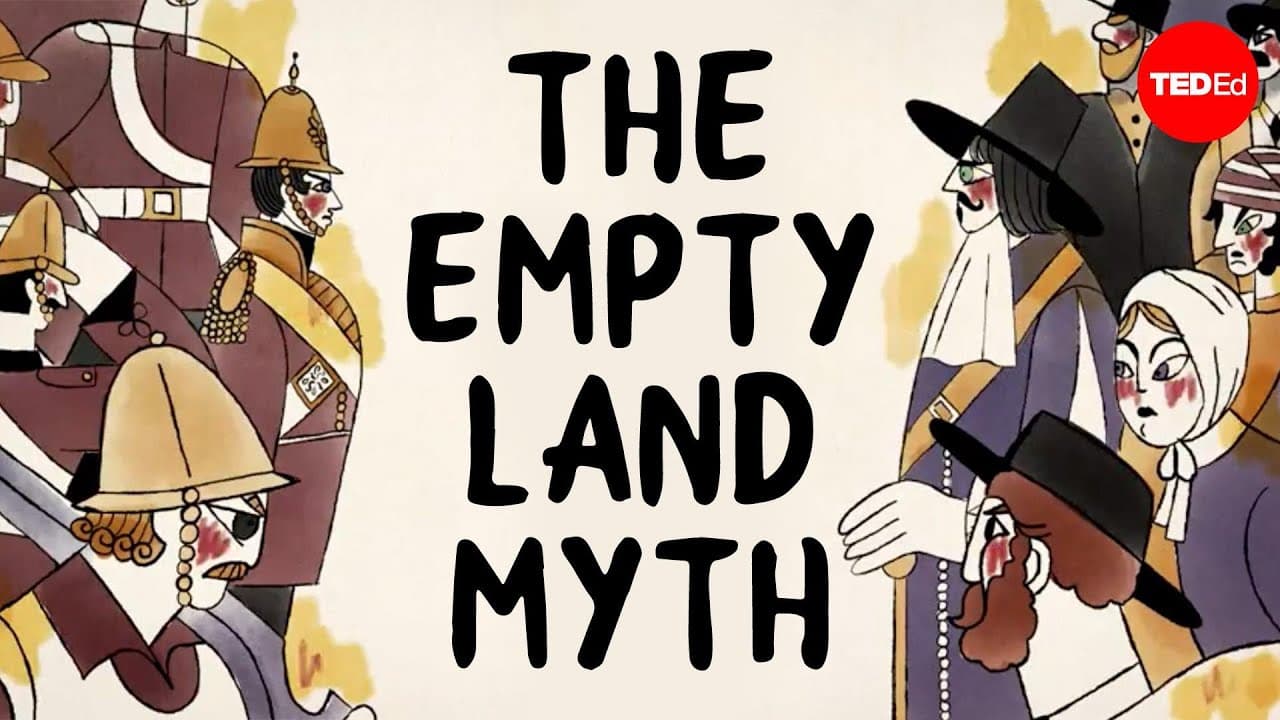
One of history's most dangerous myths - Anneliese Mehnert
TL;DR
The Empty Land Myth was dangerous because it falsely portrayed inhabited South African land as vacant, enabling European colonists to justify displacement, land theft, and institutionalized racism. The 1894 Glen Grey Act made land ownership functionally impossible for native Africans, while later policies culminated in apartheid. Read on to understand the myth’s three false arguments, its distortion of Indigenous ownership, and its enduring legacy.
Transcript
From the 1650s through the late 1800s, European colonists descended on South Africa. First, Dutch and later British forces sought to claim the region for themselves, with their struggle becoming even more aggressive after discovering the area’s abundant natural resources. In their ruthless scramble, both colonial powers violently removed numerous I... Read More
Key Insights
- 🇿🇦 European colonizers violently displaced Indigenous communities in South Africa.
- 🏝️ The Empty Land Theory falsely claimed that the land was empty and justified land theft.
- 🥺 The myth led to the Glen Grey Act, which marginalized native Africans and destroyed collective tribal ownership.
- 🇿🇦 The Empty Land Myth contributed to the implementation and persistence of apartheid in South Africa.
Install to Summarize YouTube Videos and Get Transcripts
Explore YouTube Video Summarizer or Get YouTube Transcript Extractor
Questions & Answers
Q: Why was the Empty Land Myth one of history’s most dangerous myths?
It falsely claimed that South African land was empty or that African communities had no ancestral right to it. Colonists used that narrative to justify displacement and land theft, and its influence eventually contributed to apartheid and other forms of institutionalized racism.
Q: What were the three arguments of the Empty Land Theory?
It claimed that Europeans settled land without established communities or agriculture, that Africans arrived alongside Europeans and therefore lacked ancestral claims, and that African communities had probably stolen the land from earlier inhabitants. The transcript states that all three arguments were completely false.
Q: Why was the claim that South African land was empty false?
Almost none of the land was empty, and Africans had lived there for millennia. European colonists mistook Indigenous systems of collective and seasonal land rights for an absence of ownership.
Q: How did Indigenous South African land ownership work?
Land belonged to families or groups rather than individuals, with ownership focused more on agricultural products than on the land itself. Community leaders distributed seasonal rights that allowed nomadic groups to graze cattle or forage, while even large agricultural settlements did not treat land as private property.
Q: How did European colonists use the Empty Land Theory?
Dutch and British colonists treated Indigenous land practices as evidence that the land belonged to no one and could be divided among themselves. British academics, historians, maps, letters, and travelogues reinforced the narrative while minimizing native populations.
Q: How did the 1894 Glen Grey Act marginalize native Africans?
The European parliament in Cape Town passed the Glen Grey Act in 1894, making it functionally impossible for native Africans to own land. It shattered collective tribal ownership and created a class of landless people.
Q: How did the Empty Land Myth contribute to apartheid?
After being barred from their lands, many Africans worked as migrant laborers and miners on European-owned property while laws restricted skilled employment and enforced racial segregation. These policies intensified into apartheid, which removed African voting rights and reshaped education to emphasize subservience to white settlers.
Q: How has South Africa challenged the Empty Land Myth?
Resistance movements fought throughout the 20th century for political and economic freedom. Since the 1980s, South African scholars have used archaeological evidence to correct the historical record, and South African schools now teach the region’s true history.
Summary & Key Takeaways
-
European colonizers violently displaced Indigenous communities, claiming the land was empty.
-
The Empty Land Theory argued that settlers had the right to displace African communities.
-
The myth was used to justify land theft, institutionalized racism, and the unequal distribution of resources.
Read in Other Languages (beta)
Share This Summary 📚
Summarize YouTube Videos and Get Video Transcripts with 1-Click
Try YouTube Summary with ChatGPT & Claude or YouTube Transcript Generator
Explore More Summaries from TED-Ed 📚
Summarize YouTube Videos and Get Video Transcripts with 1-Click
Try YouTube Summary with ChatGPT & Claude or YouTube Transcript Generator