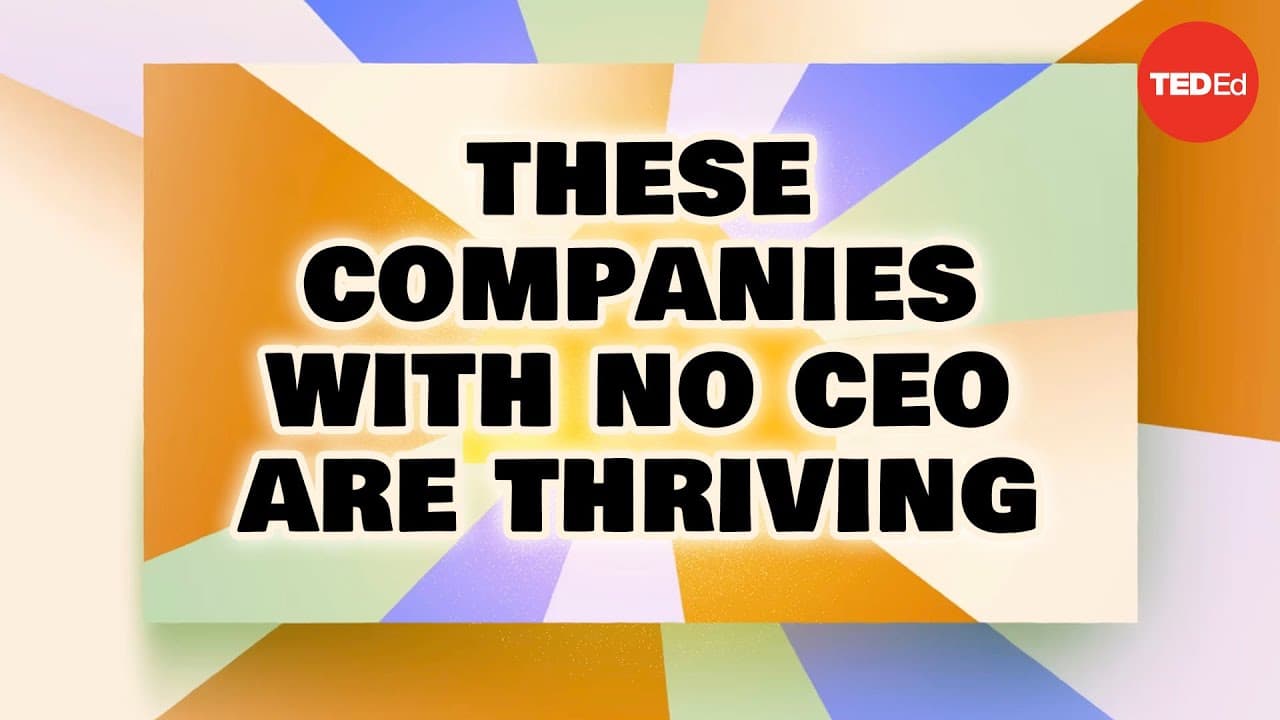
These companies with no CEO are thriving
TL;DR
Co-ops, like the Park Slope Food Co-op, with no CEO but thousands of employees, are thriving in the global economy, employing millions and benefiting their members through joint ownership, democratic control, and reduced costs.
Transcript
There's a grocery store in Brooklyn, New York, with sales per square foot 4 times as high as any other grocery store in the area. 10,000 people work there, and it doesn’t have a CEO. This place is the Park Slope Food Co-op, and it’s one of 3 million cooperatives, or co-ops for short, around the world. Co-ops are a big part of the global economy: ... Read More
Key Insights
- 🤗 The Park Slope Food Co-op in Brooklyn achieves outstanding sales figures with its cooperative structure and member-driven decision-making processes.
- 🧑🤝🧑 Co-ops are an integral part of the global economy, employing millions of people and managing trillions of dollars in transactions annually.
- 👮 Co-ops encompass various sectors, including consumer, financial, producer, and worker co-ops, each with their own unique characteristics and objectives.
- 💯 Joint ownership, democratic control, and member satisfaction are the core principles guiding the operations of co-ops.
- 👮 Co-ops challenge the traditional business model by prioritizing the well-being of members over profit maximization.
- 👮 Decision-making processes in co-ops vary, with smaller co-ops relying on collective worker decisions and larger co-ops implementing leadership roles agreed upon by members.
- ©️ Traditional companies use stock ownership to determine voting rights, while co-ops provide equal voting rights to every member, resulting in different policies and practices.
Install to Summarize YouTube Videos and Get Transcripts
Explore YouTube Video Summarizer or Get YouTube Transcript Extractor
Questions & Answers
Q: How does the Park Slope Food Co-op in Brooklyn achieve such high sales without a CEO?
Park Slope Food Co-op's success lies in its cooperative structure, where members work shifts in the store in exchange for discounted groceries. The absence of a CEO is compensated by democratic decision-making and joint ownership.
Q: What are the three essential characteristics of co-ops?
Firstly, co-ops are owned jointly by their members. Secondly, their primary objective is not profit maximization but serving their members. Finally, co-ops are controlled democratically, allowing all members to have a say in decision-making.
Q: How do co-ops differ from traditional companies in terms of leadership and decision-making?
In co-ops, leadership roles implement decisions agreed upon by members through voting, without having top-down power like a CEO. Additionally, every member in a co-op has the right to vote, regardless of shares owned, resulting in unique policies and decision-making processes.
Q: What advantages do co-ops offer compared to traditional businesses?
Studies have shown that co-ops have a higher likelihood of long-term success compared to traditional businesses. They also tend to provide higher job satisfaction, with co-op workers reporting about 40% higher job satisfaction rates than workers in traditional companies.
Summary & Key Takeaways
-
The Park Slope Food Co-op in Brooklyn generates significantly higher sales per square foot compared to other grocery stores in the area, despite not having a CEO and relying on 10,000 workers.
-
Co-ops, which employ 280 million people and handle over $2 trillion annually worldwide, operate based on joint ownership, democratic control, and the pursuit of member satisfaction.
-
Co-ops exist in various sectors, including consumer co-ops like REI, financial sector co-ops like credit unions, producer co-ops, and worker co-ops like Mondragon and The Cheeseboard.
Read in Other Languages (beta)
Share This Summary 📚
Summarize YouTube Videos and Get Video Transcripts with 1-Click
Try YouTube Summary with ChatGPT & Claude or YouTube Transcript Generator
Explore More Summaries from TED-Ed 📚
Summarize YouTube Videos and Get Video Transcripts with 1-Click
Try YouTube Summary with ChatGPT & Claude or YouTube Transcript Generator