How to Evaluate Bias in AI Security Systems
TL;DR
Evaluate an AI security system by examining its training data, collection methods, labels, and reproducibility in your own environment, not merely its algorithm. AI decisions are probabilistic rather than absolute, and hidden selection, human, or cultural biases can distort predictions. Because these biases are difficult to detect, buyers should challenge vendor claims and investigate the evidence behind every result.
Transcript
Um, my name is Winn Schwartau, and I've been a security guy since roughly nineteen eighty-three doing security awareness work, beginning with information warfare back in roughly eighty-nine, ninety, and then transitioning into various odd other fields, uh, portions of awareness and training. This is Clarence Chow, a brilliant, brilliant AI guy who ... Read More
Key Insights
- AI-based security decisions are probabilistic rather than absolute, which means their answers occupy a range of uncertainty instead of providing consistently deterministic yes-or-no conclusions. Organizations should therefore resist vendor claims that present AI outputs as unquestionable facts.
- AI decision processes can be difficult to explain because even data scientists may not know precisely how a system arrived at a particular conclusion. This lack of transparency creates a serious evaluation problem when security teams must understand, defend, or reproduce automated decisions.
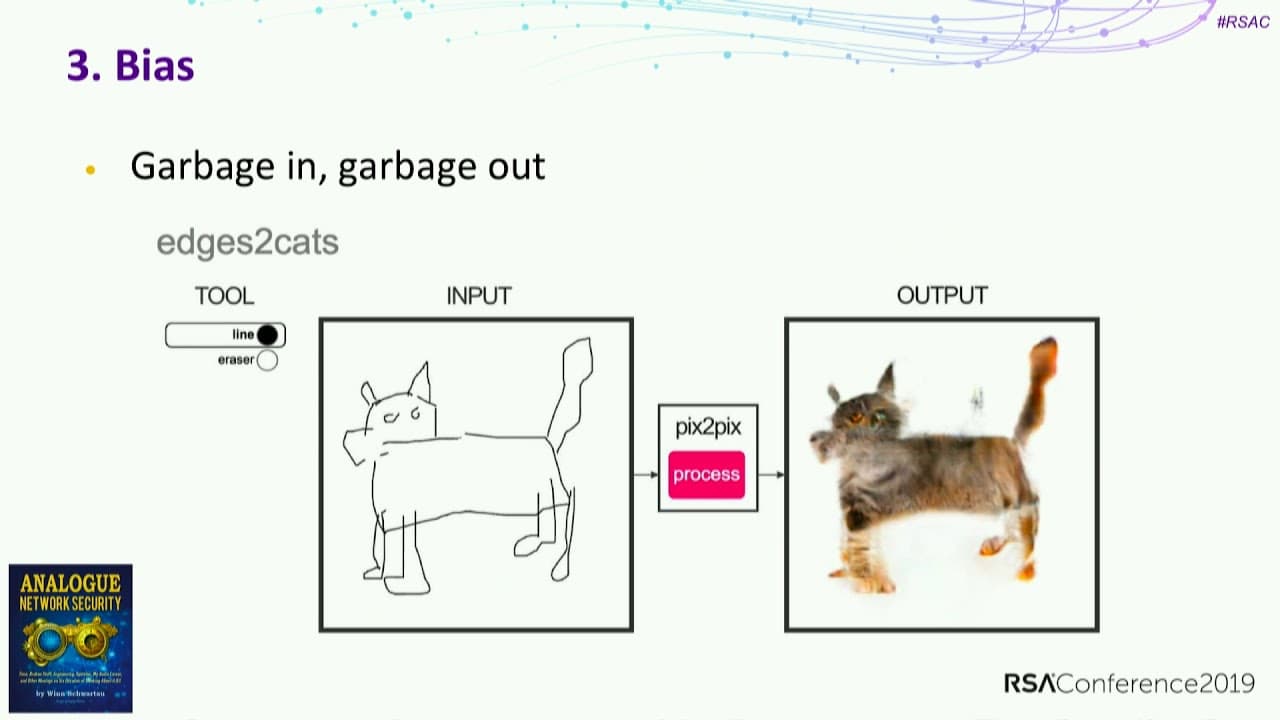
- The same input can produce different AI interpretations when the system assigns different weights to particular features. The presentation’s repeated image-processing example illustrates why no single generated output can automatically be assumed to be the uniquely correct result.
- Training data is more important than algorithm choice because the information supplied to a learning system dictates the trajectory of its learning. Data quality, representativeness, and collection practices can influence predictions more strongly than improvements to the underlying statistical method.
- Data collection and procurement processes shape algorithmic experience by determining which samples enter training. Evaluators should ask AI vendors about data sources and collection methodologies because biased or unsuitable inputs can propagate directly into security predictions.
- Bias detection is inherently difficult because investigators frequently analyze an experiment or algorithm without examining how its sample was selected from a population. External factors in sample construction can affect experimental results as much as, or more than, the tested method.
- An AI product’s suitability depends on the customer’s environment as well as the algorithm itself. Reported vendor results are not sufficient evidence unless the organization can reproduce those results reliably with its own systems, conditions, and available data.
- Supervised learning uses supplied labels to train classification or regression systems, such as labeling executables as malicious or non-malicious. Those labels guide the classifier’s predictions, so problems in labeling or sample selection can become embedded in the resulting security model.
Install to Summarize YouTube Videos and Get Transcripts
Explore YouTube Video Summarizer or Get YouTube Transcript Extractor
Questions & Answers
Q: How should organizations evaluate bias in AI security systems?
Organizations should examine the training data, its source, the methods used to collect samples, and the labels supplied during learning. They should also determine whether their internal environment is suitable for the proposed algorithm and whether vendor results can be reproduced reliably in-house. Evaluating only the algorithm overlooks the data and sampling decisions that may introduce consequential bias.
Q: Why is training data more important than the AI algorithm?
Training data dictates the trajectory of machine learning by defining the examples and experiences from which a system develops its predictions. The collection and procurement process determines the quality and character of those examples. According to the presentation, what enters an algorithm can affect its output more strongly than the quality or type of algorithm used to process it.
Q: Why should AI security decisions not be treated as absolute?
AI security decisions are probabilistic rather than deterministic, so their conclusions are not guaranteed yes-or-no truths. A system can emphasize different features and produce differing interpretations, even when it receives the same input within a short period. Security teams should consequently treat predictions as uncertain results that require evaluation, rather than as unquestionable answers from an infallible decision maker.
Q: What questions should buyers ask AI security vendors?
Buyers should ask where the vendor’s training data came from, how samples were collected, how examples were labeled, and what methodologies governed data procurement. They should also ask whether the demonstrated results can be reproduced reliably inside the buyer’s environment. These questions reveal whether attractive predictions depend on biased data, unsuitable conditions, or claims that do not transfer in-house.
Q: What is selection bias in machine learning?
Selection bias arises from how a training sample is drawn from a larger population. Machine-learning evaluations often focus on the algorithm or experiment while giving less attention to the process used to assemble the sample set. If that process favors or excludes particular kinds of data, the trained system’s predictions can reflect those distortions even when its statistical method appears sound.
Q: How does supervised learning work in security classification?
Supervised learning uses labels supplied to an algorithm for classification or regression. In the security example, a collection contains malicious and non-malicious executables, with each executable labeled according to its class. A classifier learns from those labeled examples and then predicts whether another executable is malicious. The labels and selected examples therefore directly shape what the classifier learns.
Q: Why is bias difficult to detect in AI systems?
Bias is difficult to detect because implementers often concentrate on learning methods, statistics, or experimental results instead of investigating the data-selection process. The way a sample is drawn from a population is rarely analyzed with equal care, although it can strongly affect the outcome. Undetected selection, human, or cultural influences can therefore persist through training and appear in predictions.
Q: Why must vendor AI results be reproduced in-house?
A vendor’s successful result may depend on its particular data, collection practices, labels, and operating conditions. An organization may have a different environment that is unsuitable for the same algorithm or produces different predictions. Reliable in-house reproduction helps determine whether the claimed performance transfers to the buyer’s actual setting and whether hidden biases or external factors affected the demonstration.
Summary & Key Takeaways
-
AI-based security decisions are probabilistic, so their outputs should not be treated as absolute or deterministic truths. The same input can produce different interpretations when an engine assigns different weights to selected features. This uncertainty makes transparency, repeatability, and careful evaluation essential when organizations consider AI products for security decisions.
-
Training data can influence machine-learning predictions more strongly than the particular algorithm used. Data collection and procurement determine what experiences a system receives during training and therefore shape its learning trajectory. Security buyers should ask vendors where their data originated, how samples were collected, and whether hidden bias could affect reported results.
-
Bias is difficult to identify because evaluators often concentrate on algorithms or experiments while overlooking how samples were drawn from a larger population. Selection, human, and cultural biases can pass through data into AI-powered systems. A useful evaluation framework must examine data sources, environmental suitability, reproducibility, and the reliability of claimed outcomes.
Read in Other Languages (beta)
Share This Summary 📚
Summarize YouTube Videos and Get Video Transcripts with 1-Click
Try YouTube Summary with ChatGPT & Claude or YouTube Transcript Generator
Explore More Summaries from RSAC Cybersecurity 📚






Summarize YouTube Videos and Get Video Transcripts with 1-Click
Try YouTube Summary with ChatGPT & Claude or YouTube Transcript Generator