How did Monte Carlo Tree Search evolve in Go AI?

TL;DR
UCT combines online value estimation with a growing search tree, using rollouts to estimate outcomes and an exploration term to balance exploration and exploitation. With infinite compute, it can converge toward minimax, but in practice generalization and limited resources require additional techniques to generalize across states.
Transcript
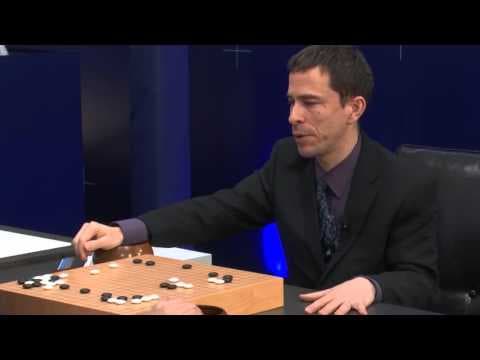
hi everyone I'm Silva back in 2007 I was finishing my PhD in Paris in the tow in Ria team in the University of Parry South and now I'm part of the Google brain team in Z Switzerland and I'm David uh back in 2007 I was doing my PhD at the University of Alberta and now in 2017 I'm at Deep Mind I'm really sorry we can't be there in person but we prepa... Read More
Key Insights
- Go presents a much larger branching factor than chess, making traditional search harder and motivating Monte Carlo approaches.
- Online value estimates are updated as the search tree grows, allowing the agent to refine action choices at each state.
- Rollout policies simulate complete games to provide outcome-based estimates for node values.
- Monte Carlo Tree Search combines simulations with tree expansion to balance depth and breadth.
- UCT adds an exploration term to the value estimate, encouraging trying less-explored actions.
- Infinite compute with full state and action enumeration would reduce to a Minimax problem, but practical limits require approximation and generalization.
- The method relies on a local search focus rather than solving the entire game upfront, emphasizing online planning over offline solving.
- Tabular representations do not generalize across states, highlighting the need for generalization techniques later used in learning.
Install to Summarize YouTube Videos and Get Transcripts
Explore YouTube Video Summarizer or Get YouTube Transcript Extractor
Questions & Answers
Q: How does UCT decide which move to explore next?
UCT uses the best online value plus an exploration bonus to decide which action to try next. The action with the highest current value is preferred, but actions with fewer visits receive a higher exploration incentive. This balance helps the search allocate more simulations to promising moves while still exploring less-tried options.
Q: What is the role of rollouts in Monte Carlo Tree Search?
Rollouts provide outcome-based estimates for node values by simulating games from a given position to the end. The average result over multiple rollouts gives an online value for the node, which guides the expansion and decision process, especially when the tree is still shallow or uncertain.
Q: Why is Go harder for traditional search than Chess according to the transcript?
Go has a much larger branching factor and far longer games compared to Chess, making exhaustive search impractical. This means simple evaluation like material balance used in Chess is not sufficient, and predictive modeling of positions becomes essential to estimate who will win.
Q: What happens when you expand the tree in Monte Carlo search?
When you expand the tree, you create new nodes for additional actions and keep the updated average outcomes for each node. This builds a more detailed representation of the expected value of actions, enabling more informed decisions at the root position as the search progresses.
Q: What does the transcript say about the limit of infinite compute in this setting?
The transcript notes that with infinite compute, the online value approach could converge to the Minimax value, assuming you can observe all states and actions. In practice, this is impossible, so the method relies on sampling, exploration, and generalization to approximate those values.
Q: Why is online planning favored over solving the entire problem at once?
Online planning focuses compute resources on the current position, extracting a good action for this specific state without solving the entire game. This local search approach is more feasible given the enormous state space of Go and helps iteratively improve the policy through tree search and rollouts.
Q: What is a major limitation of the tabular representation in this context?
A major limitation is the lack of generalization: tabular values are tied to exact states, so learning in one position does not automatically transfer to similar positions. This makes the method inefficient for large games like Go, where many states share structural similarities and can benefit from generalized learning.
Q: How do online and offline knowledge complement each other in this work?
Online knowledge comes from real-time search and rollouts, while offline knowledge is embedded in the prior policies or learned models used to guide rollouts and value estimations. Combining them accelerates learning and improves decision quality by leveraging both immediate search results and previously accumulated information.
Summary & Key Takeaways
-
UCT combines online and offline knowledge to improve Go programs, progressively expanding a search tree and updating node values. The method uses rollouts to estimate outcomes and a confidence bound to guide exploration, enabling the agent to refine its decisions beyond simple rollouts.
-
The approach highlights the mismatch between Go's high branching factor and traditional search, motivating Monte Carlo methods that sample outcomes and build a predictive model from repeated simulations.
-
The talk discusses the limitations of tabular value representations, noting that without generalization a program cannot transfer learned values across similar positions, which motivates later integration of learning methods with search.
Read in Other Languages (beta)
Share This Summary 📚
Summarize YouTube Videos and Get Video Transcripts with 1-Click
Try YouTube Summary with ChatGPT & Claude or YouTube Transcript Generator
Explore More Summaries from Google DeepMind 📚



Summarize YouTube Videos and Get Video Transcripts with 1-Click
Try YouTube Summary with ChatGPT & Claude or YouTube Transcript Generator